Fanatics: Modernizing on AWS to Become a Beloved Brand
Overview
Fanatics Commerce (fanatics.com), the global leader in licensed sports merchandise, operates a tech-powered, omnichannel platform that creates exceptional fan experiences across retail channels. The company leverages state-of-the-art fulfillment centers and data-driven personalization to connect fans with the teams and players they love. As its business expanded, it required infrastructure that could scale to meet its growth targets.
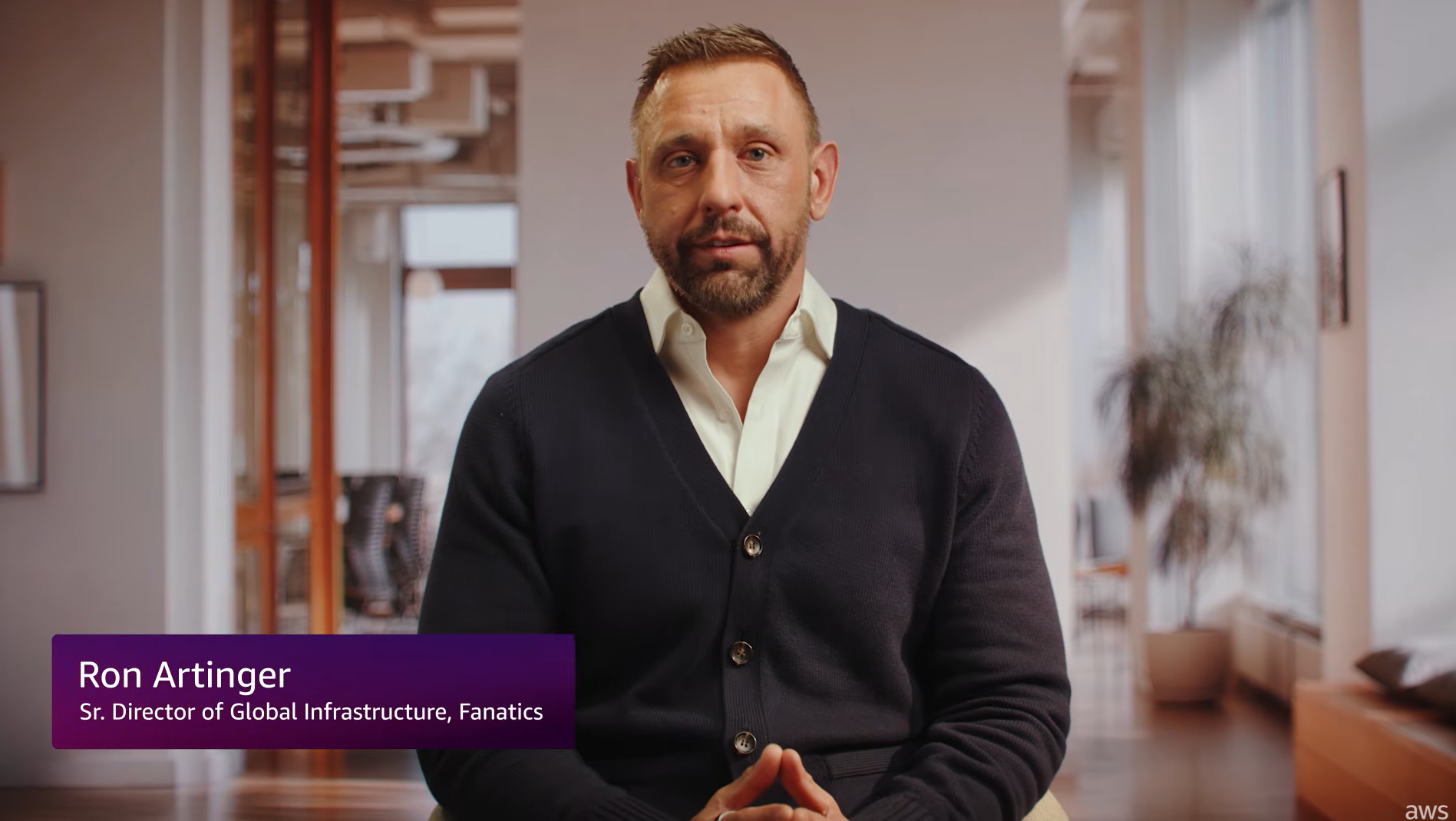
While Fanatics had already built a significant cloud-native presence in AWS—with all front-end websites and data analytics—the company's backend systems told a different story. Corporate systems and fulfillment center infrastructure were housed in multiple on-premise colocation data centers around the globe. These environments relied on VMware, Microsoft SQL Server, and Oracle database using traditional server and storage hardware platforms, legacy backup systems, and complex networks requiring constant patching and maintenance. “We already have a really longstanding and great relationship with AWS. As Fanatics is expanding, we needed to take our backend systems, corporate systems, and warehouse fulfillment systems and modernize those,” said Ron Artinger, Senior Director of Infrastructure at Fanatics Commerce.
About Fanatics
Fanatics is a company focused on sports. Starting in the commerce space—selling licensed sports apparel and gear such as t-shirts, hats, and jerseys—the company has expanded significantly in recent years into betting and gaming, collectibles, and live events such as Fanatics Fest. With a growing global presence, including offices and fulfillment centers spanning the United States, Europe, and Asia-Pacific, Fanatics has set its sights on a singular mission: to become a beloved brand that is ruthlessly focused on the fan.
Challenge | Global Expansion Requires Modernization
As Fanatics continued to grow and expand globally, it became clear the company needed to modernize its backend infrastructure to match the cloud-native maturity of its front-end platforms. “At Fanatics we don't want to run data centers—it's not our core business. We want to become a beloved brand. We want our fans to love coming to Fanatics and love their experiences here. And we just felt that hardware refresh cycles and having a number of different physical locations around the globe just wasn't the direction we wanted to continue to go,” said Artinger.
This on-premises footprint created pressing challenges:
- Operational burden: Operational costs were increasing across global data centers. The infrastructure team spent the majority of its time on maintenance and operational support rather than engineering and innovation.
- Hardware refresh cycles: Ongoing hardware procurement and refresh cycles diverted time, budget, and leadership attention away from the company's core mission.
- Complex vendor management: Leadership spent significant time negotiating contracts across a broad landscape of vendors and suppliers—VMware, Microsoft, Oracle, and numerous others—each with rigid one or three-year renewal terms.
- Poor global user experience: Employees in regions such as Bangkok and Hyderabad experienced high latency when accessing backend systems that were hosted primarily in the United States, hampering productivity.
- Technical debt: 60% of the on-premises environment ran Windows and 40% Linux, with many systems relying on legacy off-the-shelf software or aging internally developed applications. In some cases, reverse-engineering was required just to understand how systems functioned.
- Security and compliance vulnerabilities: The distributed on-premises model made it difficult to advance toward modern security frameworks like Zero Trust or properly segment operational technology from IT networks to reduce attack vectors. Fanatics had to meet compliance and operational requirements across different regions.
Opportunity | Exit Datacenters Without Downtime
Fanatics Commerce’s growth created a business need to modernize its technology foundation, requiring the migration of 1,800 Windows and Linux servers from five data centers across geographic locations to AWS. This undertaking represented far more than a technology refresh—it was essential to supporting its expansion and operational excellence.
Migrating servers across geographical locations presented logistical and technical hurdles—each data center had a unique setup, requiring a tailored approach. The datacenter team had reservations about moving its Microsoft SQL Server and Oracle database workloads to AWS, including performance parity with on-premises infrastructure, compliance and security standards, and business continuity during and after migration. It also saw an opportunity to better serve its global customers. “We needed to provide a higher quality, better user experience to folks in Asia, Europe, and the US. Migrating to AWS also allows us to place those services closer to our internal users,” explained Artinger. The company also saw an opportunity to avoid some of the upcoming license renewals. While cost savings were a primary driver, Fanatics needed assurance that the migration would result in annual savings without hidden or unexpected costs.
As a leader in licensed sports merchandise, Fanatics could not afford downtime or performance degradation, particularly during peak sports seasons. The migration strategy needed to account for operations across all time zones and markets.
Solution | Bridge Skill Gap and Modernize on AWS
Fanatics’ on-premises team spent an inordinate amount of time doing maintenance and operational work, and it sought to free them. The company wanted its team to do engineering rather than maintain gear. Transitioning from on-premises infrastructure to cloud-based services required a shift in skill sets for its IT teams, and bridging the knowledge gap was crucial for success. “We wanted to give them an opportunity to expand their skillsets, enhance their careers, and open up to bigger and better opportunities by learning these new skillsets. We already have a cloud team, and we had an opportunity to bring two infrastructure teams together to help each other more, and enhance the overall services that we provide across the globe, both for our fans, as well as for our internal users,” said Artinger.
Several AWS programs played a critical role in accelerating the migration and building a strong business case:
- Migration Acceleration Program (MAP): MAP funding demonstrated that moving to the cloud would save Fanatics money compared to its existing on-premises model. MAP brought additional engineering talent to support the migration, which was especially valuable as members of the on-premises team were upskilling in cloud technologies.
- Experience-Based Acceleration (EBA): The EBA engagement proved a transformative experience—not only from a technical perspective, helping the team level up and get initial services running, but also from a people and culture standpoint. The EBA brought together the AWS team, Fanatics' migration partner Trace3, the internal cloud team, and the on-premises infrastructure team. These groups, which didn't normally work together day-to-day, collaborated on problem solving. The result was a level of team cohesion and acceleration that Artinger believes would have been difficult to achieve otherwise.
- Optimization and Licensing Assessment (OLA): This program helped Fanatics map out a clear roadmap and path for its migration, particularly around understanding its existing licensing landscape and identifying optimization opportunities.
“Over the past year in getting to know AWS, I understand why we really enjoy this partnership so much. They can always bring the right folks in, and it's very specific, based on our individual needs. It’s very targeted, and they can hone in on those specific things that will really help us,” observed Artinger.
The teams used OLA to evaluate migration scenarios, including “like-for-like” and “rightsized” approaches under shared and mixed tenancy models. Rightsizing optimized compute and memory usage and enabled licensing and storage optimization strategies. Power management—such as turning off non-production workloads during off-hours and running them on-demand—was identified as an optimization lever.
Fanatics decided to consolidate its global colocation data centers into three AWS regions to serve its backend systems and internal users:
- Asia-Pacific – to serve employees and fulfillment operations in the region
- Europe – to support the company's growing European presence
- United States – to anchor domestic operations
By placing services closer to internal users and fulfillment centers, the migration will improve latency and deliver a significantly better experience for employees worldwide—ensuring that a team member in Hyderabad is just as productive as one in the United States. Delivering a great employee experience was central to the migration: “I need those employees to be just as productive in those regions of the world and not just the folks in the US because they're close to all the services,” said Artinger.
Through its partnership with AWS, Fanatics would achieve:
- Up to 48% infrastructure cost savings.
- Lower overall total cost of ownership (TCO).
- Efficiencies through workload scheduling and license consolidation.
- Delivery of services and content closer to end customers through AWS’s global infrastructure, improving performance worldwide.
Fanatics adopted a pragmatic approach to migration. While the goal was to modernize and not simply lift-and-shift, the team acknowledged that some lift-and-shift will occur given the tight timelines and budget of the approved project. Where possible, the company would refactor during the initial migration—particularly Oracle and Microsoft SQL Server databases—which it is migrating to Amazon RDS. A planned second phase will focus on deeper refactoring and broader adoption of AWS-native services to further optimize the environment beyond what was possible on-premises.
Impact: Up to 48% infrastructure cost savings
Through the OLA, MAP, and EBA programs, Fanatics has built a foundation validating the business case, mapping application dependencies, aligning stakeholders, and establishing the architectural framework to support its global operations. With this groundwork in place, Fanatics is now executing the Migrate and Modernize phase, targeting completion by December 2026.
Based on the completed assessments and migration progress, Fanatics is on track to achieve:
- Up to 48% infrastructure cost savings.
- Lower overall total cost of ownership (TCO).
- Improved global performance through reduced latency via AWS’s extensive infrastructure.
- Enhanced operational efficiency through workload scheduling and license consolidation.
- A scalable, modern foundation that supports continued business growth and innovation.
By moving out of the data center business, the infrastructure team is shifting from maintenance-focused work to engineering. Team members are expanding their skillsets, enhancing their careers, and opening up to new opportunities by learning cloud technologies. The migration is also bringing two previously separate infrastructure teams—cloud and on-premises—together into a unified, more capable organization.
“AWS is definitely helping us to hit our mission of being a beloved brand because we can get out of the business of maintenance, operational support, running data centers, and focus on providing the best services for our fans—and our employees, who in turn support those fans.”
Ron Artinger, Senior Director of Infrastructure at Fanatics Commerce
Moving to AWS replaces rigid, multi-year vendor contracts with a consumption-based model that offers day-to-day flexibility. Fanatics can increase spend by adding services or scaling up for sports peak seasons, or decrease spend by optimizing or decommissioning them—without being locked into fixed contract terms. “From a leadership perspective, we spend a lot of time in negotiating contracts with these vendors. Moving to AWS allows us flexibility in numerous ways: I will get away from having VMware contracts or Microsoft contracts in some places, as well as a number of others. With AWS there’s not a one-year or three-year renewal anymore. I can increase spend through more services, decrease my spend by scaling down or optimizing services, even on a day-to-day basis. I'm not locked into year terms of contracts like I am today,” explained Artinger.
The migration opens the door to implementing modern security concepts such as Zero Trust architecture and improved network segmentation between OT and IT systems, reducing the organization's overall attack surface.
Fanatics sees its migration as far more than a technology initiative—it’s a strategic enabler of the company's mission. By offloading the undifferentiated heavy lifting of running data centers, Fanatics can redirect its energy, talent, and resources toward what matters most: the fan experience. As it continues to grow across commerce, betting, gaming, collectibles, and events, its partnership with AWS positions the company to scale globally, innovate faster, and deliver on its promise of becoming a truly beloved brand.
AWS Services Used
About the authors
 Ronald Artinger is a senior IT infrastructure executive at Fanatics Commerce, the global leader in licensed sports merchandise. He is helping lead the company's migration of 1,800 servers across five global data centers to AWS, projected to deliver up to 48% infrastructure cost savings. With experience spanning Eaton Corporation and Starwood Hotels & Resorts, Ron brings deep expertise in managing complex, global IT environments at scale. He holds an BS from the University of Central Florida and is certified in ITIL and Six Sigma Green Belt.
 At AWS, Chris Saleski leads Global Customer References for Migration & Modernization, driving customer-led transformation stories. He leverages leadership experience from Intel where he directed marketing for gaming and high-performance computing (HPC) solutions. Chris was a key driver behind the SSD revolution, and led industry initiatives to optimize software for next-generation SSD technology. At Microsoft, he created and led thought leadership campaigns and partnerships focused on DevOps and big data solutions to drive adoption among developers and enterprise customers. Early in his career, Chris was a automotive body designer for Honda.
Did you find what you were looking for today?
Let us know so we can improve the quality of the content on our pages