AWS Database Blog
AWS positioned highest in execution in the latest Gartner Magic Quadrant for Cloud Database Management Systems
AWS has been named a Leader for the 11th consecutive year in the 2025 Gartner Magic Quadrant for Cloud Database Management Systems. And, once again, AWS has been positioned highest among all 20 evaluated companies for our Ability to Execute. We believe this reflects our ongoing commitment to giving customers the broadest and deepest set of capabilities to accelerate innovation as well as unparalleled security, reliability, and performance they can trust for their most critical applications.
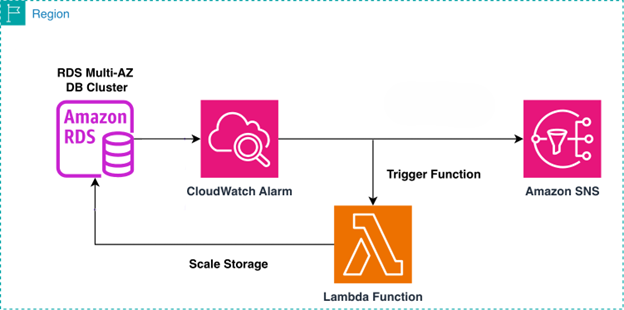
Automatically scale storage for Amazon RDS Multi-AZ DB clusters using AWS Lambda
In this post, we walk you through building an automated storage scaling solution for Amazon RDS Multi-AZ clusters with two readable standbys. We use AWS Lambda to execute scaling logic, Amazon CloudWatch to detect and alarm on storage thresholds, and Amazon SNS to deliver timely notifications. This combination provides event-driven automation, native AWS integration, and operational visibility without requiring third-party tooling.
Synchronizing a Backup on-premises Db2 Server with Amazon RDS for Db2
In this post, we provide guidance on implementing a hybrid architecture where a self-managed Db2 instance remains synchronized with Amazon RDS for Db2 via continuous archive log application, ensuring organizations maintain strategic deployment options without compromising the advantages of cloud-native managed services.
Automated parameter and option group change monitoring in Amazon RDS and Amazon Aurora
In this post, you will learn how to build a serverless monitoring solution sending detailed alerts whenever Amazon RDS parameter groups are modified, including which databases are affected and whether a restart is required.
Export Amazon SimpleDB domain data to Amazon S3
As AWS continues to evolve its services to better align with customer needs and modern workloads, we’re excited to introduce a new export functionality for Amazon SimpleDB . By using this feature, you can export domain data to Amazon S3 in JSON format, unlocking new opportunities for long-term storage, and migration to purpose-built databases. The export generates a complete JSON representation of Amazon SimpleDB data. In this post, we walk you through how to use the new export functionality, highlight best practices, and share monitoring functionality to help you make the most of it.

Migrate Cloud SQL for MySQL to Amazon Aurora and Amazon RDS for MySQL Using AWS DMS
In this post, we demonstrate how to migrate from Cloud SQL for MySQL 8+ to Amazon RDS for MySQL 8+ or Amazon Aurora MySQL–Compatible using AWS DMS over an AWS Site-to-Site VPN. We cover preparing the source and target environments, exemplifying cross-cloud connectivity, and setting up DMS tasks.
From bottlenecks to breakthroughs: Dutchie’s database migration journey
Dutchie, a leading technology platform serving the cannabis industry, manages critical operations for thousands of dispensaries across multiple states, processing millions of transactions annually. In this post, we explore how Dutchie successfully navigated the challenges of migrating mission-critical workloads to Amazon RDS for SQL Server in preparation for 4/20 week in 2025.
Automating Amazon RDS backup and maintenance windows for Daylight Saving Time shifts
In this post, you’ll learn how to deploy a serverless solution using AWS CloudFormation that automatically adjusts RDS maintenance and backup windows for DST transitions.
Set up and troubleshoot IAM database authentication in AWS DMS
In this post, we demonstrate how to configure IAM database authentication in AWS Database Migration Service (AWS DMS). You’ll also learn the structured troubleshooting approach you follow to address the errors when configuring IAM database authentication with AWS DMS
Replicate spatial data using AWS DMS and Amazon RDS for PostgreSQL
In this post, we show you how to migrate spatial (geospatial) data from self-managed PostgreSQL, Amazon RDS for PostgreSQL, or Amazon Aurora PostgreSQL-Compatible Edition to Amazon RDS for PostgreSQL or Amazon Aurora PostgreSQL using AWS DMS. Spatial data is useful for applications such as mapping, routing, asset tracking, and geographic visualization. We walk through setting up your environment, configuring AWS DMS, and validating the successful migration of spatial datasets.