AWS Database Blog
Category: Oracle Database@AWS
Provision Oracle Database@AWS resources using Terraform
In this post, we show you how to provision key components of the Oracle Database@AWS offering, including the ODB network, Oracle Exadata infrastructure, Exadata VM clusters and Autonomous VM clusters using Terraform.
Oracle Database@AWS decoded: Determining the right fit for your Oracle workloads
In this post, we explore the key reasons why Oracle Database@AWS is a strong fit for organizations running Oracle workloads on AWS. We cover the business, technical, and licensing advantages it brings, and how it complements the existing AWS options you already know, such as Amazon RDS for Oracle and Amazon EC2.
Best practices and architecture patterns for cross-account sharing in Oracle Database@AWS
In this post, we walk through the available options for sharing Oracle Database@AWS (ODB@AWS) resources across AWS accounts. We also cover common cross-account architecture patterns, along with best practices and key considerations. This helps you design your ODB@AWS architecture across your AWS accounts efficiently.
Getting started with the Oracle Database@AWS high performance networking
In this post, we explore Oracle Database@AWS high performance networking capabilities and provide a step-by-step guide to help you configure and deploy this feature.
Navigating backup and recovery options for Oracle Database@AWS
Oracle Database@AWS (ODB@AWS) delivers Oracle Exadata infrastructure, managed by Oracle Cloud Infrastructure (OCI), directly within Amazon Web Services (AWS) data centers. In this post, we walk you through the backup and recovery options available for ODB@AWS services: Oracle Exadata Database Service on Dedicated Infrastructure (ExaDB-D) and Oracle Autonomous AI Database on Dedicated Exadata Infrastructure (ADB-D).
Well-Architected design for resiliency with Oracle Database@AWS
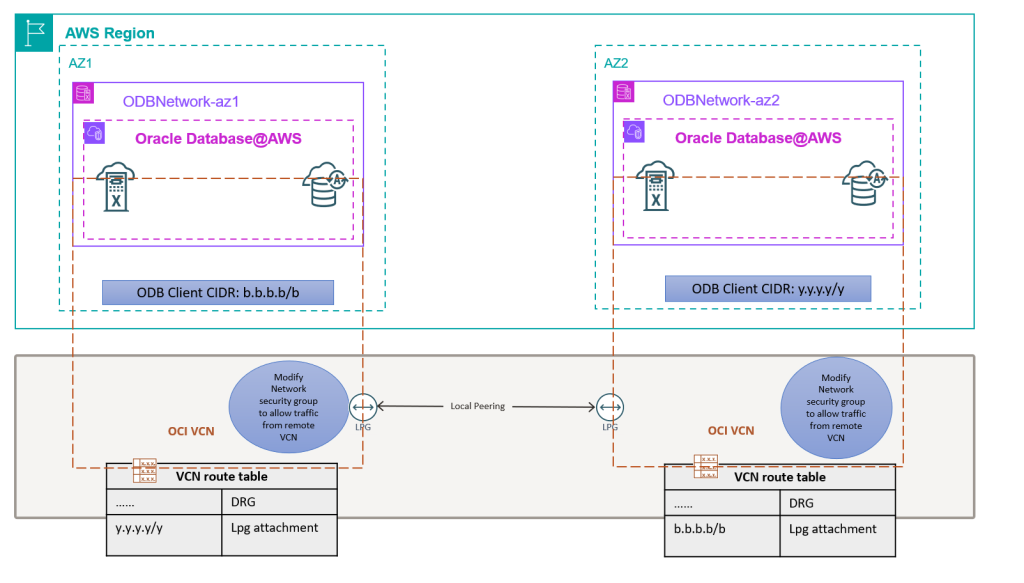
Oracle Database@AWS delivers enterprise-grade database capabilities through database services that use Oracle Exadata infrastructure managed by Oracle Cloud Infrastructure (OCI) within Amazon Web Services (AWS) data centers. High availability (HA) and disaster recovery (DR) options are important aspects to consider when migrating or deploying your critical database in Oracle Database@AWS to help make sure the architecture can meet the service level agreement (SLA) of the application. This post will help you implement and maintain Data Guard configurations that follow Oracle’s Maximum Availability Architecture (MAA) best practices and the AWS Well-Architected Framework. We will show how to select the right network architecture and configure Data Guard associations for both cross-AZ and cross-Region deployments, making sure your applications maintain seamless connectivity during role transitions.
Provision Oracle Database@AWS stack using AWS CloudFormation
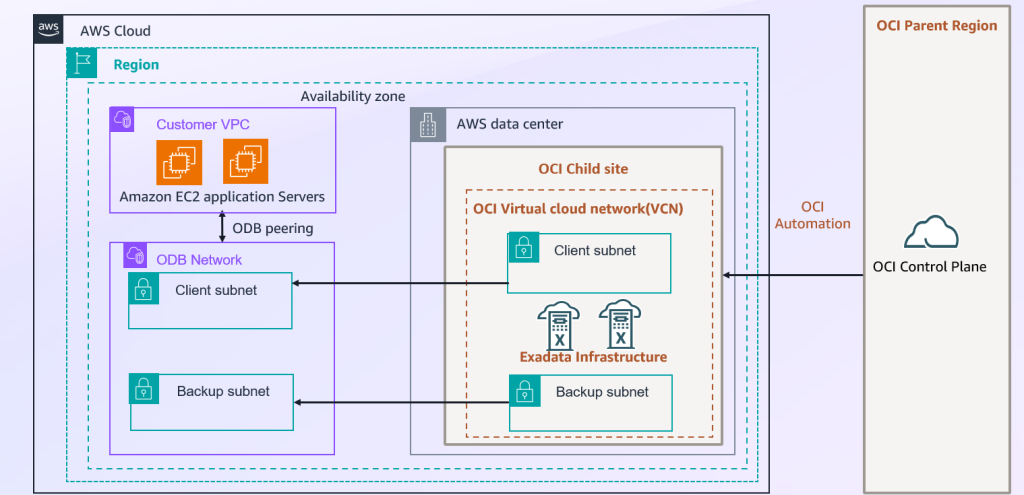
In this post, we explain how to set up key components of Oracle Database@AWS offering including ODB network, Oracle Exadata infrastructure, Exadata VM clusters and Autonomous VM clusters using AWS CloudFormation template.
Accelerate generative AI use cases with Amazon Bedrock and Oracle Database@AWS
In this post, we walk through the steps of integrating Oracle Database@AWS (ODB@AWS) with Amazon Bedrock for by creating a RAG assistant application using an Amazon Titan embedding model in Amazon Bedrock and vectors stored in Oracle AI Database 26ai.
Transform your Oracle Database journey with Accenture and AWS
In this post, we explore how enterprises can transform their Oracle Database environments by combining Accenture’s proven migration expertise with Oracle Database@AWS’s innovative capabilities to achieve faster modernization, enhanced performance, and seamless integration with AWS services
Implement network connectivity patterns for Oracle Database@AWS
Oracle Database@AWS (ODB@AWS) is an offering you can use to access Oracle Exadata infrastructure managed by Oracle Cloud Infrastructure (OCI) within Amazon Web Services (AWS) data centers. You can use ODB@AWS to migrate your Oracle Exadata workloads to AWS while maintaining the same performance and features as your on-premises Oracle Exadata deployments. You benefit from […]