What Is Agentic Commerce?
- What is agentic commerce?
- How do AI agents work in agentic commerce?
- What are the delegation levels of agentic commerce?
- What are the main use cases of AI agents?
- What is the technology stack behind agentic commerce?
- What are the challenges and risks of agentic AI commerce?
- How can AWS help you build for agentic commerce?
What is agentic commerce?
Agentic commerce is the automation of online shopping with AI (Artificial Intelligence) agents. The agentic commerce process involves natural language input, with the agent then conducting product discovery, comparisons, and price monitoring, through to full purchasing, depending on user choices. Agentic commerce saves significant time on the buyer side and can surface vendors to new customers, although it comes with some challenges, such as unintended purchases.
How do AI agents work in agentic commerce?
Agentic commerce relies on mature large language models and agentic orchestration frameworks that allow multiple AI agents to conduct multi-step reasoning, following processes through several stages. These agents are able to receive input from users, understand it, plan steps to complete the task, interact with external systems, and then coordinate transactions across multiple services.
A typical configuration will see an orchestrator agent that receives user input and delegates subtasks to subagents. These subagents might handle tasks such as product discovery, product comparison, and transactions.
Emerging open interoperability protocols, such as Model Context Protocol (MCP), Agent2Agent protocol (A2A), ACP (Agentic Commerce Protocol), and UCP (Universal Commerce Protocol), allow AI agents to connect, access data, and directly interact with merchant systems. The availability of these protocols makes it easier for AI agents to coordinate processes across the various systems they may encounter when following through on a commerce task.
Here are the three main steps that occur within agentic commerce agents.
Goal definition and permissions
A user will write an objective for the AI system in natural language. These inputs could be as simple as buying a certain product or include multi-step instructions, like traversing across websites to find the best deal on a specific product.
During the setup, you can preconfigure useful parameters that will help guide the agents and avoid mistakes. For example, you can set permissions for checkout operations to have a human approvals process for payments in your transaction agent, or restrict your discovery agent to read-only operations. You will need to provide credentials for services, such as merchant logins and payment credentials, depending on your system scope. An additional layer, including budgets, preferred merchants, and stop words, can provide additional constraints.
Discovery and evaluation
After receiving the query, an orchestrator agent will then process it with its Natural Language Processing (NLP) capabilities to better understand the goals the user had in mind.
From there, the agent will split it into subtasks, distributing them among subagents. These subagents might query merchant APIs, search available product catalogs, and query MCP-compatible services with structured data (like pricing or availability). Inconsistent schemas or unstructured data make results less findable for the agents, meaning they will mainly source product references from stores with standardized data formats.
A dedicated comparison subagent will then compare all available data against the user’s original constraints and the initial query. For example, it may filter out some options based on the price being too high or rank products lower down if they don’t align with other requirements, like delivery timelines, availability, or specific specifications. The subagent’s final output will rank the potential products based on these criteria, passing along the results to the orchestrator to present the best options to the user.
Transaction execution
If human gating is in place, the orchestration agent will request permission from the original user. If granted, the transaction agent will then start the transaction process, authenticating with the merchant systems using its identity and tokenized payment credentials.
The transaction agent moves through the checkout process through APIs, rather than a browser, reducing the need for UI scraping or manually filling in forms. After submitting structured payloads with the product’s identifier, quantity of products, shipping details (if necessary), and the tokenized payment references, the merchant will confirm the transaction, which the subagent returns to the orchestrator.
After completing a transaction, other subagents can also follow up on any post-purchase tasks, such as tracking shipments, polling merchant systems for updates, and handling delays. However, these additional tasks require state management, as the subagents need to maintain continuity across asynchronous merchant events.
What are the delegation levels of agentic commerce?
Agentic commerce can take several forms depending on how much autonomy a user wants to give their agents. Here are the main levels of delegation and what they look like in practice.
AI-powered discovery
In an assisted discovery agentic commerce system, the AI agents recommend products. The agent will interpret what a user is looking for and then generate a range of recommendations based on their specific constraints. But the user will always make the final decision, not tasking the AI with making the purchase.
Assisted discovery is the simplest form of agentic commerce. Although it does introduce additional context that goes beyond search engine capability, it doesn’t handle any of the transactional side of things.
Conversational checkout
A conversational checkout takes assisted discovery one step further by then guiding a user through the actual transaction process. The AI will pre-fill the checkout submission forms, such as shipping details and payment methods, while the user only needs to check things over and then confirm the final transaction.
Doing this keeps a human in the loop for all final approvals but speeds the actual shopping experience.
Autonomous purchasing
Autonomous purchasing is a commerce agent that has permission to complete transactions within the pre-approved parameters that the user sets. This system doesn’t have an automatic pre-transaction approval; instead going off the initial scope that the user outlines.
Before using agentic commerce in this style, you need to outline every condition that you’d like the AI agents to complete, including product category, approved merchants, delivery requirements, pricing budget, and so on. This approach should be carefully considered to avoid risky purchasing.
Automated replenishment
Automated replenishment is an additional layer of autonomous purchasing that works based on specific rules, rather than user requests. For example, an agentic commerce system monitors inventory levels for a business and then automatically orders more stock when a certain threshold is met.
Automated systems connect to wider inventory or business management tools to automate some of the administrative side of supply chain tasks.
Agent-to-agent transactions
Agent-to-agent transactions are the highest level of delegation, where the AI agent has full control over purchasing. The orchestrator agent will directly communicate with merchant agents to discover products, negotiate terms of sale, and complete transactions autonomously.
Machine-readable data flows between agents. The main benefit of this approach is that it is highly scalable, making it useful for supply chain systems where both sides of the engagement can be automated.
What are the main use cases of AI agents?
There are several different use cases for agentic commerce.
Retail
In retail, shopping agents can automate purchasing workflows like replenishing stock or buying items if they reach a certain price threshold.
Intelligent agents can analyze consumer behavior, historical purchases, and real-time data to find the optimal time to buy something. Alternatively, based on preferences and context, a shipper could find a gift purchase for a user.
Travel
AI-powered agents can coordinate booking flights, hotels, car rentals, or other travel services while optimizing for multiple user constraints. Agents will weigh up the budget, a user’s schedule, and extra conditions, such as if they’re signed up with a certain loyalty program, to find the best deal.
Procurement
AI agents can compare suppliers, evaluate pricing models, and generate purchase orders to make procurement as automated as possible. Agents with permission to take on more tasks can automate large segments of procurement, from vendor assessment to routine purchasing.
Subscriptions
Consumer agents can manage lifecycle purchases like renewing an annual subscription, upgrading a plan, negotiating, or cancelling. AI agents can optimize these subscriptions over time, helping to save money or minimize unnecessary spending where possible. By drawing from usage signals, they can determine where a person isn’t actually using their subscription to then recommend cancellation.
Financial services
Financial operations are another area where AI agents often excel, as they can collect invoices, categorize expenses, and match transactions to invoices from statements. By processing data across multiple systems, these agents can automate tasks like automated billing to improve operational efficiency in finance.
However, due to the risk associated with this industry, businesses typically include a final verification step with human-in-the-loop to make sure no errors make it through.
What is the technology stack behind agentic commerce?
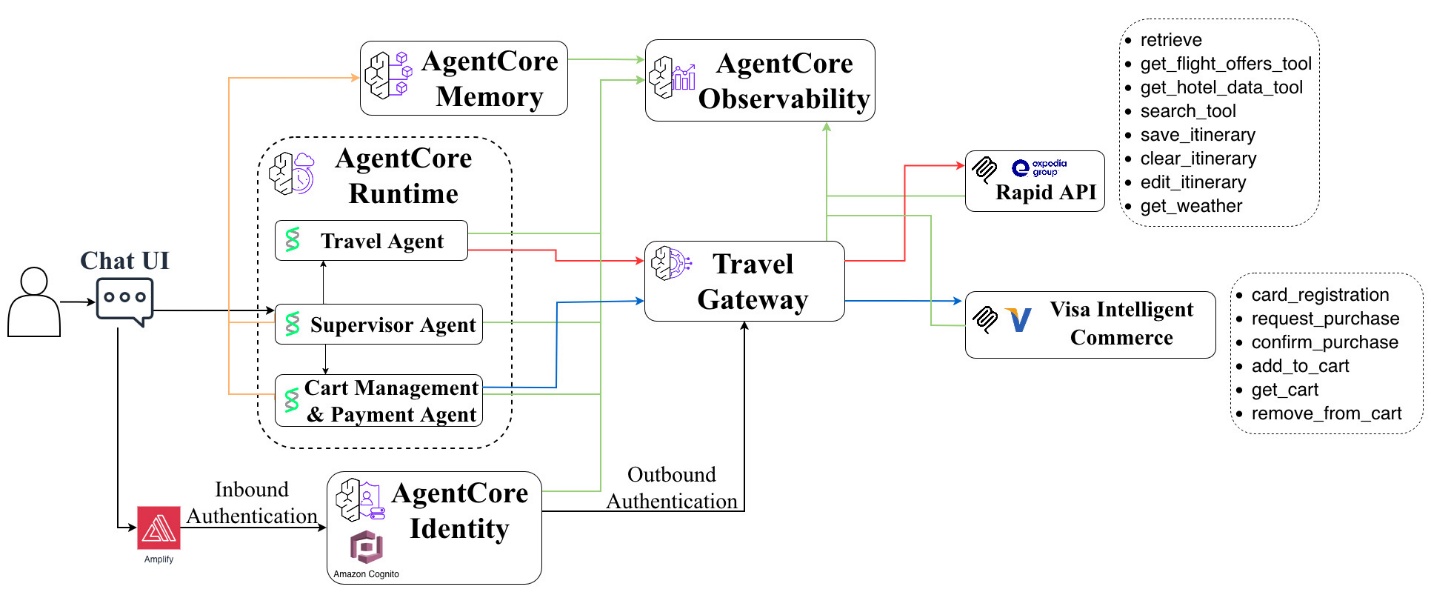
Several distinct components work together to enable agents to perform full-scale agentic commerce. These layers combine advanced AI capabilities with system interaction to allow shopping agents to operate with minimum human input.
Here is the technology stack that allows agentic commerce to work:
-
Foundation models: FMs reason, parse intent, evaluate prompts, and make decisions across complex workflows. As the basis of the orchestrator agent, it can interpret user requests, support product discovery, and make a series of choices that lead to complete purchases.
-
Agentic frameworks: These frameworks orchestrate how AI agents acting across different systems break down tasks, call external tools, and manage operations. They allow for coordinating actions across APIs, services, and agent hops.
-
MCP (Model Context Protocol): The MCP offers a standardized way for agents to connect to external tools and data sources, accessing their structured data and performing actions without specific components for each system.
-
A2A, ACP, and UCP: These protocols define how agents communicate and interact with other agents, with emerging standards like the agent-to-agent protocol and the agent payment protocol enabling secure, machine-to-machine connections.
-
Memory: Memory systems store previous conversations and context, providing a deep understanding of user preferences and active tasks for more accurate decisions over short-term and long-term periods.
-
Identity and authentication: These layers ensure that an agent can act on behalf of a user across different systems. They use credential delegation and tokenized payments to perform transactions safely.
-
Observability: Observability tools provide visibility into how these models work, generating data that teams can then use to better understand how models are working and trace their decisions. Especially for auditing, compliance, and debugging, the observability layer is important.
Together, these systems allow agentic commerce AI to work across multiple environments and take actions.
What are the challenges and risks of agentic AI commerce?
Although agentic AI offers a range of ways to automate supply chain administration and purchasing, it also introduces significant systemic risks that you need to address before deployment in e-commerce environments.
Consent and authorization
Establishing the exact level of consent that AI agents can operate with, without the need for human interaction, is one of the main challenges of agentic commerce. For example, if an AI agent misunderstands a parameter you set, it could make an unintended or unauthorized purchase. Knowing consumer intent only from natural language isn’t always straightforward, with any ambiguity in the initial commands leading to potential errors.
This extends into ethical considerations around liability when an agent acts incorrectly on a user’s behalf. To reduce this risk, you need to enforce strict approval thresholds and monitor agentic systems for unusual behavior. Switch on human-gated approvals processes for protection.
Identity and security
Agentic commerce authenticates AI agents rather than human users, interacting with multiple systems like merchant APIs and payment providers with their designated credentials. You work to secure transactions by using identity controls, using tokenized payment mechanisms, and building safeguards against impersonation through fraud detection.
Prompt injection is especially important to protect against, as malicious actors can build inputs into external product data to manipulate agent decision-making processes. Cross-agent propagation can compound unintended consequences. Separating execution logic from all untrusted data sources and implementing a range of validation layers can help here.
Protocol fragmentation
While having various standards makes integrating into various systems easier, the lack of consolidation results in a fragmented list of protocols. Agentic commerce today still has not settled on a specific standard, leading to inconsistencies in how agents interact with systems.
Inconsistencies in structured product data and API design across e-commerce platforms also limit how reliable modern agents are. The lack of standardized interfaces limits agentic capabilities, meaning custom integrations are required that add overhead and limit portability.
How can AWS help you build for agentic commerce?
AWS can help you build agentic commerce workflows, with services for building, deploying, and operating your agentic infrastructure:
-
Amazon Bedrock is the platform for building generative AI applications and agents at a production scale. Amazon Bedrock gives you access to hundreds of FMs from leading AI companies, along with evaluation tools to pick the best model based on your unique performance and cost needs.
-
Amazon Bedrock AgentCore is an agentic platform for building, deploying, and operating effective agents securely at scale. Convert APIs and Lambda functions into agent-compatible tools, connect to existing MCP servers, and enable intelligent tool discovery through semantic search.
-
Amazon Bedrock Agents use the reasoning of foundation models (FMs), APIs, and data to break down user requests, gather relevant information, and efficiently complete tasks—freeing teams to focus on high-value work. Building an agent is straightforward and fast, with setup in just a few steps.
Get started with building agentic commerce on AWS by creating a free account today.
Browse all cloud computing concepts
Browse all cloud computing concepts content here:
Did you find what you were looking for today?
Let us know so we can improve the quality of the content on our pages