AWS News Blog
Introducing the next generation of Amazon OpenSearch Serverless for building your agentic AI applications

|
Today, we’re announcing the next generation of Amazon OpenSearch Serverless, a fully managed search and vector engine designed for customers building AI agents. The next generation of OpenSearch Serverless scales from zero to thousands of requests per second and back to zero when idle, offering up to 60% cost savings compared to the cost of OpenSearch Service clusters provisioned for peak capacity.
The next generation of OpenSearch Serverless creates resources in seconds and scales capacity up to 20 times faster than the previous generation. With instant resource creation and native integrations with AI development platforms like Vercel and Kiro, you can deploy production-ready search and vector backends for your AI agents in minutes without managing infrastructure.
The next generation of OpenSearch Serverless in action
To get started with the next generation of OpenSearch Serverless, choose Create collection in the Serverless menu in the Amazon OpenSearch Service console.
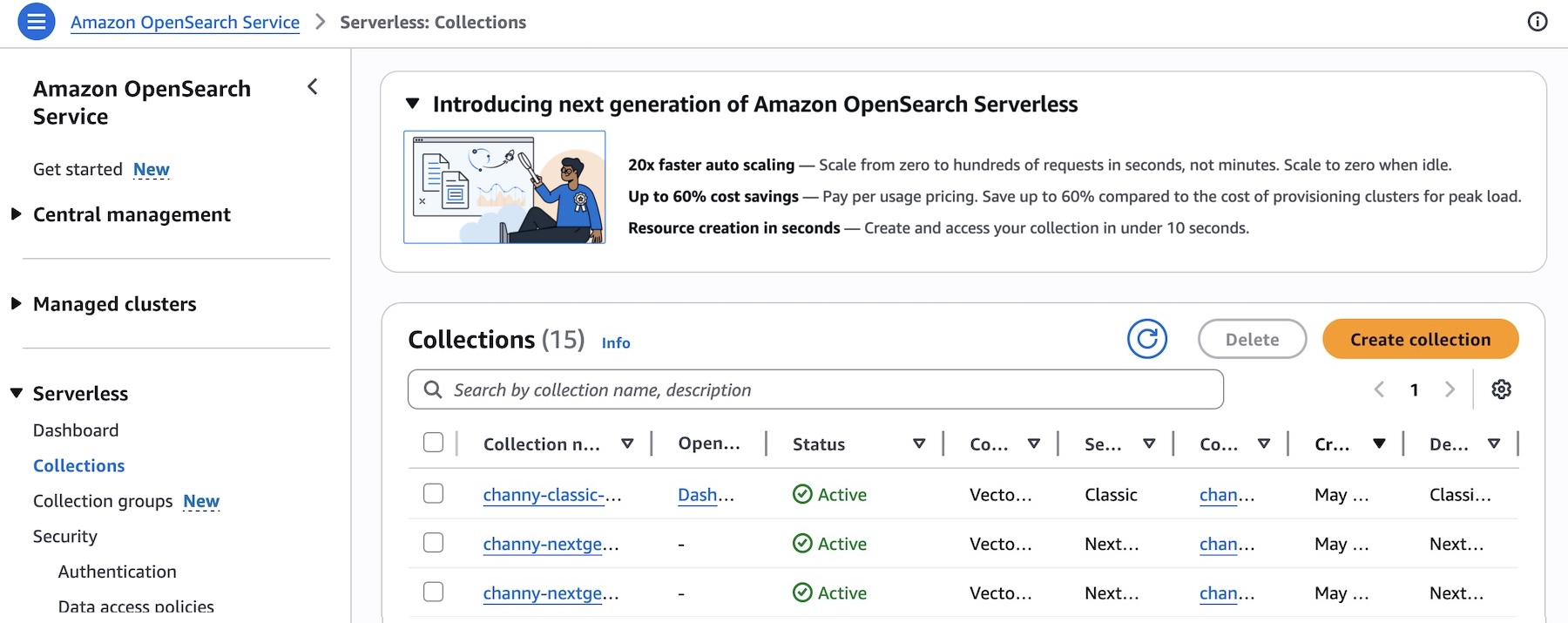
Create NextGen collection with instant auto scaling and scale-to-zero for cost optimization. At launch, we support full-text search and vector search only for the collection type. If you want to use the existing OpenSearch Serverless infrastructure, choose Switch to Classic.
Choose Express create, the fastest way to create collection. No configuration is required—the default settings and matching security policies are applied automatically. Some configuration options can be changed later.
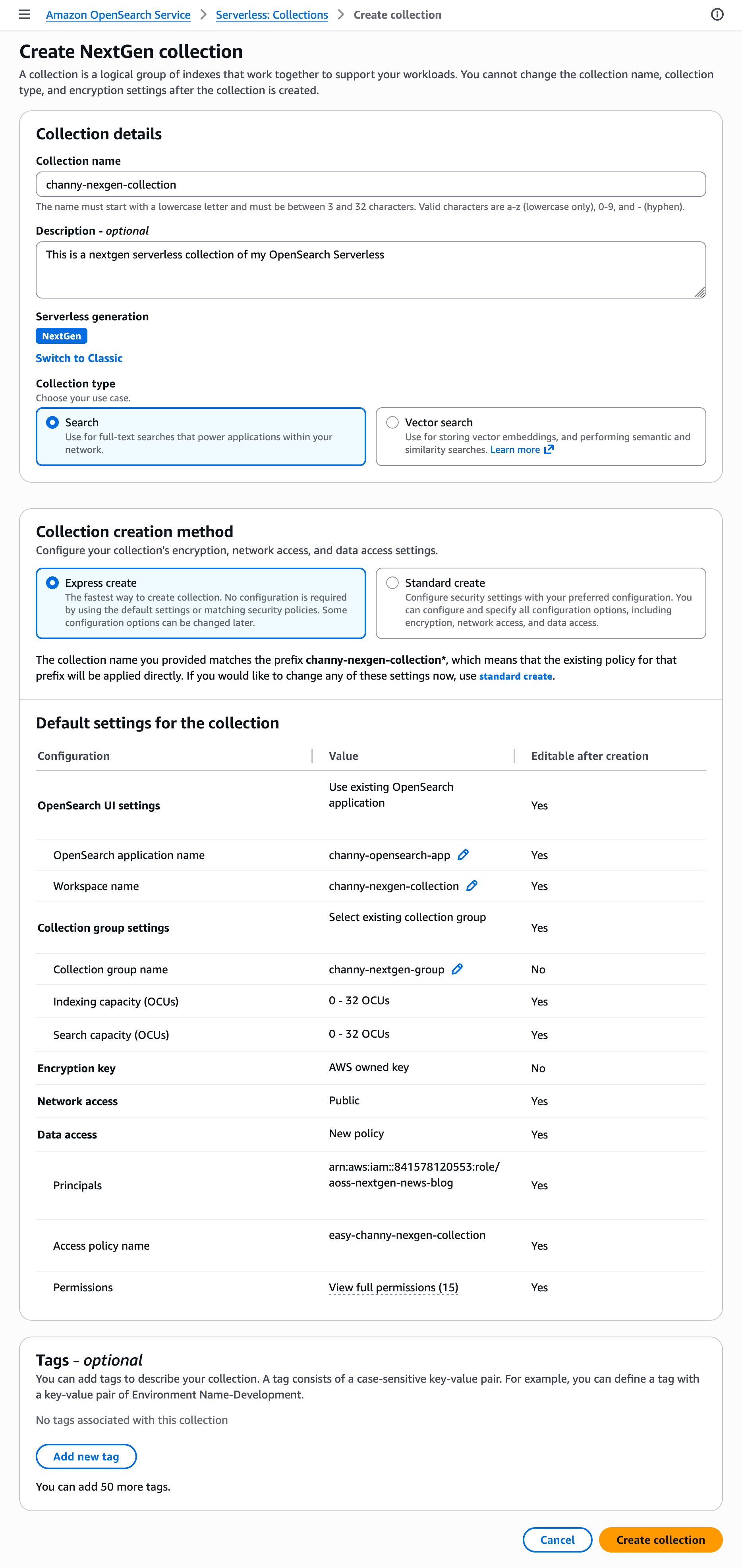
When you choose Create collection, OpenSearch Serverless will provision resources in seconds.
You can also create a collection of OpenSearch Serverless with AWS Command Line Interface (AWS CLI) or AWS SDKs. Here is a sample CLI command to create a collection group.
aws opensearchserverless create-collection-group \
    --name channy-nextgen-group \
    --standby-replicas ENABLED \
    --generation NEXTGEN \
    --description "My NextGen collection group" \
    --capacity-limits '{
        "maxIndexingCapacityInOCU": 96,
        "maxSearchCapacityInOCU": 96,
        "minIndexingCapacityInOCU": 0,
        "minSearchCapacityInOCU": 0
    }' \
    --region "us-east-1"
Now, you can create a collection that inherits the generation from its parent collection group. Supported collection types: SEARCH and VECTORSEARCH.
aws opensearchserverless create-collection \
    --name channy-nextgen-collection \
    --type SEARCH \
    --collection-group-name channy-nextgen-group \
    --standby-replicas ENABLED \
    --description "My collection in NextGen group" \
    --region "us-east-1"
To learn more about managing the next generation of OpenSearch Serverless, visit the Amazon OpenSearch Serverless documentation.
Building your agents faster with OpenSearch Serverless
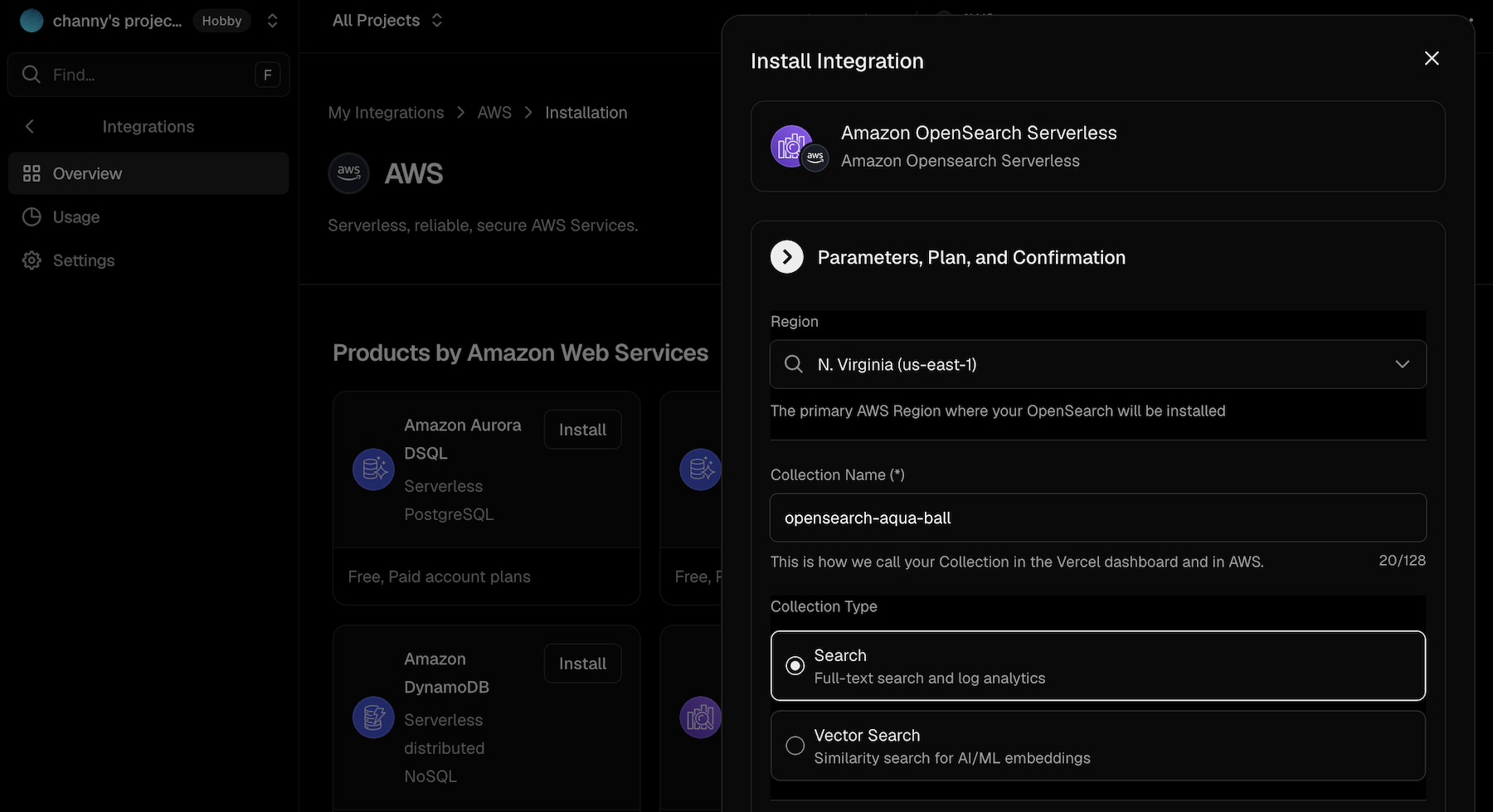
To support building production-ready agent applications in Vercel, you can now create a new OpenSearch collection or connect your existing OpenSearch Serverless collection within the Vercel console. Create a search backend in seconds and add features on-demand as your application grows. To learn more, visit AWS for Vercel.
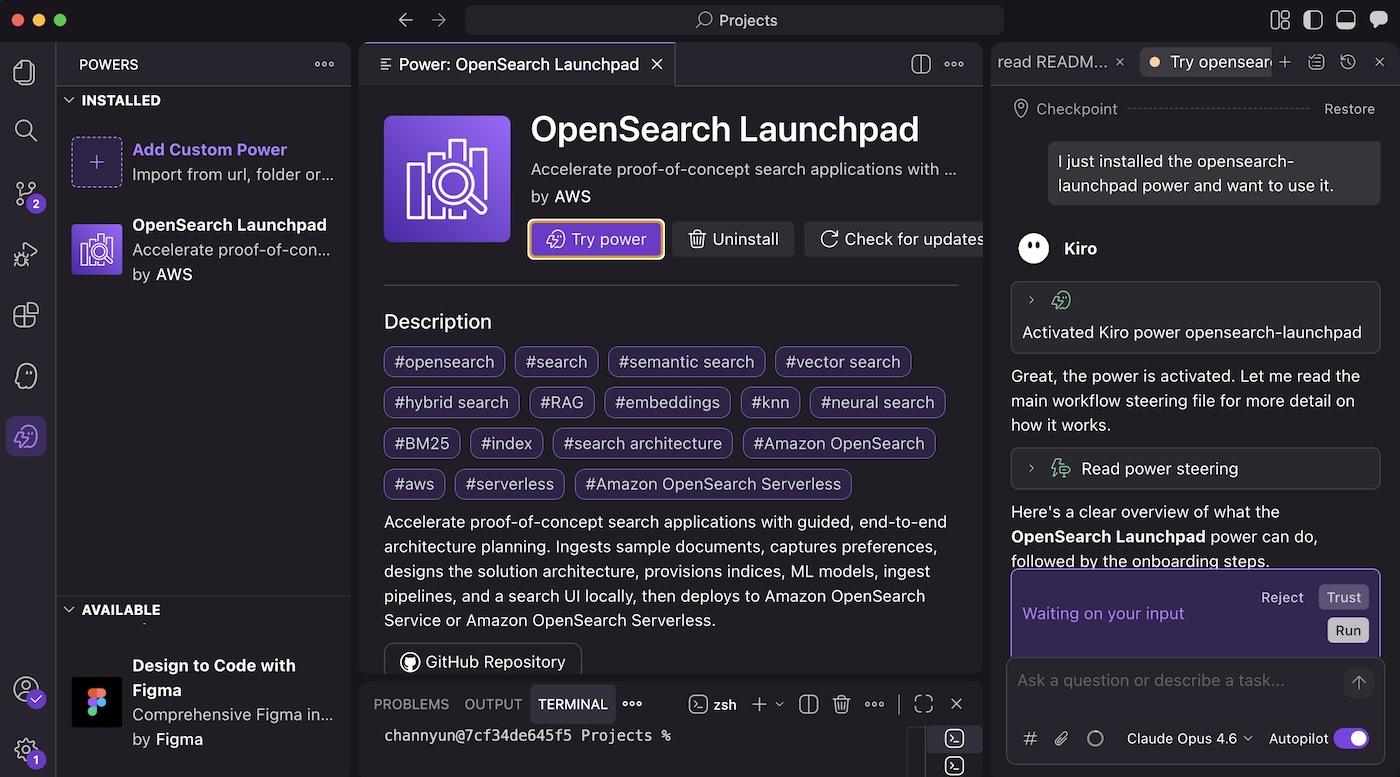
You can go from idea to working prototype in minutes using Claude Code, Cursor, and Kiro. OpenSearch Agent Skills provide a repository of skills that bring OpenSearch intelligence directly into your agent. Each skill encapsulates domain knowledge, best practices, and multi-step execution logic for a specific workflow–so your agent not only gets results, but understands how they were achieved. You can also use the OpenSearch Launchpad in Kiro Powers to accelerate search applications with guided, end-to-end architecture planning.
Now available
The next generation of Amazon OpenSearch Serverless is generally available today and is available in all AWS commercial Regions where Amazon OpenSearch Serverless is currently available.
The next generation of OpenSearch Serverless charges for the compute you use in OpenSearch Compute Units (OCUs) for indexing, search, and GPU acceleration. You are charged separately for storage in GB-month. For more information, see Amazon OpenSearch Service Pricing.
Give it a try and send feedback to the AWS re:Post for Amazon OpenSearch Service or through your usual AWS Support contacts.
— Channy
Updated on May, 29, 2026 – Fixed the default value (96) of maximum indexing/search capacity in the CLI command. You should use the number of binary sequence to set these values.