AWS for SAP
Agent-to-Agent Interoperability between AWS and SAP
This blog is co-authored with Vikas Motiwal (SAP), Kay Schmitteckert (SAP) and Praveen Padegal (SAP)
AWS and SAP now support the agentic integration via open protocols, enabling autonomous cross-system business processes at enterprise scale.
The autonomous enterprise depends on AI agents that can complete business processes that run across both SAP and non-SAP applications. As enterprises put AI agents to work on these processes, the agents need to work across SAP and non-SAP applications, which makes agent-to-agent interoperability essential. Until now, connecting an agent built on AWS to SAP business logic meant building and maintaining custom point-to-point integrations, one use case at a time. AWS and SAP now support the agentic integration via open protocols, enabling autonomous cross-system business processes at enterprise scale.
In this post, we explain how the agent integration works, show how business users can access Joule agents from AWS Quick, and share how to get started.
Why agent-to-agent interoperability matters
Consider an order-to-cash process for a customer running SAP Cloud ERP Private on AWS. Joule agents in SAP create the sales order, check availability and pricing, and handle billing. An agent on Amazon Bedrock AgentCore manages delivery through the customer’s logistics applications on AWS. It gets the order details from a Joule agent and confirms the shipment back to SAP. Each agent works where its data lives, and together they move the order from capture to cash.
The best place to build an agent is close to the data and business logic it depends on. On AWS, Amazon Bedrock AgentCore lets you build, deploy, and operate agents using any framework and any model, on the data from your entire IT application landscape you have on AWS. SAP provides prebuilt Joule agents with deep ERP context, and you can build custom Joule agents with Joule Studio using any framework and any model.
A2A, an open protocol governed by the Linux Foundation, connects these agents through a standardized interface. An AgentCore agent can discover a Joule agent, send it a task, and receive the result without custom integration. Each team builds the agent it knows best, and A2A lets those agents work together.
How does the agentic integration work
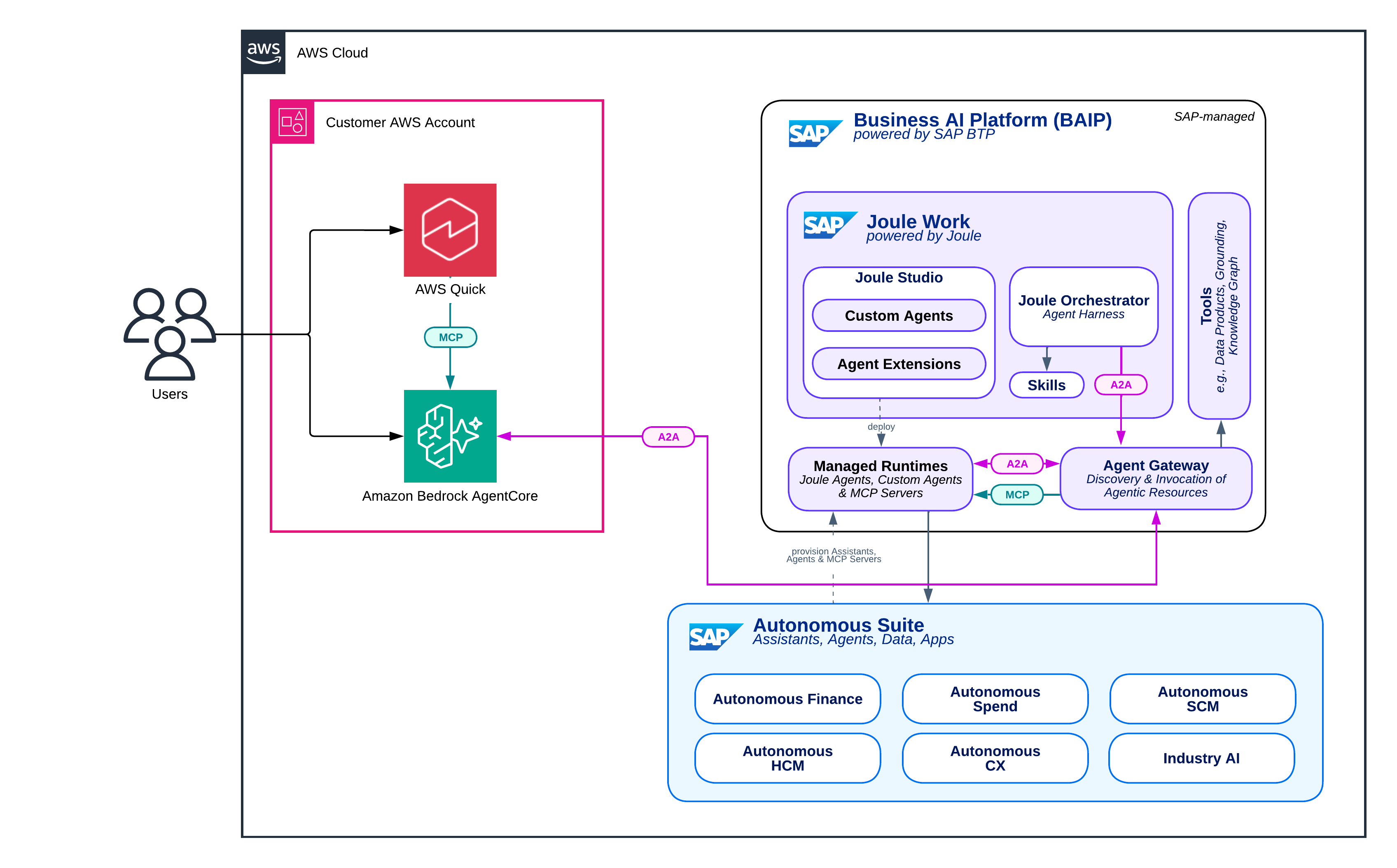
SAP’s agent gateway is the entry point to Joule agents. As the central integration layer for SAP Business AI Platform, the gateway handles agent discovery, invocation, and protocol routing. It also centrally manages authentication, principal propagation, policy enforcement, and tenancy for both SAP-built and custom agents.
The flow works as follows:
- An agent running on Amazon Bedrock AgentCore receives a task that requires SAP data or business logic.
- The agent discovers the appropriate Joule agent and sends the request to SAP’s agent gateway using A2A.
- SAP’s agent gateway authenticates the request and routes it to the Joule agent.
- The Joule agent completes the task in SAP and returns the result to the AgentCore agent.
Security and governance are built in. SAP Cloud Identity Services federates trust between AWS and SAP, so every cross-platform invocation runs under the signed-in user’s identity, without exposing credentials at any hop. Because each request runs as the user, your existing SAP authorizations continue to govern what an agent can do, with full traceability.
Today, the integration supports calls from AWS to SAP. In the future, SAP plans to support calls from Joule to AWS agents through SAP’s agent gateway.
Work across every system from one conversation with AWS Quick
For business users who prefer one place to work, AWS Quick is an AI assistant, that provides an entry point on top of this architecture. With AWS Quick, a user can hand an SAP-specific task to a Joule agent and get the answer back in the flow of work, without switching tools or needing to know where each agent runs.
When a user asks AWS Quick an SAP-related question:
- AWS Quick calls an AgentCore agent through a Model Context Protocol (MCP) connector.
- The AgentCore agent selects the appropriate Joule agent and calls it through SAP’s agent gateway using A2A.
- The Joule agent’s response comes back to the user in AWS Quick.
To the user, it’s one continuous conversation. Underneath, AWS and SAP work together through open, standards-based protocols.
Benefits for customers
With A2A interoperability between Amazon Bedrock AgentCore and Joule, AWS and SAP agents can work together to complete business processes across SAP and non-SAP applications. For customers, that means faster progress toward the autonomous enterprise, with less integration work and governance built in:
- Build agents where your data lives. Keep SAP data in SAP and AWS data on AWS. Joule agents work with SAP business objects natively, AgentCore agents use your AWS data sources, and A2A connects them without moving data.
- Choose how you build. Use Joule Studio for SAP-centric agents, applications, and workflows, and Amazon Bedrock AgentCore with any framework and any model for workloads on AWS. A2A makes sure these agents work together wherever they were built.
- Remove integration complexity. A single, standards-based gateway replaces point-to-point integrations, so engineering teams spend less time maintaining connections and more time delivering business value.
- Preserve existing investments. Agents connect through agent gateway using your existing business logic, data models, and authorizations, without rebuilding SAP or AWS applications.
- Govern every interaction. Each request runs under the user’s identity and is governed by existing SAP authorizations, with full traceability across platforms.
Conclusion
AI agents deliver the most value when they can work together across the systems that run your business. With A2A interoperability between AWS AI Services and SAP agents, you can build agents where your data lives and connect them through agent gateway using open protocols, without custom integration code. You can also give business users a single entry point in AWS Quick.
Get started
The joint reference architecture is based on the SAP Architecture Center guidance for A2A and MCP interoperability. To get started:
- Review the reference architecture in the SAP Architecture Center.
- Try the integration with the A2A interoperability cookbook.
To learn more about SAP on AWS, visit aws.amazon.com/sap.