AWS Big Data Blog
Kinesis On-demand Advantage saves 60%+ on streaming costs
Amazon Kinesis Data Streams is a serverless streaming data service that helps you capture, process, and store streaming data at any scale. On November 4, 2025, Amazon Kinesis Data Streams introduced On-demand Advantage mode, a capability that enables on-demand streams to handle instant throughput increases at scale and cost optimization for consistent streaming workloads. Historically, you had to choose between provisioned mode, which required managing stream capacity, and on-demand mode, which automatically scaled capacity, but this new offering removes the need to think about stream type at all.
In this post, we show three real-world scenarios comparing different usage patterns and demonstrate how On-demand Advantage mode can optimize your streaming costs while maintaining performance and flexibility. To have a meaningful comparison, we ran simulations in two separate AWS accounts: one with On-demand Standard mode and another with On-demand Advantage mode enabled at the account level. Both deployments maintained identical stream configurations, shard allocations, and ingest patterns, providing a comparison of the billing impact for all of the following scenarios.
All prices displayed in this post are from the us-east-1 Region.
Breaking down On-demand Advantage savings
Now let’s go into more details. In the first post, we talked about the warm throughput feature and how you can use it to warm streams to handle gigabytes or millions of records per second with On-demand Advantage mode. Next, we illustrate how different streaming use cases operate most cost efficiently with the On-demand Advantage mode, while maintaining performance and flexibility.
Enabling On-demand Advantage mode in the account level gives you cost savings across many dimensions compared to On-demand Standard, here are some notable ones:
- Provides at least 60% savings by committing to an account to stream at least 25 MiBps usage in the AWS Region. The minimum commitment is about $100 a day based on AWS N. Virginia Regions’ public pricing.
- Enhanced Fan Out consumers usage is priced 68% lower and you can have up to 50 per stream, compared to 20 per stream without On-demand Advantage.
- Extended retention usage is priced 77% lower when using data storage beyond 24 hours.
- No minimum per-stream fixed charge, so you can use as many streams as you need without incurring a higher cost.
Why choose Kinesis On-demand Advantage: 60%+ savings
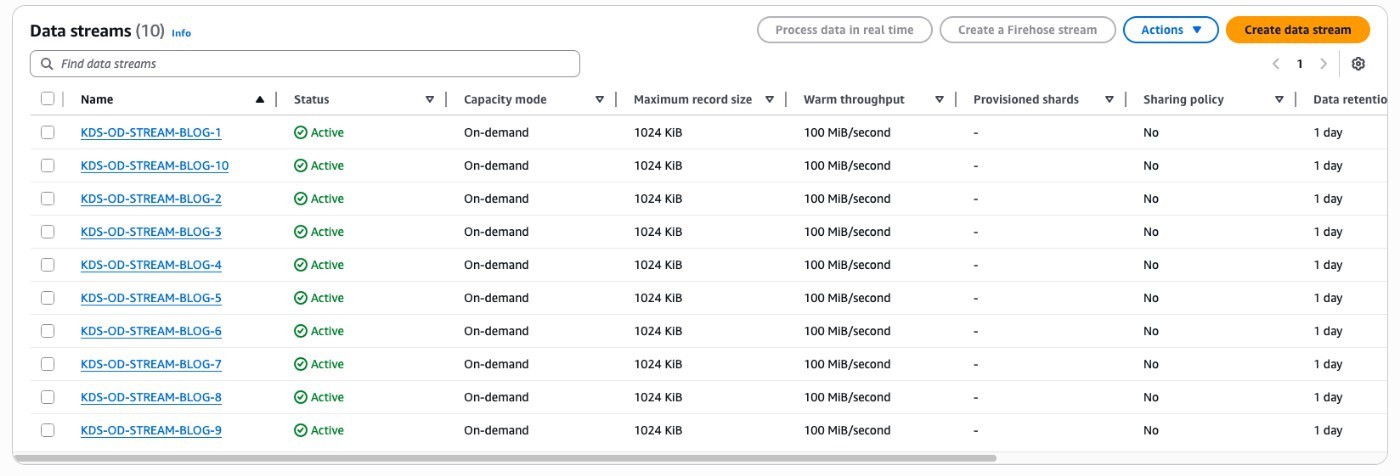
We evaluated Amazon Kinesis Data Streams On-demand using both Standard and Advantage modes by deploying 10 streams and generating a sustained ingest throughput of 100 MiBps across all streams. This scenario models an ecommerce company streaming user clickstream data to generate real-time insights. The simulation was run over two days in two separate AWS accounts with the different modes. On day one, we maintained a steady ingestion rate of 100 MiBps. On day two, in anticipation of a holiday sales event, we increased the warm throughput capacity by 10X across all 10 streams while keeping the actual ingest rate constant at 100 MiBps. Each stream is ingesting 10 MiBps with a total of 100 MiBps across all On-demand streams.
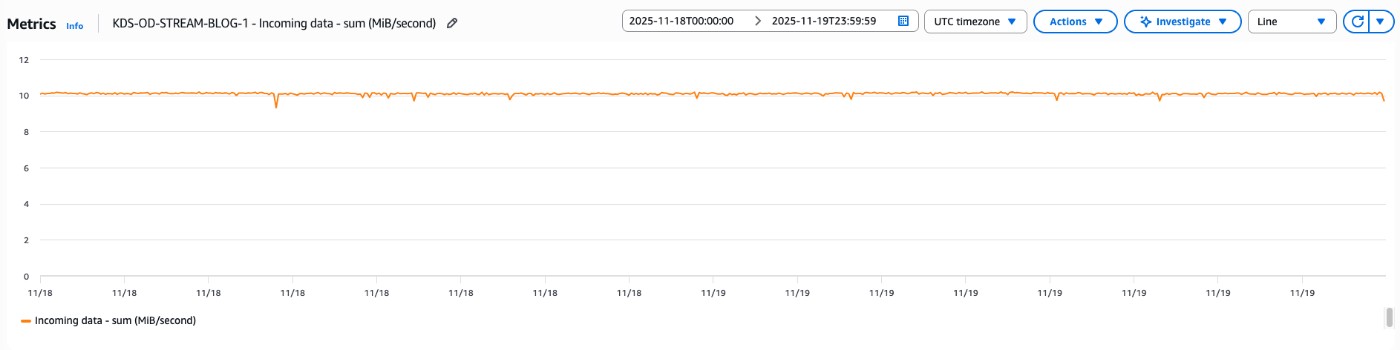
On the second day, we enabled warm throughput of 100 MiBps in an account with On-demand Advantage mode configured. With warm throughput, you can proactively pre-scale your streams when expecting a traffic surge.
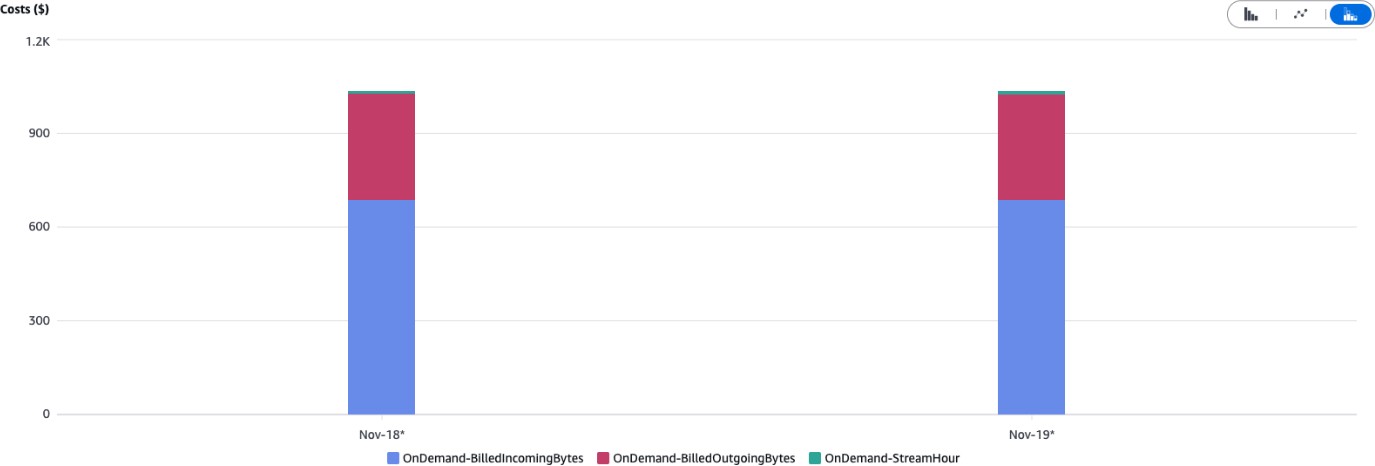
On-demand Standard Cost Explorer:
On-demand Advantage Mode Cost Explorer:
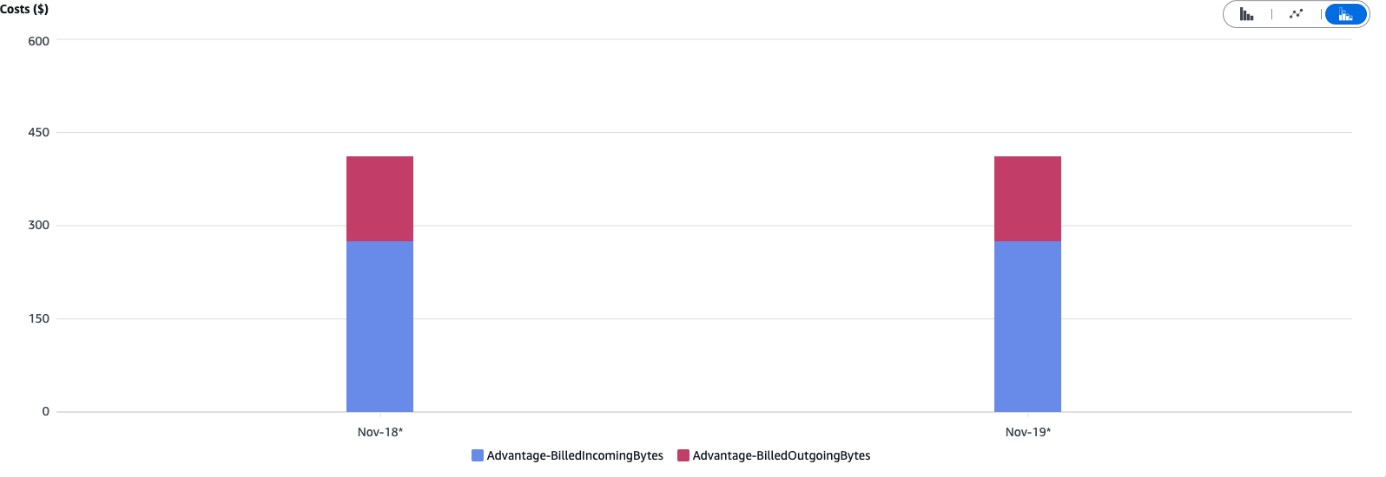
This use case is cost effective in On-demand Advantage because of the consistent data throughput traffic and the need to use multiple streams. You can see zero stream hour charges in Advantage mode but in On-demand Standard mode there is a $0.04 charge per stream hour. Additionally, the incoming bytes charge for Advantage mode is $0.032 per GB and On-demand Standard is $0.08 per GB. The On-demand Standard configuration generated total costs of $2,071.75 over the 48-hour period, which comes out to $1,037 per day, which is $378,505 annually. The identical workload running with On-demand Advantage mode costs $823.44 for the same 48-hour period, approximately $412 per day resulting in an annual cost of $150,380. There is also no additional cost for warm throughput in On-demand Advantage. This translates to a 60% cost reduction, which means annual savings of $228,125 for this single workload.
Scenario 2: 15 MiBps throughput and extended retention across 10 streams in one account
A healthcare company requires a two-day data retention period to ensure continuous replay-ability, and regulatory requirements mandate that different types of data be stored in separate streams. To emulate this scenario, we deployed 10 Amazon Kinesis Data Streams configured in both On-demand Standard and Advantage modes, each with an extended 48-hour retention period. The extended retention allows downstream systems to reprocess data and recover from transient failures. This use case is also expected to be cost-efficient in On-demand Advantage mode due to the need for multiple streams and retention, a point we explore further in the following cost breakdown image.
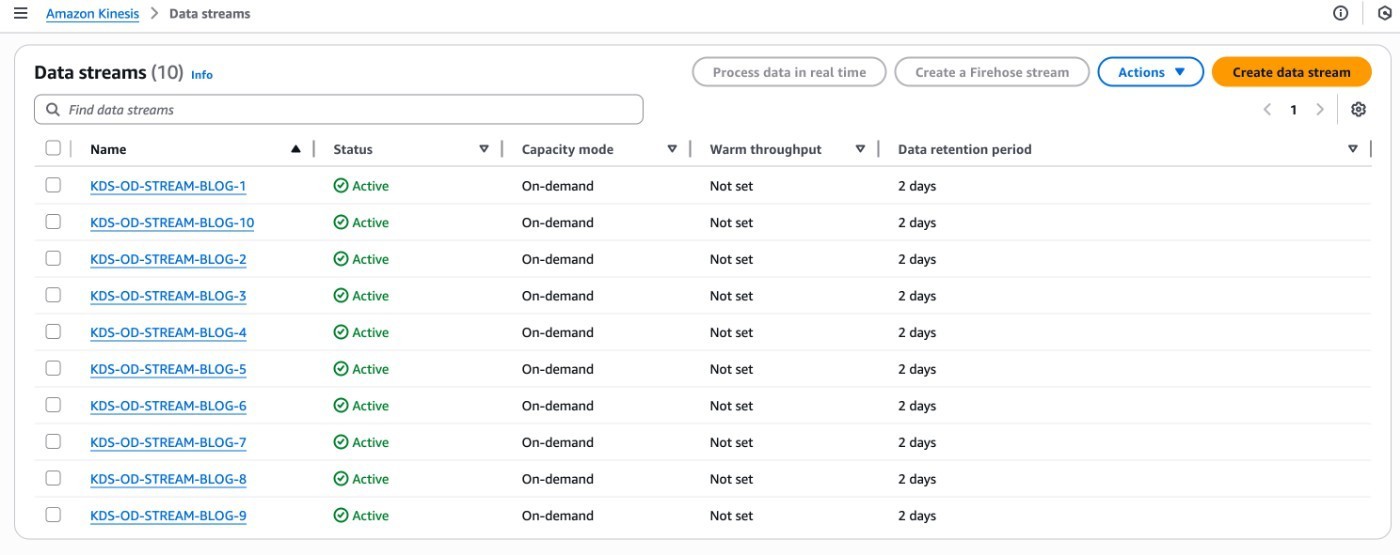
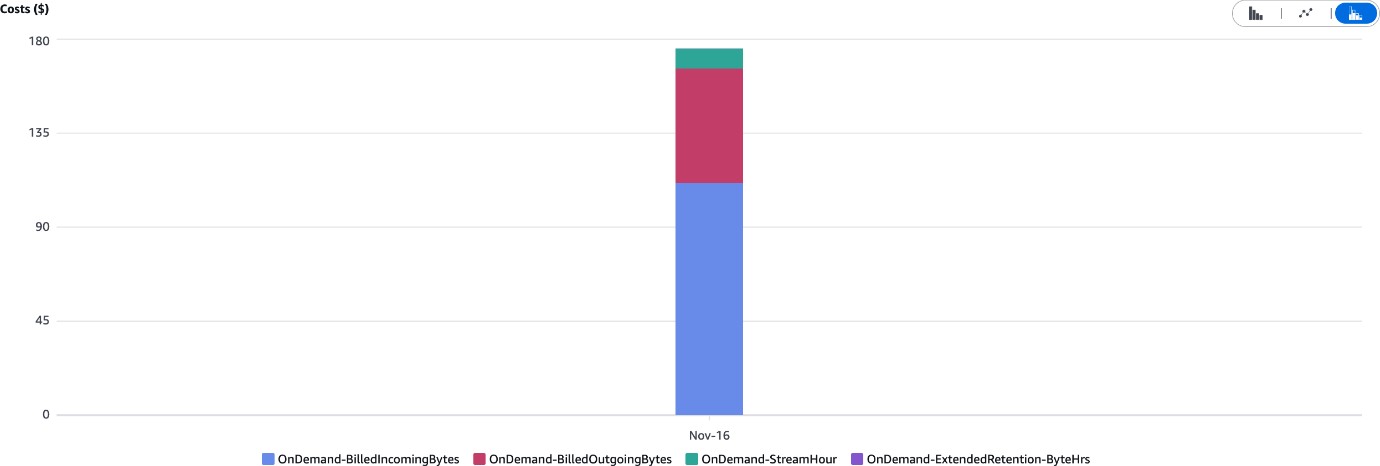
We generated consistent ingest traffic of 15 MiBps distributed across 10 streams for 48 hours to evaluate costs. On-demand Standard Mode:
On-demand Advantage Mode enabled:
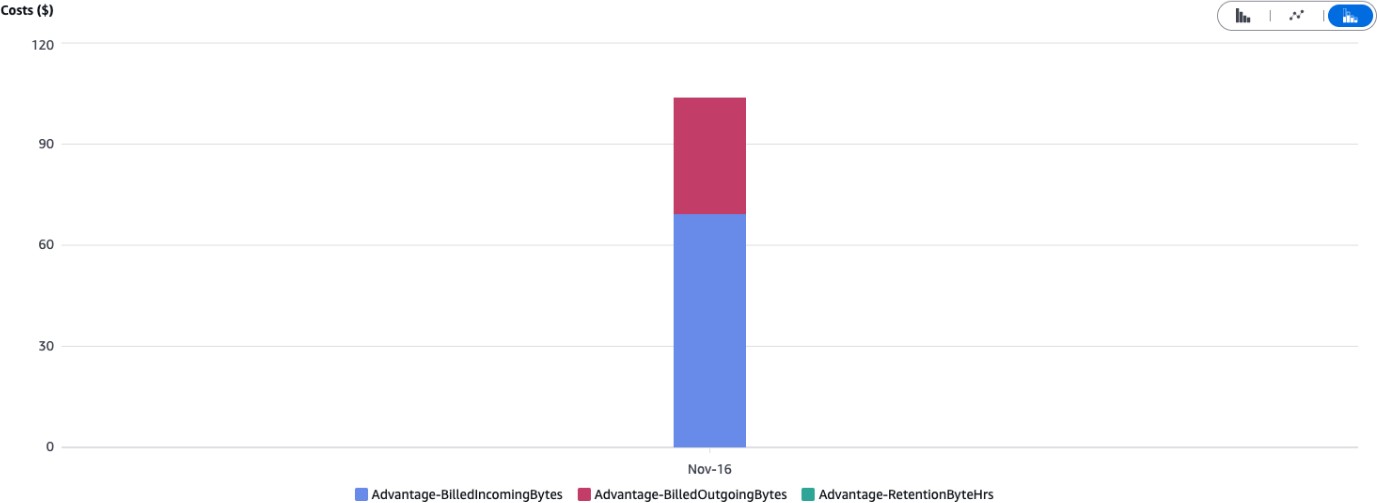
The Cost Explorer screenshot gives us a side-by-side view of the pricing between On-demand Standard and Advantage modes. On-demand Standard came out to a daily cost of $176, annually becoming $64,240. For On-demand Advantage, the daily cost was $104 with an annual cost of $37,960. As a result, we achieve a 41% savings with Advantage mode despite operating with 15 MiBps throughput and implementing extended retention. Standard mode has an additional cost of $0.10 per GB of data stored beyond 24 hours, up to 7 days. Advantage mode costs an additional $0.023 per GB month (beyond 24 hours, up to 365 days) resulting in cost optimization for data storage. This scenario shows how Advantage mode delivers cost benefits across a broader range of workloads. When enabling Advantage mode, you commit to paying for usage at a minimum of 25 MiBps. However, in our simulation with 15 MiBps throughput, we found that customers still achieved significant cost savings. With Advantage mode, as long as you’re ingesting 10 MiBps or more, you will experience lower costs compared to Standard mode, even when committing to the 25 MiBps threshold.
Scenario 3: 1 Kinesis Data Stream with 10 enhanced fan-out consumers
In a microservices architecture, multiple services might need to read from the same data stream concurrently and with low latency. As the system evolves, additional Enhanced Fan-Out (EFO) consumers might be added to support new analytics use cases and derive deeper insights from the streaming data pipeline.
Next, we evaluate the cost comparison of using EFO consumers with On-demand Advantage mode in a microservices architecture. Over a 24-hour period, we tested a single Amazon Kinesis Data Stream with standard 24-hour retention, connected to 10 AWS Lambda functions configured as EFO consumers.
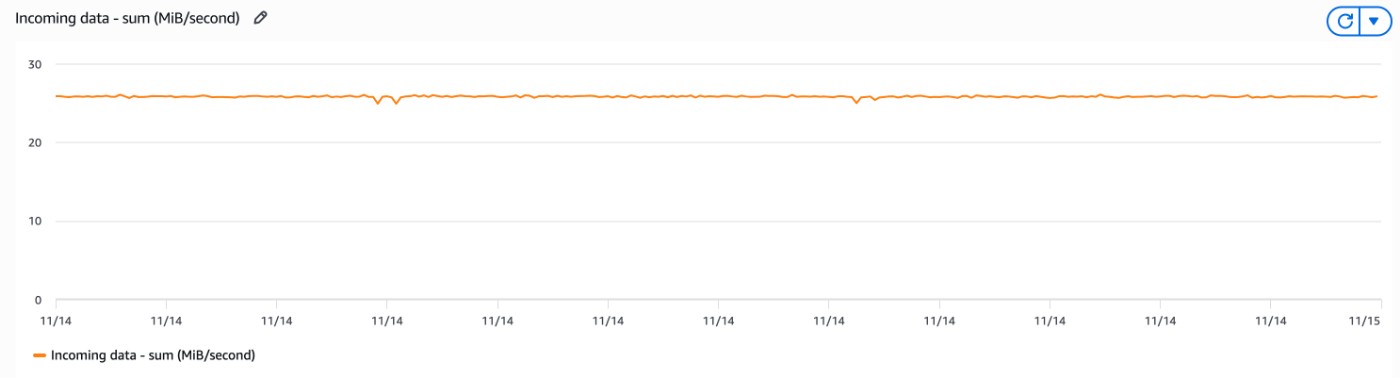
To assess the cost impact of multiple EFO consumers accessing the same stream simultaneously, we generated a consistent ingest rate of 25 MiBps throughout the evaluation period. The following chart shows a Kinesis Data Stream with Enhanced Fan-Out Consumers with 25MiBps payload.
The following charts show the cost difference between On-demand Standard mode vs On-demand Advantage mode enabled:
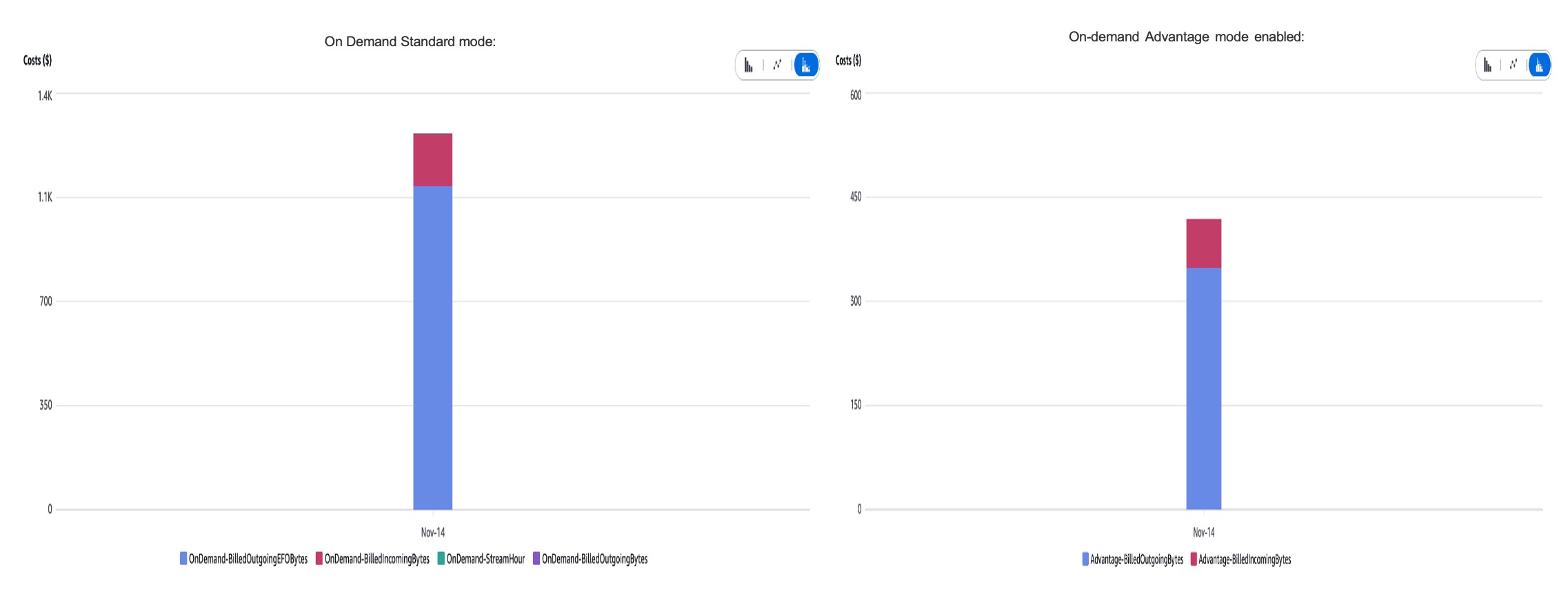
Our Cost Explorer analysis demonstrates that even with multiple EFO consumers, the On-demand Advantage mode resulted in lower overall costs compared to the On-demand Standard mode. The On-demand Standard cost was $1,266 while the Advantage mode cost was $419. For the same workload characteristics, we observed approximately 67% savings with annual savings of $309,155. This is especially important for organizations building event-driven architectures where multiple services need independent, real-time access to streaming data. Enhanced fanout data retrievals are $0.016 per GB per consumer in Advantage mode compared to the $0.05 of Standard mode. Now that we’ve discussed which workloads we recommend for Kinesis On-demand Advantage, let’s turn to workloads that we recommend for On-demand Standard mode. Highly spiky, unpredictable workloads with low sustained throughput (under 10 MiBps) are recommended candidates for On-demand Standard. With these workloads, customers can let the stream automatically scale throughput capacity without committing to a consistent throughput usage.
On-demand Advantage compared to Provisioned mode:
With both On-demand Standard and On-demand Advantage modes available, customers no longer need to rely on Provisioned mode. Instead of continuously managing capacity to balance performance and cost, on-demand streams offer a streamlined pricing model and greater ease of use. Additionally, customers running provisioned workloads that operate many streams or use features such as Extended Retention and Enhanced Fan-Out should strongly consider migrating to On-demand Advantage. Data streams use the same underlying infrastructure, regardless of which mode you choose, so there is no difference in availability or reliability between On-demand Advantage and provisioned.
- For ensuring streams can support instant scaling at no extra cost and can reactively scale when needed, On-demand Advantage is a better fit than Provisioned mode, because warm throughput doesn’t incur an additional cost.
- Even at a large scale (Gbps), On-demand Advantage’s pay-for-actual-data-usage billing is competitive.
- On-demand Advantage has a much lower cost to use EFO (for high fanout needs like microservices) and Extended Retention.
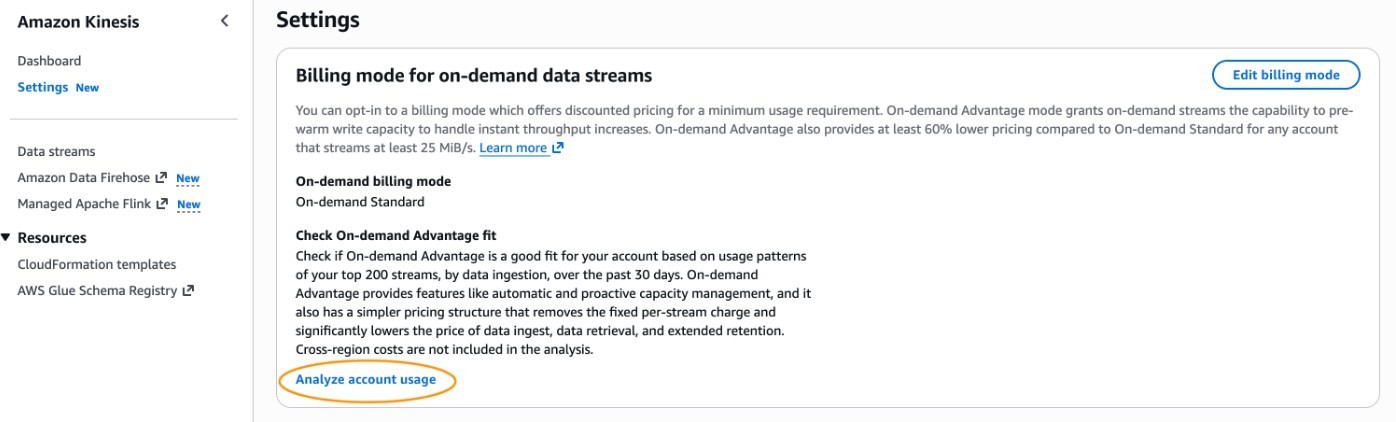
To help you compare, you can use the Kinesis console to check if your account’s top 200 provisioned streams are a good fit to use On-demand Advantage instead.
Conclusion
In this post, we explored three real-world scenarios demonstrating how Amazon Kinesis Data Streams On-demand Advantage mode delivers significant cost savings while maintaining performance and flexibility. On-demand Advantage provides you with the best performance at scale, and together with On-demand Standard, Kinesis Data Streams offers you a streamlined way to use and most cost-effective streaming solution for any streaming use case. If your workloads consistently stream at least 10 MBps, fan out to two or more consumers, retain data for more than 24 hours, or operate hundreds of streams, On-demand Advantage is the most cost-effective mode. For all your other workloads, On-demand Standard mode is a great fit. Whether you’re streaming millions of records or gigabytes of data per second from diverse producers to consumers, Kinesis Data Streams has you covered. We look forward to hearing how you and your teams take advantage of Kinesis Data Streams On-demand Advantage to bring real-time insights to your organizations and processes.