AWS Compute Blog
Introducing public preview runtimes on AWS Lambda, starting with Node.js 26 and Python 3.15
Today, AWS Lambda introduces public preview runtimes, a new way to try upcoming language versions on Lambda before their general availability (GA) release. Starting today, you can create and update Lambda functions using Node.js 26 and Python 3.15, the first runtimes available as public previews.
Previously, Lambda has always launched new runtimes as Generally Available (GA), giving you a production-ready experience from day one. But this means you couldn’t run your functions on Lambda using a pre-release language version, and we couldn’t hear your feedback while breaking changes were still possible. Public preview runtimes change that. By putting pre-GA runtimes in your hands months earlier, we can listen to your feedback and address it before GA, while we still have the opportunity to make breaking changes to improve the runtime.
Preview runtimes are available in all AWS commercial Regions, AWS GovCloud (US) Regions, and China Regions. They use the same runtime identifier as the eventual GA runtime, so your functions graduate automatically when the runtime reaches GA, with no action required.
Why public preview runtimes
When Lambda launches a new runtime as GA, that means it is ready for use in production workloads from day one. Historically, the Lambda team has validated new runtimes through internal testing and pre-release benchmarking. However, without real customer workloads running on the runtime, some issues only surface after the GA launch. And once the runtime is GA, the scope to address those issues is much reduced since we cannot risk breaking existing production workloads.
Public preview runtimes address this by opening up a pre-GA feedback window. During this period, you can deploy functions using the upcoming runtime, and the Lambda team can act on what you find, including making potentially breaking changes if necessary. In addition, because the upstream language is still in its pre-release phase, there’s also the opportunity that issues discovered during preview can be fixed in the runtime itself, not just worked around.
This benefits everyone involved. You get a runtime that’s been tested against a broader range of real workloads before it reaches GA. Third-party partners, including observability providers, infrastructure-as-code tools, and deployment frameworks, get time to validate compatibility. And upstream language communities get a signal from a major cloud platform while they can still act on it.
This is the first time we’re launching runtimes as public previews. As such, it’s an experiment. We hope to make public previews the default for all future runtime launches, depending on the success of this experiment and the feedback we receive.
What’s included in the preview runtimes
The Node.js 26 and Python 3.15 preview runtimes are built on the latest upstream pre-release of each language version. At launch, they are a straightforward version bump. There are no additional Lambda-specific enhancements beyond what the new language version itself provides. For details on what’s new in each language version, refer to the upstream release information:
Preview runtimes are available as both managed runtimes and base container images. The base images are published to the Lambda base image ECR repository with image tags starting with 3.15-preview (for Python) and 26-preview (for Node.js).
During the preview period, we may introduce additional features or enhancements to these runtimes. When we do, we’ll announce them on the same GitHub issue we use to collect your feedback:
- Node.js 26 preview runtime – feedback and announcements
- Python 3.15 preview runtime – feedback and announcements
Follow these issues to stay informed of any changes during the preview period.
What to expect during preview
Preview runtimes follow the same patching cadence as GA runtimes. When an update is released upstream, Lambda applies it to the preview runtime on the same schedule as any other supported runtime. All Lambda features supported by the current GA runtimes are available on the preview runtimes, including Lambda Managed Instances and durable functions.
The key difference is that the underlying language version has not yet reached its stable release. In addition, the Lambda team is still working on the runtimes to add features and optimize performance. This means breaking changes may occur during the preview period. A function that works today may require a fix after Lambda rolls out the next runtime update. This is by design: the preview period exists so that these issues can be found and resolved before GA, not after.
Because of this potential for breaking changes, preview runtimes are not covered by the AWS Lambda SLA or AWS technical support plans. We strongly recommend against using them for production workloads. Lambda emits a warning message to CloudWatch Logs on each cold start to make it clear when a function is running on a preview runtime:
You may notice that, at launch, preview runtimes have slower performance than GA runtimes, in particular for cold starts. This is because of a combination of lack of optimization and less caching in internal Lambda sub-systems. We will benchmark and optimize performance during the preview period, prior to GA.
Functions that use preview runtimes are billed at standard Lambda rates. There is no additional cost or separate pricing.
Share your feedback
We want to hear from you during the preview period. We’ve created a dedicated GitHub issue for each preview runtime where you can share your experience:
- Node.js 26 preview runtime – feedback and announcements
- Python 3.15 preview runtime – feedback and announcements
Comment on these issues directly, or open a separate issue in the repository if you prefer.
We’re interested in all feedback, not just bug reports. If you see an opportunity to take advantage of a new language feature in the runtime, or a way to improve the Lambda programming model for that language, we want to hear about it. The preview period is when we can still make meaningful changes, so this is the best time to share your ideas.
Note that feedback should be scoped to the runtime itself: the execution environment, language integration, and programming model. For broader Lambda feature requests, refer to the AWS Lambda public roadmap.
Transition to GA
Both Node.js 26 and Python 3.15 are expected to reach their stable upstream releases in October 2026. Lambda GA for each runtime is targeted within two months following those releases. For the latest estimated GA dates, see Lambda documentation.
For Node.js, the GA timeline is tied to the Node.js “Active LTS” release, which is scheduled for October 2026. Only at that point is the release considered suitable for production workloads by the Node.js project, and only then is it sufficiently stable for Lambda’s automatic runtime patching in which patches are applied to your functions without action on your part. Lambda will not GA the Node.js 26 runtime until it reaches Active LTS.
When a preview runtime reaches GA, your functions graduate automatically. The runtime identifier does not change: nodejs26.x in preview is the same nodejs26.x at GA. You do not need to update your function configuration, templates, or code. The preview label is removed from the console and documentation, the runtime becomes covered by the Lambda SLA and AWS Support, and the GA performance and quality bar applies from that point forward.
If you have pinned your function to a specific runtime version using Runtime Management Controls during the preview period, it remains pinned. You can unpin at any time to move to the GA runtime. Functions pinned to a pre-GA runtime version are not covered by the Lambda SLA and AWS Support.
Getting started
You can start using the Node.js 26 and Python 3.15 preview runtimes today using the Lambda console, AWS Command Line Interface (AWS CLI), AWS CloudFormation, AWS Serverless Application Model (AWS SAM), or AWS Cloud Development Kit (AWS CDK).
Console
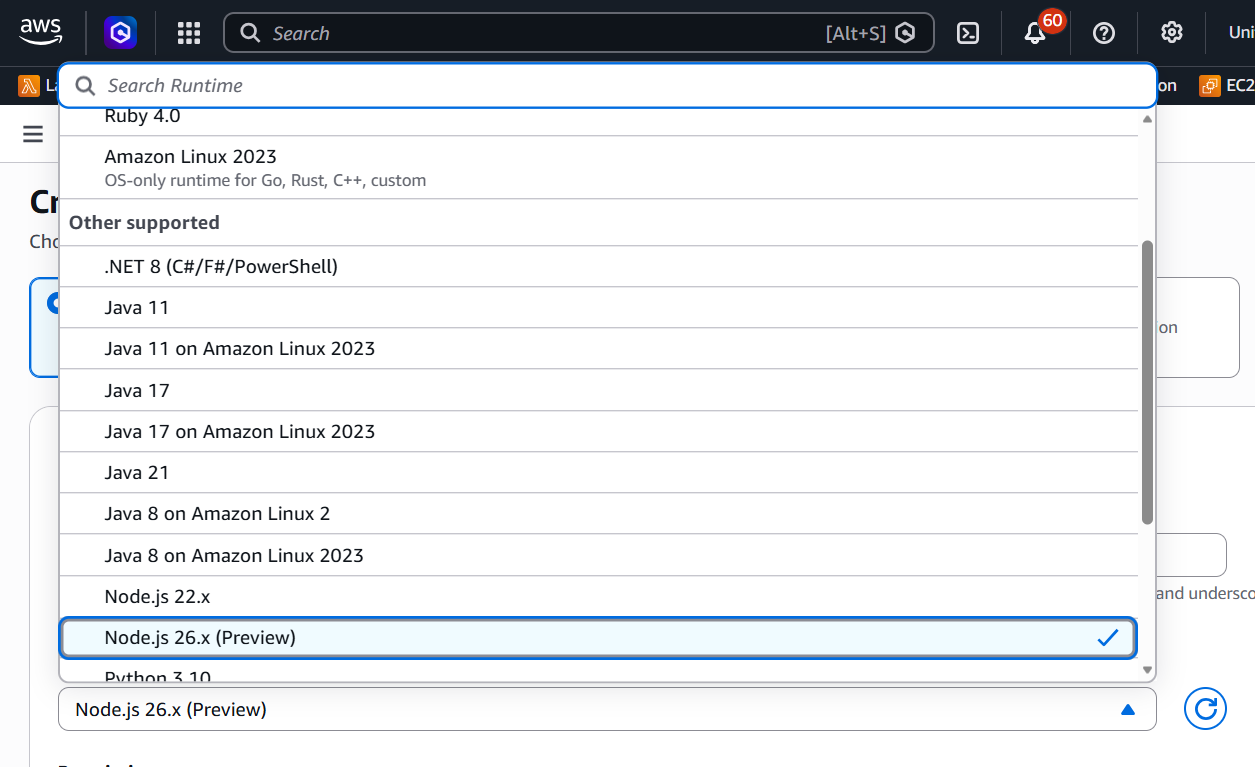
In the Lambda console, choose “Node.js 26 (Preview)” or “Python 3.15 (Preview)” from the runtime list when creating or updating a function.
AWS CLI
Create a function using the preview runtime with the standard runtime identifier:
For Python 3.15, use --runtime python3.15. These are the same identifiers the GA runtimes will use, there is no separate preview-specific value.
AWS CloudFormation
Specify the preview runtime in your CloudFormation template using the same runtime identifier:
AWS SAM
AWS SAM supports preview runtimes using the standard runtime identifier in your template:
When you run sam init, preview runtimes appear in the template list with a “(Preview)” label, so you can scaffold a new project directly.
AWS CDK
The AWS CDK does not yet include built-in enum members (such as Runtime.NODEJS_26_X). During the preview phase, you can use the public Runtime constructor to specify the runtime directly, for example:
Or, for Python 3.15, replace new Runtime("nodejs26.x", RuntimeFamily.NODEJS) with new Runtime("python3.15", RuntimeFamily.PYTHON).
This synthesizes identical CloudFormation to what a built-in enum produces. When the runtime reaches GA, a corresponding enum member will be added. There is no functional difference in the meantime.
Conclusion
Public preview runtimes give you a seat at the table while Lambda’s next runtimes are still taking shape. Try using Node.js 26 or Python 3.15 today to deploy a function, run your test suite, and let us know what you find.
Share feedback and follow along:
- Node.js 26 preview runtime – feedback and announcements
- Python 3.15 preview runtime – feedback and announcements
These GitHub issues are where we’ll post any enhancements or breaking changes during the preview period, so they’re worth watching even if you don’t have immediate feedback. The preview runtimes are available today in all AWS Regions, including AWS GovCloud (US), and the AWS China Regions. To learn more, see the Lambda runtimes documentation.