AWS Contact Center
The Self-Improving Supply Chain: What We’re Learning From Amazon Connect Decisions and AI Agents in Production
Today, supply chain teams are challenged by how long it takes to resolve urgent issues, and disruptions are estimated to cost the industry billions in losses each year. The problem isn’t a lack of trying. Teams are buried in coordination rather than focused on decisions. Legacy tools and processes can’t keep pace with a network that changes by the hour. We built Amazon Connect Decisions on a different premise. The people who run supply chains should spend their time making decisions to grow the business, and the system itself should learn and optimize to your needs.
Our mission is to help every business make faster, smarter supply chain decisions. Getting there means rethinking the relationship between teams, process and technology. Instead of tools that people operate, Amazon Connect Decisions agents work alongside your team to adapt and learn from your business. Amazon Connect Decisions harmonizes demand into consensus forecasts, generates constraint-aware supply plans, and provides actionable insights and recommendations with clear explanations you can trust. It helps drive business outcomes, prevent problems, resolve issues, and find root causes, combining decisioning backed with 30 years of Amazon operational science with 30+ specialized supply chain tools. It connects to your existing systems and adapts to your business, getting sharper with every decision your team makes.
Since Amazon Connect Decisions became generally available earlier this year, customers across manufacturing, CPG, and automotive have moved from pilot to daily operations. As a result, we’re seeing businesses run their supply chain operations with the help of our agents.
Customers Creating Value with Amazon Connect Decisions
Consider TVS Motor Company, a major manufacturer of two-and three-wheeler brands such as Apache, Jupiter, and the iQube electric scooter. Across its assembly plants and a network of hundreds of vendors, a single late part can stop a line, while excess safety stock ties up working capital. Its planners started each morning in spreadsheets, identifying critical parts and expediting reactively by phone, with no early warning and no systemic view of supplier reliability.
With Amazon Connect Decisions continuously watching the parts network 24/7, the team sees trouble coming instead of chasing it. As Baskaran Jayaraman, EVP Manufacturing, describes it, Amazon Connect Decisions “gives us forward-looking visibility into critical shortages for the same day and the next three to four days,” and “enables proactive action and system-level fixes instead of repeated short-term interventions.”
TE Connectivity, a global industrial technology leader, is one of the world’s largest makers of connectors and sensors, managing close to 200,000 active SKUs across more than 25 manufacturing plants. Its planners once triaged exceptions manually every day at high volumes which made pinpointing severity of issues a challenge. With Amazon Connect Decisions, exceptions are now ranked by financial impact, with specific order-level recommendations. The AI filters out the routine noise, so teams focus on what matters. According to Gautam Kamdar, Global Logistics & Supply Chain Leader at TE Connectivity: “We are working with Amazon Connect Decisions because we trust Amazon’s supply chain expertise and the solution adapts to our unique business and systems. The key things that stood out for us as a product vision were (1) learning from planner actions and data to constantly improve recommendations; (2) detecting patterns based on data to identify challenges planners couldn’t in their busy work; (3) the ability to automate actions in third party systems; and (4) last but not least ability to connect to our data sources without a ton of effort.”
What these stories share is a system that learns from both internal and external signals. That’s the shift: from software you configure once to AI that keeps getting better the more your team uses it. It learns from each decision your team makes, turning expertise into better recommendations over time.
Closing the gap between planning and execution
Planning is often one of the biggest challenges because real-world constraints rarely line up. Most teams close that gap by hand, in spreadsheets and email threads, and by the time they understand what changed, the window to act has usually passed. The institutional knowledge that keeps plans sane tends to walk out the door when experienced team members leave.
Amazon Connect Decisions closes the gap. Because the same system forecasts demand, builds the supply plan, and monitors execution, there is no handoff where context gets lost. When execution drifts from plan, the agents already know what the plan intended, why it was built that way, and what to do about it. It can act in your system once you approve, getting sharper each cycle.
How the Amazon Decisions work
Amazon Connect Decisions empowers businesses with faster and smarter decisions. It works alongside your team harmonizing demand signals into consensus forecasts, generating constraint-aware supply plans, and continuously monitoring operations to detect problems, identify root causes, and resolve them before they recur.
Using your existing environment, Amazon Connect Decisions provides full decisioning loop capabilities to plan, monitor, detect, root cause, recommend, act and learn. These capabilities are connected to your business’s systems and data.
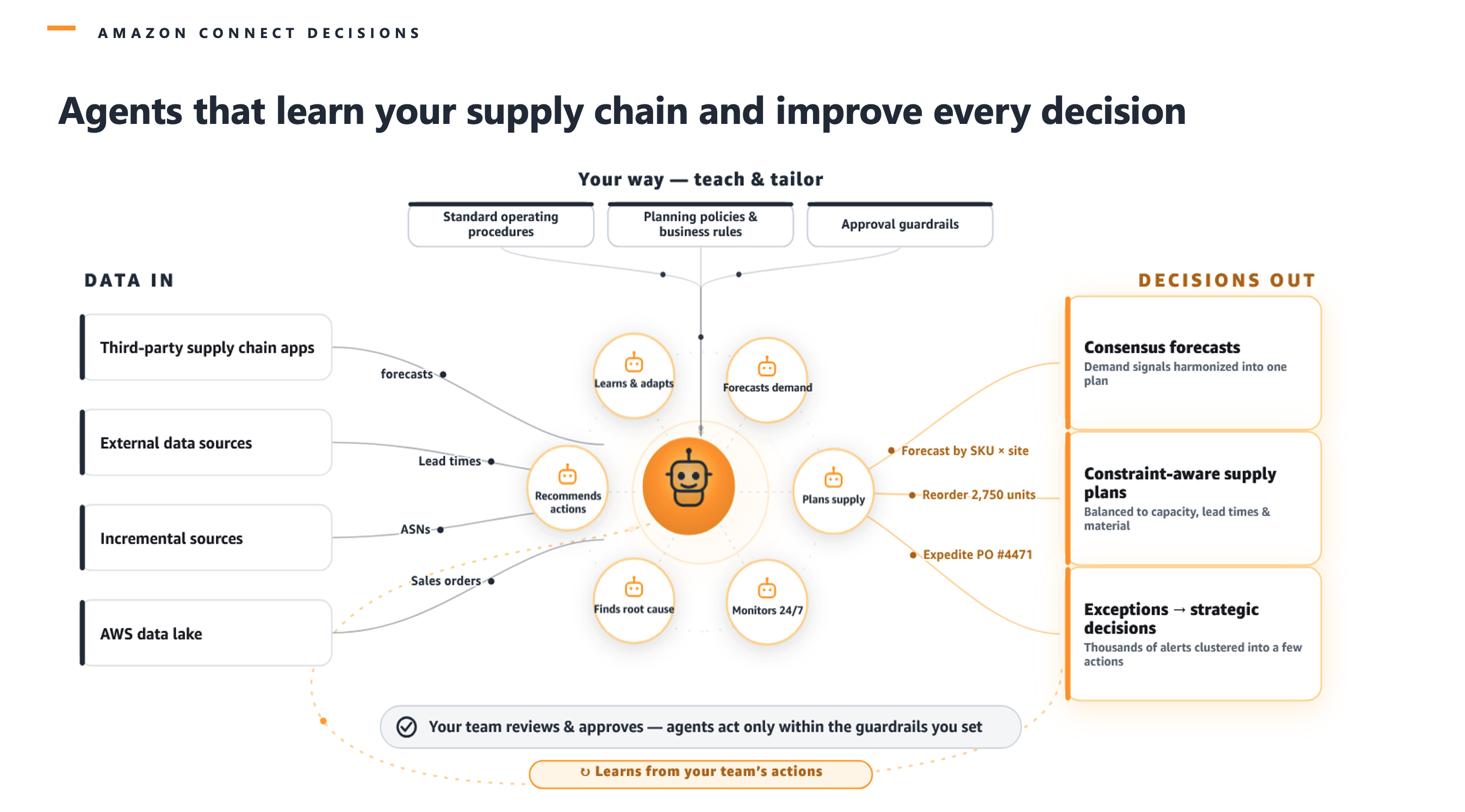
Getting started begins with Onboarding Intelligence. AI-powered onboarding agents guide you through setup in natural language conversation, and they help you ingest, prepare, and validate your data. From day one, they flag what is useful, what is missing, and what needs attention, so value starts as soon as you begin. You configure business rules, policies, and priorities in plain language with real-time previews. That configuration carries across the system allowing most teams to be up and running in weeks, not months.
Demand Intelligence takes the forecasting workload off your team, so planners focus on judgment calls instead of model tuning. It runs an ensemble of 20+ forecasting models alongside Amazon-built foundation models trained on decades of supply chain data. It picks the best model for each SKU and demand pattern, and it keeps tuning itself as patterns shift. For example it generates forecasts from day one, even with limited history, sparse demand, and new product launches. It then combines system-generated forecasts, customer forecasts, and cross-functional inputs through consensus planning.
Demand Intelligence also looks outside your business. A heat wave, flu season, a holiday, or a big sporting event can move demand in ways your sales history can’t predict. Amazon Connect Decisions finds signals like these in public sources, checks that they actually track demand for each product group, and feeds them into the forecast.
Supply Intelligence takes that demand signal, or a forecast from your existing system, and runs optimization models to build constraint-aware supply plans across your network. It flags projected exceptions and suggests plan adjustments before the plan moves into execution.
Adaptive Intelligence is the learning loop that runs across Amazon Connect Decisions, and it keeps every plan connected to what happens. Between planning cycles, Amazon Connect Decisions monitors your operations 24/7, detects exceptions, finds the root cause, and recommends what to do. Once you approve, they act directly in your existing systems. Planners don’t get a long queue of alerts. They get a short list of insights ranked by business impact, so they spend their time on the decisions that matter. This works whether you plan in Amazon Connect Decisions or in a planning system you already run.
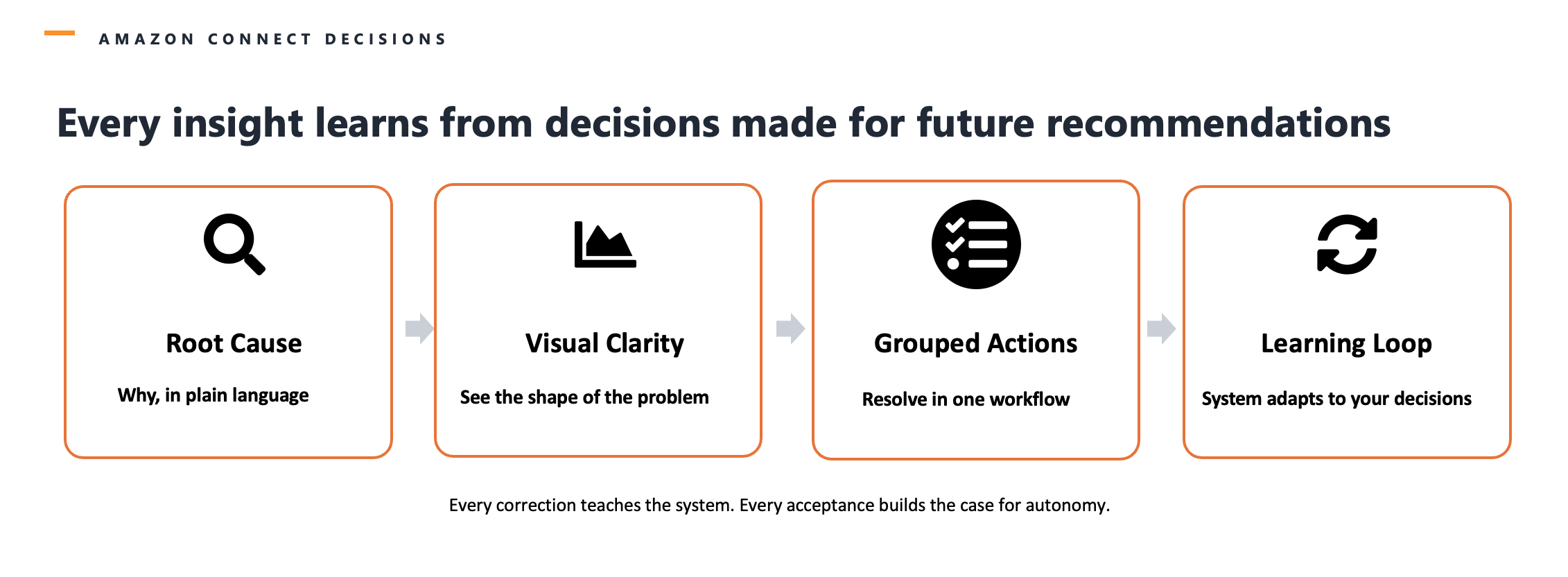
Every plan your team builds and every recommendation it reviews teaches the AI agents something. Forecasting improves as the system learns your patterns. Supply planning adapts to your priorities. Recommendations improve as the agents learn from the actions your team takes. Knowledge that used to live only in a veteran planner’s head becomes part of the system. When people move on, their expertise stays, and new people are productive on day one. Because Amazon Connect Decisions shares what it learns, an insight on the demand side sharpens decisions on the supply side, and the other way around.
The latest release closes the full loop
Many tools generate supply plans. What matters is keeping that plan connected to shifting demand, real-world constraints, planner decisions, and what happens in execution. With full loop capabilities generally available across Amazon Connect Decisions, customers are benefitting from AI agents in production.
RealTruck shows what this looks like in practice. Planning across tens of thousands of SKUs, as product families expand across vehicle year, make, model, bed configuration, and engine, had become too complex to scale by hand. With Supply Intelligence, RealTruck turns that complexity into actionable plans while cutting its reliance on spreadsheets and tribal knowledge.
Another early manufacturing customer needed to scale planning across a growing SKU portfolio while respecting finite production capacity and order requirements. Supply Intelligence generates a feasible 52-week plan that prioritizes demand fulfillment while balancing inventory and working within capacity. The customer cut the time to build its 52-week plan by 40% while managing 30% more SKUs without adding headcount, and now has better demand and inventory visibility for faster Sales and Operations Execution (S&OE) decisions.
What is new since preview brings this loop to life. Constraint-aware supply planning now applies inventory policies, capacity limits, supplier lead times, and production constraints across your network to generate optimized inventory, production, purchase, and placement recommendations, so teams start from a high-quality plan and focus on the decisions that need human judgment. An embedded AI agent explains the trade-offs behind each plan, diagnoses configuration issues, analyzes results, and helps fine-tune, moving teams faster from issue to cause to action. Together these connect demand, supply planning, and execution into one continuous process where each cycle feeds the next.
Get started
In this post, we showed you how Amazon Connect Decisions is helping businesses make use of AI agents in production. Contact AWS to learn more and try it with your own data or a preloaded industry dataset, and the onboarding agents will walk you through connecting, preparing, and validating your data in plain language. To learn more, visit the Amazon Connect Decisions product page.
About the Authors
 Jeet Dattani is Head of Product for AWS Applied AI Solutions, where he leads product management for Amazon Connect Decisions. He brings 15+ years of product management experience launching AI-based products across AWS, fintech, marketplaces, and Alexa.
 Rodrigo Celis is Director of Product Management (Technical) for AWS Applied AI Solutions. He owns the strategy and roadmap for Amazon Connect Decisions, drawing on 20+ years scaling enterprise software, e-commerce, and cloud services.
 Tinna Zhang is Senior Manager, Product Management Technical at AWS where she leads the supply chain domain for Amazon Connect Decisions. She drives the vision, customer experience, and platform capabilities behind agentic supply chain planning and intelligence.
 Dave Campbell is Head of Product Marketing for Amazon Connect Decisions at AWS.