Containers

Author: Marcio Morales
Marcio Morales is a Principal Specialist Solution Architect at Amazon Web Services, helping customers to migrate and modernize their infrastructure into AWS. He is the author of the book "Running Windows Containers on AWS" and a global SME for Windows containers. He helps AWS customers design, build, secure, and optimize Windows container workloads on AWS.

Monitoring Windows pods with Prometheus and Grafana
This post was co-authored by Cezar Guimarães, Sr. Software Engineer, VTEX Introduction Customers across the globe are increasingly adopting Amazon Elastic Kubernetes Service (Amazon EKS) to run their Windows workloads. This is a result of customers figuring out that refactoring existing Windows-based applications into an open-source environment, while ideal, is a very complex task. It […]

Domainless Windows Authentication for Amazon EKS Windows pods
Introduction .NET Developers commonly design Windows-based applications with Active Directory (AD) integration running on domain-joined servers to facilitate authentication and authorization between services and users. Since containers cannot be domain-joined, running these applications in a Windows-based containers required configuring group Managed Service Accounts (gMSA), domain-joined Kubernetes Windows nodes, webhooks and cluster roles to enable Windows […]

Windows Authentication on Amazon EKS Windows pods
Per Microsoft documentation: Windows-based networks commonly use Active Directory (AD) to facilitate authentication and authorization between users, computers, and other network resources. Enterprise application developers often design their apps to be AD-integrated and run on domain-joined servers to take advantage of Integrated Windows Authentication, which makes it easy for users and other services to automatically […]

Centralized Logging for Windows Containers on Amazon EKS using Fluent Bit
Introduction Today, Amazon Web Services (AWS) announced the support for Fluent Bit container images for Windows operating system. This support eliminates the need for Windows customers to implement any custom logging solutions in their application code or manage custom agents on their Windows nodes to scrape the logs. For more details about the supported Windows […]
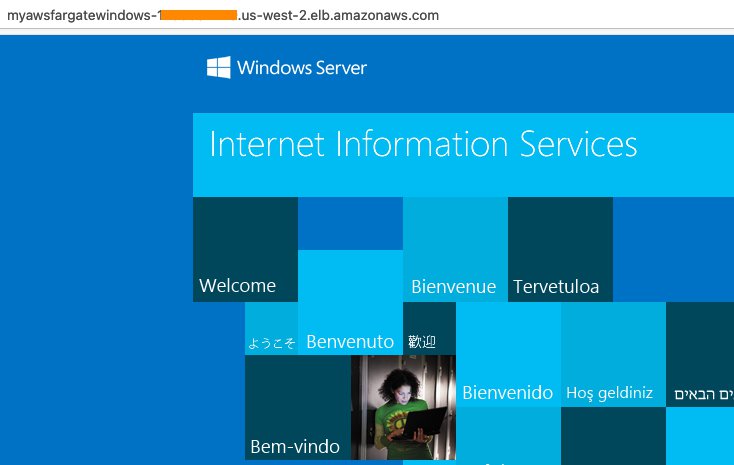
Running Windows Containers with Amazon ECS on AWS Fargate
At AWS, customers are running their most mission-critical workloads on Amazon Elastic Container Service (Amazon ECS) with Windows as their compute layer. Still, the undifferentiated heavy lifting of managing the underlying host OS, patching, scaling, and hardening when running Windows containers are time-consuming tasks. Therefore, customers can choose to use the optimized AMIs, which are preconfigured […]

Speeding up Windows container launch times with EC2 Image builder and image cache strategy
Update: On January 11, 2022, AWS announced the ability to launch Microsoft Windows Server instances up to 65% faster on Amazon Elastic Compute Cloud (EC2). Customers can flag any Amazon Machine Image (AMI) running Microsoft Windows Server to launch faster. Once flagged, every instance launched from the AMI will automatically launch faster. This is an […]

Using Amazon FSx for Windows File Server as persistent storage on Windows Containers
This post has been updated due a recent launch. Designed for simplicity from the start, Amazon ECS delivers an AWS-opinionated solution for running containers at scale. Previously, customers had to implement a lengthy workaround (detailed in the original blog post below) in order to use an Amazon FSx for Windows File Server as persistent storage […]
Streaming logs from Amazon EKS Windows pods to Amazon CloudWatch Logs using Fluentd
Containers are a method of operating system virtualization that allow you to run an application and its dependencies in resource-isolated processes. Containers allow you to easily package an application’s code, configurations, and dependencies into easy-to-use building blocks that deliver environmental consistency, operational efficiency, developer productivity, and version control. Using Windows containers allows you to get […]
Using Amazon FSx for Windows File Server on EKS Windows Containers
This blog post is deprecated and the solution is no longer valid. Please refer to the new solution that uses CSI Driver posted in the following blog post: Using SMB CSI Driver on Amazon EKS Windows nodes. Recently, we published a blog post on using Amazon FSx for Windows File Server as persistent storage for […]