Containers
Category: Containers
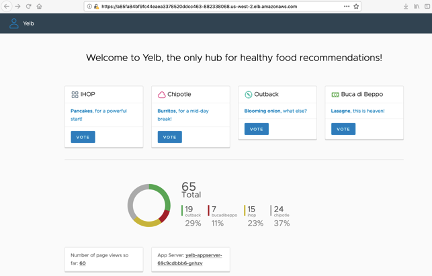
Securing Kubernetes applications with AWS App Mesh and cert-manager
NOTICE: October 04, 2024 – This post no longer reflects the best guidance for configuring a service mesh with Amazon EKS and its examples no longer work as shown. Please refer to newer content on Amazon VPC Lattice. ——– Updated Sept. 24, 2021 – This post has been amended to include a newly available option […]

Amazon Elastic Beanstalk introduces support for shared load balancers
AWS customers love using managed services because they can offload the undifferentiated heavy lifting associated with deploying applications while they focus on innovating to support their business. Throughout the years, this is why so many customers have opted to use Amazon Elastic Beanstalk to deploy their software artifacts. Customers can pick a runtime environment, point […]

Introducing security groups for pods
Security groups, acting as instance level network firewalls, are among the most important and commonly used building blocks in any AWS cloud deployment. It came as no surprise to us that integrating security groups with Kubernetes pods emerged as one of the most highly requested Amazon Elastic Kubernetes Service (Amazon EKS) features, as seen on […]

Creating Kubernetes Auto Scaling Groups for Multiple Availability Zones
Kubernetes is a scalable container orchestrator that helps you build fault-tolerant, cloud native applications. It can handle automatic container placement, scale up and down, and provision resources for your containers to run. While Kubernetes can take care of many things, it can’t solve problems it doesn’t know about. Usually these are called unknown unknowns and […]

OCI Artifact Support In Amazon ECR
By Shubhra Deshpande and Michael Hausenblas In the container roadmap issue 308 you asked us about making Amazon Elastic Container Registry (ECR) understand artifact types beyond container images. We now launched support for Open Container Initiative (OCI) artifacts, such as Helm charts. In this post we give you some background on OCI artifacts and walk […]

Automatically deploying your container application with AWS Copilot
Taking an application from idea to working implementation that people can interact with is a multistep process. Once the design is locked in and the code is written, the next challenge is how to deploy and deliver the application to users. One way to do this is using a Docker container and a tool like […]

ICYMI: AWS Cloud Containers Conference
On July 9th, the AWS Containers team hosted the first AWS Cloud Containers Conference (C3). The full day, virtual conference covered deep dives, launches, and demos on Amazon EKS, Amazon ECS, AWS Fargate, Amazon ECR, and AWS App Mesh. As well as, a keynote from GM of Kubernetes, Bob Wise, and closing remarks from Chief […]
Introducing the AWS Controllers for Kubernetes (ACK)
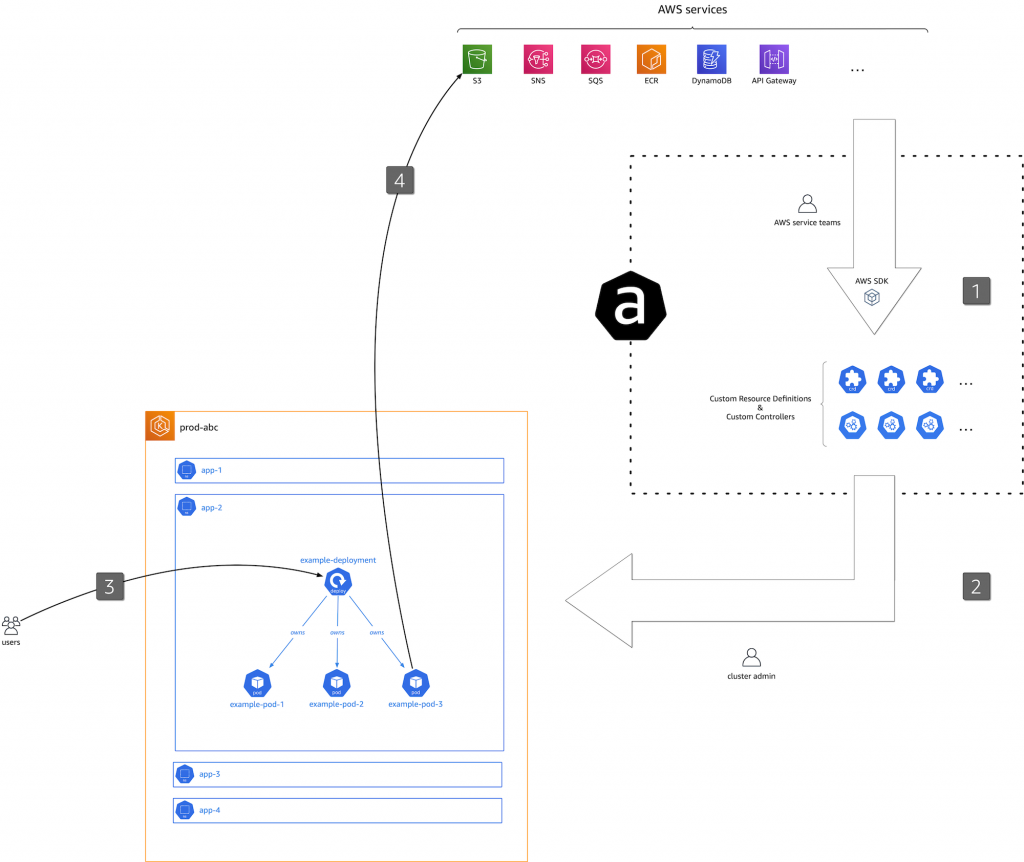
AWS Controllers for Kubernetes (ACK) is a new tool that lets you directly manage AWS services from Kubernetes. ACK makes it simple to build scalable and highly-available Kubernetes applications that utilize AWS services. Today, ACK is available as a developer preview on GitHub. In this post we will give you a brief introduction to the […]
Load balancing Amazon ECS services with a Kubernetes Ingress Controller style approach
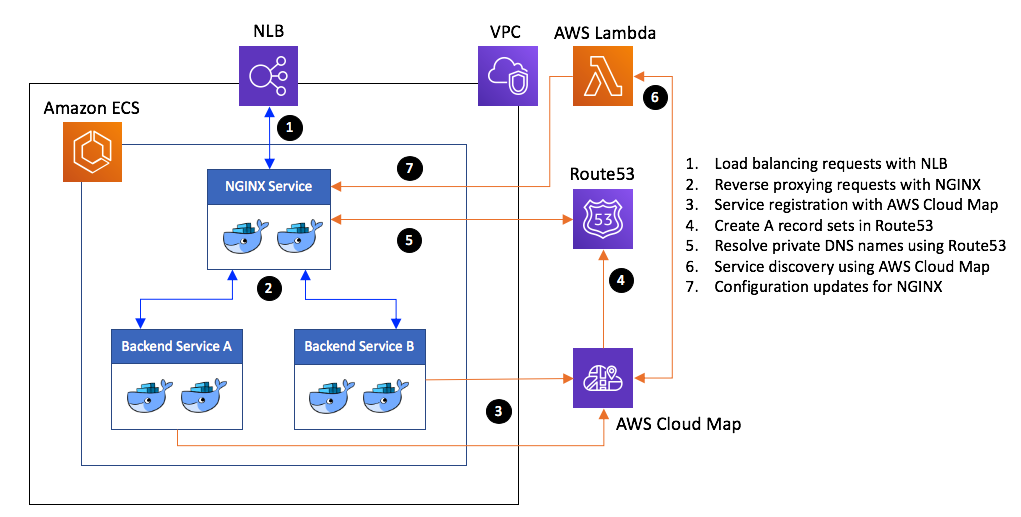
Introduction A common approach to traffic routing in a Kubernetes cluster is to employ an Ingress Controller. The Ingress Controller is an application that runs in a cluster in conjunction with a load balancer and routes incoming HTTP/HTTPS/TCP requests to proxied servers according to routing rules specified in Ingress resources. When deploying to either a […]

CI/CD pipeline for testing containers on AWS Fargate with scaling to zero
Development teams are running manual and automated tests several times a day for their feature branches. Running tests locally is only one part of the process. To test workloads against other systems as well as give access to QA engineers, it requires deploying code to dedicated environments. These servers/VMs spend hours idling because new test […]