Containers
Category: Management Tools

Access Logging Made Easy with AWS App Mesh and Fluent Bit
NOTICE: October 04, 2024 – This post no longer reflects the best guidance for configuring a service mesh with Amazon ECS and Amazon EKS, and its examples no longer work as shown. For workloads running on Amazon ECS, please refer to newer content on Amazon ECS Service Connect, and for workloads running on Amazon EKS, […]

Kubernetes Logging powered by AWS for Fluent Bit
September 8, 2021: Amazon Elasticsearch Service has been renamed to Amazon OpenSearch Service. See details. Centralized logging is an instrumental component of running and managing Kubernetes clusters at scale. Developers need access to logs for debugging and monitoring applications, operations teams need access for monitoring applications, and security needs access for monitoring. These teams have […]

Results of the 2019 AWS Container Security Survey
Security is a top priority in AWS, and in our service team we naturally focus on container security. In order to better assess where we stand, we conducted an anonymous survey in late 2019 amongst container users on AWS. Overall, we got 68 responses from a variety of roles, from ops folks and SREs to […]
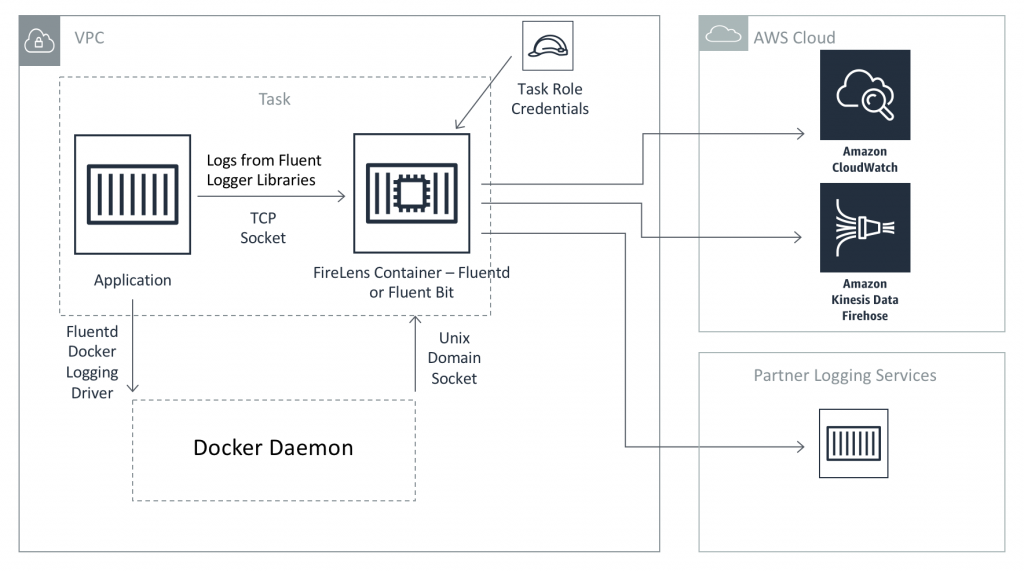
Under the hood: FireLens for Amazon ECS Tasks
September 8, 2021: Amazon Elasticsearch Service has been renamed to Amazon OpenSearch Service. See details. Recently, Amazon ECS announced support for custom log routing via FireLens. FireLens makes it easy to use the popular open source logging projects Fluentd and Fluent Bit; enabling you to send logs to a wide array of AWS Services and […]

Containers and infrastructure as code, like peanut butter and jelly
Infrastructure as code tools like AWS CloudFormation and HashiCorp Terraform enable teams to describe and automate provisioning of cloud infrastructure resources, including container-related resources like Amazon ECS services and Amazon EKS clusters. In this post, I cover why I believe infrastructure as code is especially important for containerized applications, how we use infrastructure as code with […]