AWS Database Blog
Category: RDS for MySQL

Best practices for configuring parameters for Amazon RDS for MySQL, part 3: Parameters related to security, operational manageability, and connectivity timeout
August 2025: This post was reviewed for accuracy. In the previous blog post of this series, I discuss MySQL parameters used to optimize replication in Amazon Relational Database Service (Amazon RDS) for MySQL and best practices related to them. In today’s post, I discuss the most important and commonly used MySQL parameters for implementing various […]
Best practices for configuring parameters for Amazon RDS for MySQL, part 2: Parameters related to replication
This blog post was last reviewed or updated May, 2022. In the previous blog post of this series, I discuss MySQL parameters used to tune and optimize Amazon Relational Database Service (Amazon RDS) for MySQL performance and best practices related to them. In today’s post, I discuss the most important MySQL parameters used for replication […]
Best practices for configuring parameters for Amazon RDS for MySQL, part 1: Parameters related to performance
This blog post was last reviewed or updated January, 2025. With Amazon Relational Database Service (Amazon RDS) for MySQL, you can deploy scalable MySQL servers in minutes with cost-efficient and resizable hardware capacity. Amazon RDS frees you up to focus on application development by managing time-consuming database administration tasks including backups, software patching, monitoring, scaling, […]
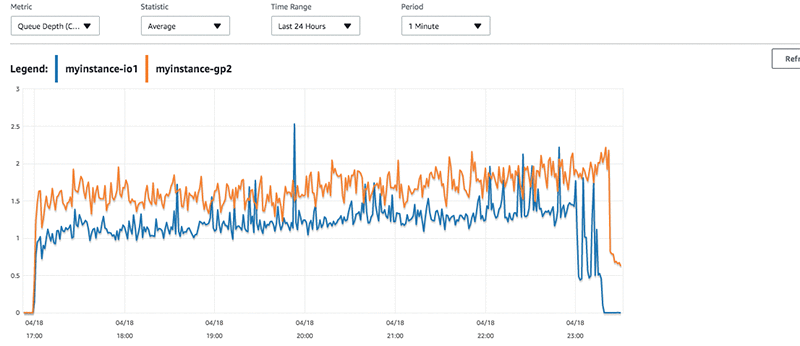
How to use CloudWatch metrics to decide between General Purpose or Provisioned IOPS for your RDS database
July 2023: This post was reviewed for accuracy. In this blog post, I talk about how you can use Amazon CloudWatch metrics to understand when you might benefit from provisioned IOPS, also known as IO1 volumes, for highest performance mission-critical database workloads. I start by setting up a test case that simulates a nonbursting consistent […]
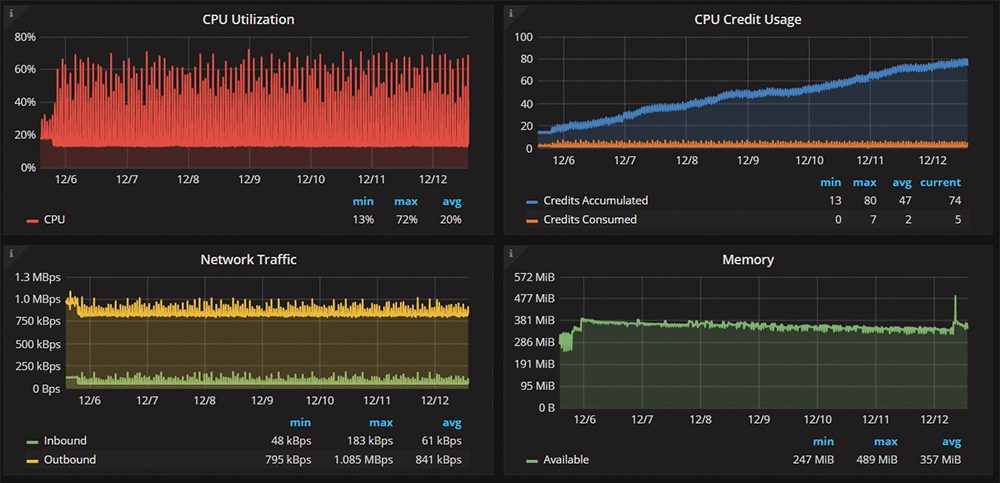
Supercharge your Amazon RDS for MySQL deployment with ProxySQL and Percona Monitoring and Management
So your organization is looking to deploy an application to the cloud, and you plan to use Amazon RDS for MySQL for the data tier… great! Let’s look at some of the best practices to ensure that you get the most out of your architecture.

Tuning Amazon RDS for MySQL with Performance Insights
Amazon RDS Performance Insights brings an intuitive tuning interface to Amazon RDS to help you discover and investigate performance issues on your RDS databases. The look and feel of Performance Insights is the same across all database engine types, such as RDS for MySQL, RDS for PostgreSQL, and Amazon Aurora. However, every engine has a […]

Recover from a disaster with delayed replication in Amazon RDS for MySQL
July 2023: This post was reviewed for accuracy. Amazon RDS for MySQL now supports a delayed replication, which allows you to set a time period that a replica database lags behind a source database. In a standard MySQL replication configuration, there is minimal delay between the source and the replica. Now you have the option […]

Best practices for migrating RDS for MySQL databases to Amazon Aurora
MySQL is the most popular open-source database in the world. However, many customers find that the undifferentiated heavy lifting of backups, high availability, and scaling of MySQL databases to be complex, time-consuming, or both. This is one of the leading reasons why customers move their existing MySQL footprint to Amazon RDS for MySQL. Amazon RDS […]

Build a notification mechanism to manage Amazon RDS manual snapshots
It’s no secret that data is an essential part of running a business, no matter how large or small a business may be. Many companies host their business data using relational databases. As a result, backup and recovery are important aspects of keeping the business running. Amazon RDS customers use a mixture of strategies to […]

Cal Poly’s software engineering capstone class builds MySQL capture and replay on AWS
At California Polytechnic State University, the software engineering school’s capstone class was created in support of the university’s “Learn by Doing” philosophy. Students in the class experience over the course of a full school year what it’s like to work on a collaborative industry project. This is Dr. David Janzen’s tenth year teaching this course, […]