AWS for Industries
Highlights from the 2026 AWS Life Sciences Symposium: Research and Drug Discovery
Across the life sciences industry, scientists are fundamentally reshaping how they design experiments, interpret data, and close the loop between computation and the lab bench—and AI agents are accelerating the entire arc of discovery.
At the 2026 AWS Life Sciences Symposium earlier this month, leaders from Sanofi, Genentech, Noetik, Apheris, Bristol Myers Squibb, Memorial Sloan Kettering, and more demonstrated how they’re using agentic AI today to accelerate scientific discovery and improve patient outcomes.
Three capabilities reshaping research
Throughout the symposium, the foundation for research innovation took shape around three interconnected capabilities:
- Connecting the physical and digital lab — instrumenting wet labs so that experimental data flows automatically into computational systems, closing the loop between hypothesis and result.
- Building a unified, FAIR, and governed data foundation — giving AI agents the scientific context they need to reason, so that insights are grounded in trusted, accessible data.
- Putting powerful AI tools directly in the hands of scientists — from biological foundation models to autonomous research agents, so that every researcher, not just a specialized few, can harness the full power of AI in their daily work.
Together, these three pillars define what it means to build a true lab-in-the-loop.
The track opened with a vision-setting session, grounding the audience in why this moment matters: despite remarkable scientific progress, drug discovery remains constrained by the immense complexity of human biology—staggering combinatorial spaces of cells, compounds, and molecular interactions, with gaps in knowledge exchange that persist across therapeutic areas, organizations, and disciplines. The convergence of richer biological data, modern data foundations, and a new generation of AI is beginning to close those gaps, and the key is building the connective tissue between them to accelerate insights in a virtuous cycle. That is the essence of lab-in-the-loop.
Closing the loop: AI-assisted antibody design with Amazon Bio Discovery
One of the marquee announcements of the day, first unveiled in the morning keynote and brought to life in this session, was the launch of Amazon Bio Discovery.
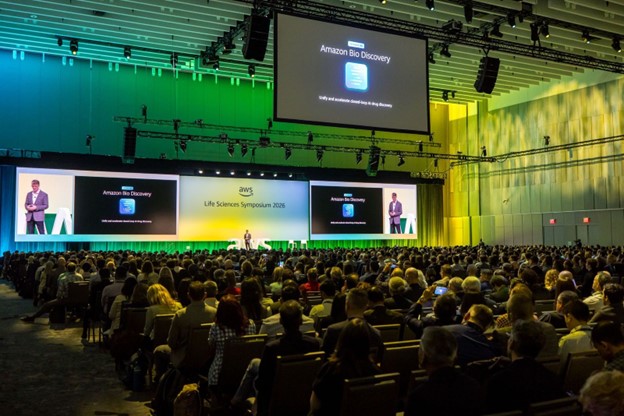
Amazon Bio Discovery is a unified application purpose-built for AI-driven antibody discovery, designed to address the most common pain points holding lab-in-the-loop workflows back: too many models to evaluate, fragmented data, and the persistent challenge of coordinating in silico experiments with wet-lab validation. The application brings these together in a single, secure, scalable environment, offering agentic AI assistants that guide scientists through model selection, experiment design, and candidate evaluation in scientific terminology rather than code; access to a catalog of over 40 open source and commercial biological foundation models; head-to-head model benchmarking; and model training, all through a click-through UI so that any scientist can run sophisticated discovery workflows from day one.
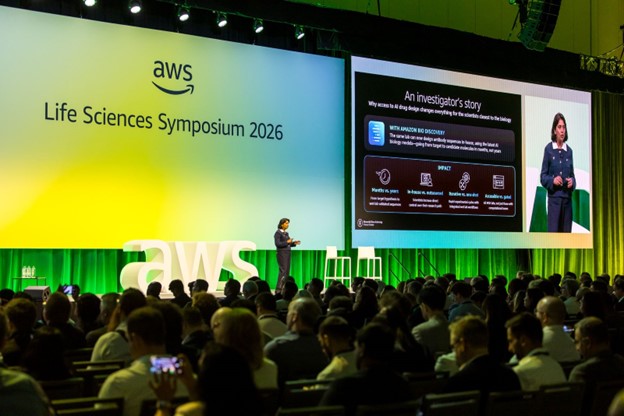
In a compelling case study with Memorial Sloan Kettering (MSK), the team used Amazon Bio Discovery AI agents to design de novo nanobody binders against a novel desmoplastic small round cell tumor (DSRCT) target, without any experimental protein structure or prior antibody data for that target. Using three de novo design methods (RFantibody, IgGM, and mBER), the team generated over 288,000 candidate sequences, filtered them using multi-objective Pareto optimization, and sent the top candidates to Twist Bioscience for wet-lab validation. The result: 46 confirmed binders with a top candidate achieving sub-nanomolar affinity of KD = 0.66 nM, going from target to lab validation in weeks. Twist Bioscience served as the CRO partner, contributing deep expertise in antibody engineering and biophysical characterization, and exemplifying how the Amazon Bio Discovery CRO partner network extends lab-in-the-loop capacity beyond a company’s own walls.
The session also introduced the Antibody Developability Benchmark Dataset, developed in partnership with the Gray Lab at the Johns Hopkins Whiting School of Engineering. The benchmark is powered by the largest and most diverse antibody dataset in public literature and encompasses 50 seed antibodies across four structural formats (IgG, VHH, NearGermline-IgG, and scFv), targeting 42 distinct antigens, with up to 99 engineered variants per seed. The dataset evaluates six key developability traits: expression, purity, thermostability, aggregation, polyreactivity, and hydrophobicity, all validated through wet-lab experiments. It provides the rigorous benchmarking foundation the field has long needed to evaluate AI models and supports zero-shot inference so that models can be evaluated without prior exposure to the dataset. The benchmark results are now available as part of Amazon Bio Discovery.
Boltz rounded out the session by previewing its proprietary foundation model, coming soon to Amazon Bio Discovery, adding protein-protein affinity prediction and developability filters on top of improved foundation models. Boltz demonstrated a compelling inference-time scaling law: hit rates continue to improve as more designs are generated, with continued gains observed from 60,000 to 180,000 designs. It was a fitting close to the session—a reminder that Amazon Bio Discovery is designed as an extensible application, where the best models in the field can be benchmarked, integrated, and put directly in the hands of scientists running real discovery campaigns.
Accelerating discovery cycles: Sanofi’s centralized lab-in-the-loop on AWS
Sabya Dasgupta, Head of R&D Data Platforms and Products, and Pradeep Bandaru, Head of Platforms and AI Workflows, from Sanofi shared how one of the world’s largest pharmaceutical companies is building enterprise-scale lab-in-the-loop capabilities on AWS.
The core insight from Sanofi’s journey: context is the new compute. Even with better pipelines, AI agents that lack scientific context will repeat recommendations that were already attempted, interpret data without experimental understanding, and scale up bad decisions instead of good ones.
Sanofi’s answer is SWEL—scientific workflow experience labs—the scientific operating layer that makes AI agents contextually aware and orchestrates complex compute chains. Built on AWS and powered by Amazon Bedrock AgentCore, SWEL propagates context up through every layer of the discovery stack: from AI-driven design and SIPS (Sanofi’s Unified Data Foundation), through automated experimentation, orchestration and compute chains, to scientific reasoning agents that know molecule history, prior cycles, design rationale, and failure modes.
The results speak for themselves: SWEL shipped its minimum viable product (MVP) in 2.5 months, now powers over 50 scientific workflows, provides access to over 20 PB of scientific data products, and has enabled 2–3 times more projects in the same timeframe with 10 times faster deployment.
A standout use case was AI Autolead—a continuously learning medicinal chemistry system that screens over 1 billion enumerated molecules per cycle from a feature space of more than 10¹³ possible structures, using 100s of ADME and target AI models and 28 validated reactions. The result: a more than 50% reduction in molecules generated per program with higher hit quality, with routine de novo design now running across all modalities.
On the data infrastructure side, AWS demonstrated how agentic code generation can significantly accelerate instrument data converter development, reducing development from weeks to minutes. In one evaluation covering 20 instrument file types, the approach achieved a 100% pass rate on ASM (Allotrope Simple Model) format conversion, compared with 35% for zero-shot generation. AWS is making this sample code library available as open source. AWS also presented a “connectivity factory” model designed to help organizations onboard in-house labs in months rather than years.
Beyond research agents: Roche’s Galileo platform
Arick Huensche, Global Head and VP Diagnostics R&D at Roche spoke to how Roche is deploying agentic AI at enterprise scale across more than 90,000 connected lab instruments.
Roche’s Galileo platform—an agentic AI platform built on Amazon Bedrock and Bedrock AgentCore—isn’t a research prototype. It’s production infrastructure that serves over 70,000 users, with 29 agents deployed across Roche’s DIA R&D domain. The platform enables AI agents to move data, extract metadata, validate results, and orchestrate workflows—turning complex scientific processes into natural language interactions while preserving rigor and traceability.
Two protocol innovations took center stage. Model Context Protocol (MCP)—used through AgentCore Gateway—allows Roche to expose hundreds of lab instrument APIs, LIMS/ELN connectors, and bioinformatics pipeline triggers as MCP tools without rewriting underlying systems. Agent-to-Agent (A2A) protocol enables autonomous collaboration across agent frameworks and vendors, with defined task lifecycle states and cross-framework interoperability across Strands, LangGraph, CrewAI, Google ADK, and OpenAI SDK.
Arick’s key takeaways for the industry: scope agents to jobs-to-be-done (not broad functions), invest heavily in data foundations before agent ambitions, and treat governance as a feature, not a constraint. In regulated environments, built-in compliance accelerates adoption because scientists trust what they can audit.
From an AWS tools perspective, Brian Loyal demonstrated how customers are adopting AgentCore for workflows in data science, bioinformatics, and lab process automation – so teams can move faster without sacrificing scientific rigor. The AWS Sample Agents for Life Sciences provides working samples for customers to get started and extend their AgentCore ecosystem.
Scaling AI science factories: Lila Sciences
Bob Gantzer, VP of Next Generation Platform at Lila Sciences, presented a bold vision for what can be achieved with a lab-in-the-loop: the AI Science Factory.
Lila is building a single model—a scientific intelligence—with access to the tools necessary to conduct the full wheel of science: a knowledge base, universe simulator, computational tools, and AI science factories. The goal is to reinvent the scientific method itself, enabling self-play in the lab through full parametrization of instruments, dynamic execution, and scaled data pipelines.
A compelling demonstration showed Lila’s seamless mRNA design-to-experimentation workflow from generative AI molecule selection through automated synthesis, ADME assay execution, and ML model retraining—all orchestrated through scientific graphs. Lila’s mRNA designs have demonstrated industry-leading in vivo performance, and the platform is now being deployed across proteins, RNA, DNA, small molecules, catalysts, nanoparticles, and beyond.
Advancing AI models for biology: Data-driven model training
The final session brought together Ron Alfa, CEO and Co-Founder, Noetik, Robin Roehm CEO and Co-Founder, Apheris, and Payal Sheth, SVP, Therapeutic Discovery Sciences, Bristol Myers Squibb, for a deep dive into the frontier of biology foundation model training.
AWS framed the landscape: the cumulative number of published foundation models relevant to drug discovery has grown from 1 in early 2021 to 226 by mid-2025, spanning protein and molecule structures, single-cell transcriptomics, bioimaging, DNA sequences, and multimodal data. AWS offers a full spectrum of model customization options, from fine-tuning with Amazon Bio Discovery and serverless customization in Amazon Bedrock, to large-scale distributed training on Amazon SageMaker HyperPod and frontier model development with Amazon Nova Forge. Nova Forge enables organizations to build custom frontier models by blending proprietary data with Amazon Nova checkpoints and curated training data—at 10–100 times less cost than building from scratch.
BMS and Apheris shared the next chapter of the AI Structural Biology (AISB) Network—a pharma-to-pharma federated AI network now operating across nine leading companies. The AISB-1 federated co-folding model, trained across five companies in under 10 weeks, achieved 51% on the fraction of structurally reliable binding-site interactions (LDDT greater than 0.8); compared to 34% for the OpenFold3 baseline and 39% for the average single-company fine-tuned model. AISB-1 is now available in Amazon Bio Discovery. AISB-2 is in development, using orders of magnitude more proprietary data across structural, quantitative affinity, and HTS-scale binary activity data, targeting a broader, more generalizable foundation model for structure-enabled virtual screening, lead optimization, and off-target screening.
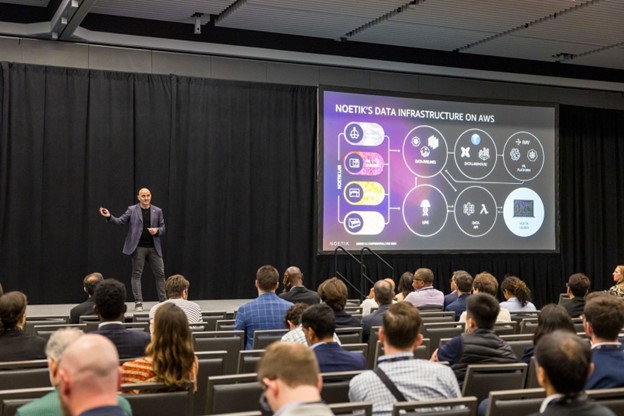
Noetik closed the session with a provocative thesis: AI drug discovery has spent a decade training on the wrong data: cell lines, mouse models, and public datasets. Noetik’s approach starts from real human data: commercially sourced, wholly owned human tumor specimens (FFPE), processed through a patent-pending robotics-assisted workflow and paired with H&E, protein, spatial RNA, and DNA data. Their foundation models—trained on this multimodal patient dataset—have demonstrated zero-shot inference with a 56% objective response rate (ORR) in a Noetik-identified population, compared to 8% in the original trial. Scaling laws hold for biology: performance increases substantially with model size and context length, with no signs of plateau.
The era of agentic discovery is here
Across every session, a unified narrative emerged: the future of drug discovery isn’t about more models or more compute—it’s about context, orchestration, and closing the loop between intelligence and experimentation.
The 2026 AWS Life Sciences Symposium’s Research and Drug Discovery Track made clear that agentic AI is no longer a future promise. It’s production infrastructure at Sanofi, Roche, BMS, and beyond. It’s validated science at MSK. It’s a new asset class at Noetik. And it’s the foundation upon which the next generation of medicines will be built.
At AWS, we’re proud to partner with the life sciences industry at this pivotal moment; providing the compute, the models, the data infrastructure, and the agentic frameworks that turn scientific ambition into patient impact. The era of agentic discovery is here. The question is no longer whether to build—it’s how fast.
Contact an AWS representative today to learn how we can help your organization accelerate what’s next.