AWS for Industries
How Multi-Agent AI Is Changing the Way CPG and Retail Brands Manage Advertising at Scale
A consumer packaged goods (CPG) brand advertising across multiple categories—snacks, beverages, personal care, household essentials—can easily accumulate hundreds of active Sponsored Products campaigns, well within Amazon’s 10,000-campaign account limit. Its campaign analyst starts Monday morning like this:
They open the reporting dashboard to check weekend performance. The back-to-school snacks campaign dropped 22 percent in return on ad spend (ROAS) after a competitor launched a coupon. They switch to another tool to pull historical bid data by Amazon Standard Identification Number (ASIN), then open the internal wiki to find the team’s playbook on mid-flight optimization during promotional periods. After 20 minutes of research, they navigate to the campaign management console to increase the daily budget from $800 to $1,200 and shift targeting toward higher-converting pack sizes. One campaign down, 82 to go.
This isn’t unusual. According to a Gartner survey (May 2026), only 16 percent of marketing work is currently automated by AI—meaning the vast majority of campaign operations still run on manual effort. In 2025, Gartner’s CMO Spend Survey found that 59 percent of chief marketing officers (CMOs) report insufficient budget to execute their strategy, even as marketing budgets remain flat at 7.7 percent of company revenue.
For CPG and retail brands managing hundreds of SKUs across seasonal peaks, Prime Day, back-to-school, and holiday windows, the operational burden compounds fast. Budgets aren’t growing, headcount isn’t scaling, but campaign complexity is—and that gap is where multi-agent AI fits in.
A different model: one conversation, many specialists
What if the campaign analyst could type: “The snacks campaign is underperforming since the competitor coupon launched. What does our promo-defense playbook recommend, and can you increase the daily budget to $1,200?”—and the system handled the rest?
That’s the premise of a multi-agent AI system built on Amazon Web Services (AWS). Instead of one monolithic assistant, the architecture uses focused specialist agents coordinated by a central orchestrator. Each agent owns a single domain, and the orchestrator uses Amazon Bedrock to understand intent and route each request to the right specialist.
The Amazon Ads solutions architecture team demonstrated this in a hands-on workshop, showing how brands can assemble a production-ready multi-agent system on AWS.
The architecture: hub-and-spoke with specialist agents
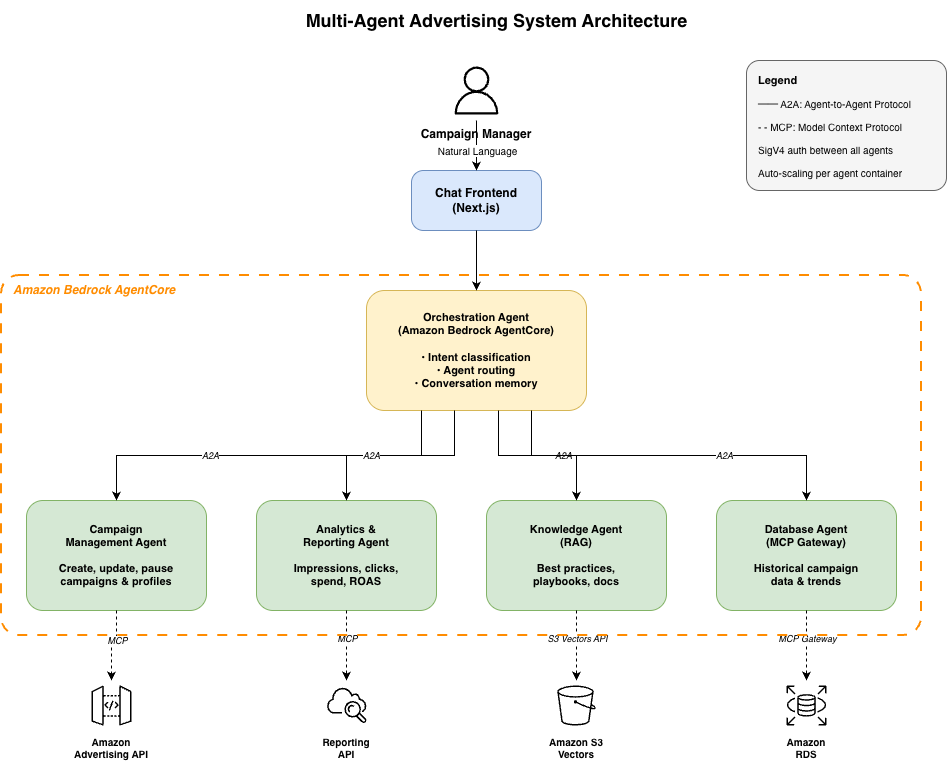
Figure 1: Logical architecture diagram
An orchestration agent receives natural language requests and delegates to four specialists:
- Campaign Management Agent: Creates, updates, and pauses campaigns and advertising profiles through the Amazon Advertising API and Amazon Ads MCP Server. Handles actions such as budget changes, targeting adjustments, and campaign launches across product categories.
- Analytics and Reporting Agent: Pulls performance data (impressions, clicks, spend, ROAS, share of voice) across campaigns, categories, and date ranges. Useful for weekly business reviews and real-time promotional monitoring.
- Knowledge Agent: Searches a curated library of category-specific advertising playbooks stored as semantic embeddings. When a brand manager asks, “What’s our approach when a competitor launches a coupon in snacks?” it retrieves strategies grounded in proven methods—not generic advice.
- Database Agent: Queries historical campaign data in Amazon Relational Database Service (Amazon RDS) for trend analysis across seasonal windows, year-over-year comparisons, and custom reporting by category or SKU.
Each agent runs in its own container on Amazon Bedrock AgentCore, scales automatically and independently, and discovers other agents automatically through the Agent2Agent (A2A) protocol. Adding a new specialist—say, a Seasonal Planning Agent—requires zero changes to the orchestrator.
How it works in practice
Campaign Analyst: “Show me weekend performance for snacks and beverages campaigns.”
→ Analytics Agent queries the reporting API → returns ROAS, spend, and impression data by category.
Campaign Analyst: “The snacks campaign dropped after the competitor coupon. What does our promo-defense playbook say?”
→ Knowledge Agent searches the best-practices library → returns the section on bid escalation and budget reallocation during competitive promotions.
Campaign Analyst: “Increase the snacks daily budget to $1,200 and shift targeting to the 24-pack ASINs.”
→ Campaign Agent calls the Amazon Advertising API → confirms the changes.
Three systems, one conversation, under two minutes. Amazon Bedrock AgentCore Memory maintains context across turns, so the analyst doesn’t re-explain which campaign they mean in each follow-up.
The business outcomes
For a business decision maker (BDM) or CMO, the question isn’t what the system does—it’s what measurable results it drives. The following figures are directional, grounded in the before-and-after of the workflow described earlier rather than a specific customer deployment, but they point to where the value lands.
Reclaim analyst capacity—roughly 10x more campaigns optimized per hour. In the manual workflow, one mid-flight optimization takes about 20 minutes across four tools. In the multi-agent workflow, the same decision—pull performance, consult the playbook, execute the change—happens in under two minutes in a single conversation. That’s an order-of-magnitude gain in how many campaigns a single analyst can touch per hour, which translates directly into lower cost-to-serve and headcount that scales with strategy instead of SKU count.
Give hours back to the team every week. Those 18 minutes saved per optimization add up fast at category scale. An analyst managing about 80 campaigns through a single weekly review cycle reclaims roughly 24 hours—more than half a workweek—that would otherwise go to tool-switching and manual research. Directionally, that’s time redirected from operational mechanics toward the strategic work—creative testing, category planning, competitive positioning—that budgets and headcount are actually meant to fund.
Protect ROAS during the windows that matter most. When a competitor drops a coupon, ROAS erosion compounds every hour the response is delayed. Compressing time-to-action from hours to minutes—a directional 80–90 percent reduction in response lag—means less spend wasted on underperforming placements and more revenue captured during Prime Day, back-to-school, and holiday peaks, when a disproportionate share of annual sales is on the line.
Defend and grow share of voice at category scale. Because the system scales independently across dozens of categories and hundreds of SKUs, no category team waits in line while another runs its Monday review. Faster, more consistent optimization across the full portfolio helps hold share of voice where competitors are pressing—the leading indicator of market share in crowded CPG categories.
Reduce execution variance across the team. With category playbooks, seasonal strategies, and promo-defense tactics in the Knowledge Agent, a new hire executes closer to the level of a senior brand manager. The potential outcome is more consistent campaign performance across the team and less dependence on the tribal knowledge of a few experts.
Take a fast, low-risk path to value. Start with two agents for the highest-volume category and expand as results prove out—the orchestrator discovers new specialists automatically, so there’s no re-architecture cost to scaling adoption. The investment can grow in step with the returns it generates rather than requiring a large upfront commitment.
The technology stack
- Amazon Bedrock AgentCore: Managed runtime for agent deployment, scaling, and SigV4-authenticated agent-to-agent communication.
- Amazon Ads MCP Server and APIs: These are MCP tools and APIs to integrate with Amazon Ads.
- Agent2Agent (A2A) Protocol: Enables dynamic agent discovery throughpublished capability cards.
- Amazon S3 Vectors: Semantic search over category playbooks and best-practices documentation using Amazon Titan Text Embeddings V2.
- Amazon Bedrock AgentCore Memory: Conversation continuity for multi-step workflows.
Getting started
The full workshop takes about three hours; a fast-track path takes roughly one hour.
For CPG and retail brands managing growing advertising portfolios across categories, seasons, and competitive dynamics, multi-agent AI means less time on operational mechanics and more time on the strategic decisions that drive market share.