AWS for Industries
Run HPC Simulations faster with Siemens Teamcenter and AWS ParallelCluster
Manufacturing organizations can now reduce simulation cycle times from days to hours by integrating Teamcenter Simulation with AWS ParallelCluster — eliminating high performance compute (HPC) queuing bottlenecks while maintaining full data traceability. The demand for high-fidelity engineering simulations such as Computational Fluid Dynamics (CFD), Finite Element Analysis (FEA), and Multi-physics analyses continues to grow as manufacturing organizations pursue product innovations. These simulations require massive computational resources that traditional on-premises infrastructure struggles to deliver cost-effectively. At the same time, managing the lifecycle of simulation data and workflows across distributed teams remains a critical challenge. Simulation Process and Data Management (SPDM) addresses this by centralizing simulation data, making it organized, reusable, and fully traceable for regulatory compliance. As a secure, metadata-enriched repository, SPDM also accelerates AI model development by enabling informed data selection for more efficient training.
In this blog, we explore how Teamcenter Simulation, Siemens’ SPDM solution, pairs with AWS ParallelCluster for HPC job execution and Amazon FSx for NetApp ONTAP as a shared storage layer to deliver a seamless end-to-end simulation workflow. This combination accelerates product engineering with full data traceability, enabling faster decision-making through standardized processes that connect simulation results to broader product development data.
The challenge: simulation at scale
Modern product development relies heavily on digital engineering workflows, including Computational Fluid Dynamics (CFD), Finite Element Analysis (FEA), and Multi-domain system simulations. These workloads are computationally intensive, data-heavy, and time-sensitive. Yet, for many organizations, the simulation process itself has become a bottleneck rather than an accelerator.
Traditional on-premises High Performance Computing (HPC) environments struggle to keep pace. When simulation demand spikes during critical design reviews or product launches, fixed infrastructure forces engineers to queue jobs, wait for resources, or compromise on fidelity. Analysis teams frequently work with stale or incorrectly versioned data, and program managers often lack real-time visibility into simulation results without direct analyst involvement. These inefficiencies translate directly into delayed product launches and increased development costs.
Beyond performance limitations, on-premises deployments present significant operational challenges such as transferring large simulation files (often tens to hundreds of gigabytes) between the data management system and the HPC compute environment, aging security postures, limited disaster recovery capabilities, and high capital expenditure for infrastructure that sits idle during off-peak periods. As the number of design variants and associated simulations grows exponentially, the challenges compound further.
Teamcenter Simulation
Teamcenter Simulation is a Simulation Process and Data Management (SPDM) solution designed for engineers and analysts working on engineering workflows. Built on Teamcenter, a Product Lifecycle Management (PLM) solution within the Siemens Xcelerator business platform of software, this tool enables comprehensive management of simulation and physical testing processes, data, tools, and workflows. It seamlessly integrates with existing product data, providing complete traceability and visibility to all stakeholders. By utilizing Teamcenter Simulation, engineering teams can collaborate effectively throughout the digital thread, ensuring a cohesive and efficient product development process.
AWS HPC for simulation workloads
While Teamcenter Simulation delivers robust data and process management capabilities, running large-scale simulation jobs requires elastic HPC infrastructure. This is where AWS ParallelCluster and AWS Parallel Computing Service (AWS PCS) prove transformative, providing the on-demand compute power needed to handle demanding workloads efficiently.
AWS ParallelCluster is an open-source cluster management tool that makes it easy to deploy and manage High Performance Computing clusters on AWS. It automates the provisioning of compute nodes, networking, storage, and job schedulers, enabling engineers to spin up a fully configured HPC environment in minutes and scale it elastically based on workload demand. With support for popular job schedulers such as Slurm, AWS ParallelCluster integrates seamlessly into existing simulation workflows.
For organizations seeking a fully managed alternative, AWS PCS provides a managed service that makes it easier to run and scale HPC workloads and build scientific and engineering models on AWS using Slurm.
The combination of Teamcenter Simulation and AWS HPC services creates a powerful end-to-end simulation pipeline. Teamcenter manages the simulation data, processes, and traceability, while AWS ParallelCluster or AWS PCS provide the elastic compute backbone to execute those simulations at scale. Engineers can submit simulation jobs directly from within Teamcenter workflows, with results automatically captured and versioned back into the PLM system maintaining full traceability across the product lifecycle.
Simulation process flow
To deliver on-demand scalability, enhanced resiliency, and manage high-volume simulation data, we have defined an architecture to orchestrate consistent, accurate, and accessible data flows through different systems. In the architecture below, Teamcenter services run on multiple Amazon EC2 instances with either Amazon Relational Database Service for Oracle or Amazon Relational Database Service for SQL Server as the fully managed database. The Teamcenter volume is provisioned using FSx for NetApp ONTAP. AWS ParallelCluster is configured with a Head Node and scalable Compute Nodes, with Simcenter STAR-CCM+ installed on a FSx for NetApp ONTAP volume accessible to both, ensuring consistent data access across the entire cluster.
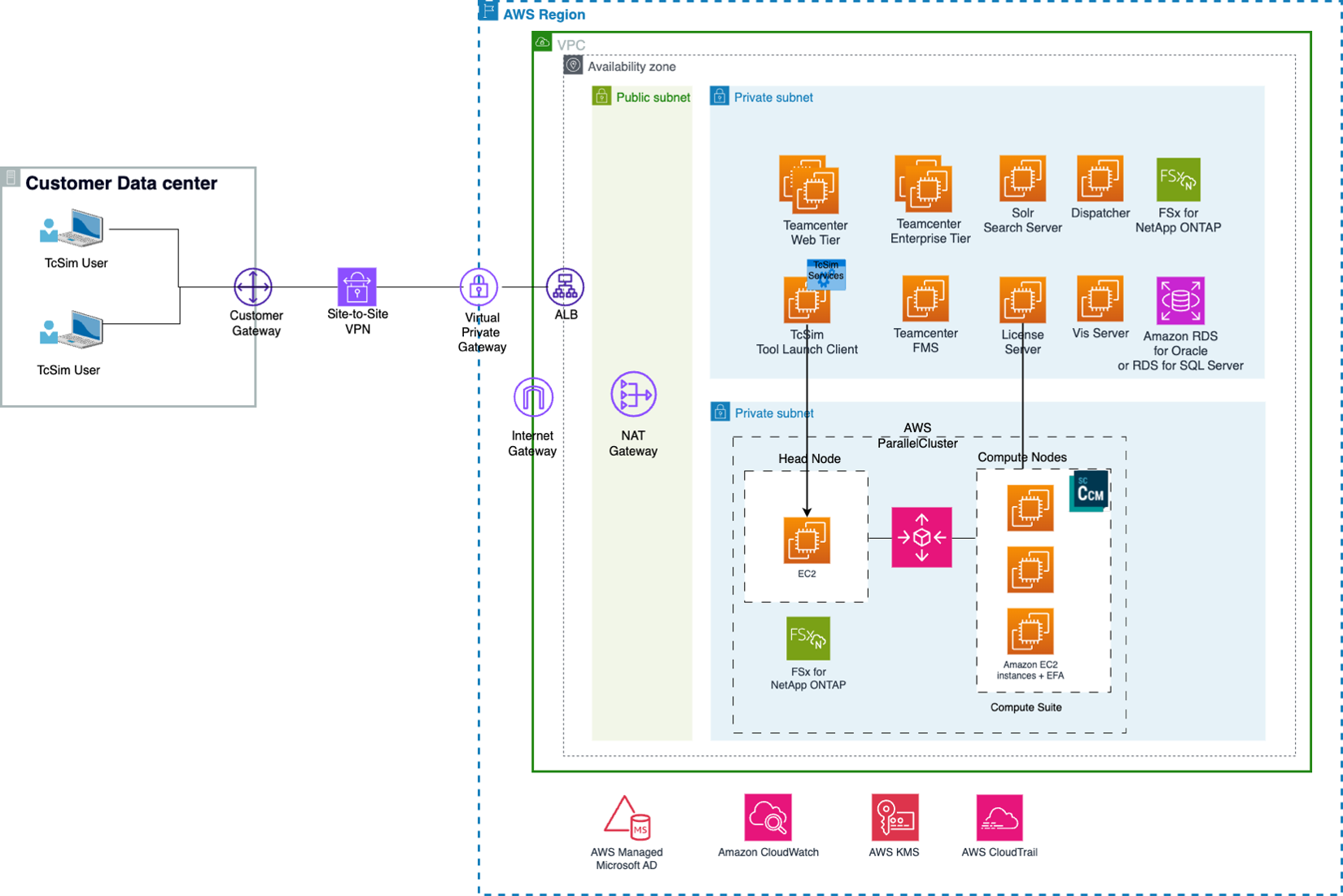
Figure 1: Siemens Teamcenter Simulation with AWS ParallelCluster Architecture
The architecture integrates Teamcenter Simulation, FSx for NetApp ONTAP, and AWS ParallelCluster into a seamless engineering workflow:
Simulation job preparation (Teamcenter Simulation on AWS)
Engineers access Teamcenter Simulation through the Active Workspace client, where they can quickly locate the latest design iteration of the product, select the appropriate simulation study, configure solver parameters, and launch the job. Teamcenter Simulation then automatically stages all required input files to the designated staging location on the FSx for NetApp ONTAP volume, eliminating manual file management and reducing the risk of version errors.
Data staging (FSx for NetApp ONTAP)
FSx for NetApp ONTAP provides a shared file system accessible to both the Teamcenter environment and the ParallelCluster nodes. The multi-protocol capability of FSx for NetApp ONTAP ensures that Teamcenter servers (which may run on Windows with SMB) and ParallelCluster nodes (Linux with NFS) can both access the same data in the staging location seamlessly.
Job submission and execution (AWS ParallelCluster)
Teamcenter Simulation triggers job submission to the ParallelCluster’s Slurm scheduler via Simulation tool integration. The Slurm scheduler queues the job and the ParallelCluster automatically provisions the required compute nodes. Compute nodes read input files directly from the staging location on FSx for NetApp ONTAP volume, whose high-throughput capabilities ensure that storage never becomes a bottleneck, allowing even large simulation models (multi-GB mesh files) to be read efficiently. The simulation solver executes, writing intermediate files and results back to the FSx for NetApp ONTAP volume. Upon job completion, ParallelCluster terminates the compute nodes, avoiding cost accrual.
Results and post-processing (Teamcenter Simulation on AWS)
Teamcenter Simulation detects job completion and automatically imports result files back into Teamcenter volume and the engineers can visualize the results using the Simulation Result Viewer in Teamcenter.
Benefits of running Teamcenter simulation with AWS HPC
Scalability: AWS ParallelCluster enables organizations to scale HPC compute resources dynamically in response to real-time simulation demand. This eliminates the queuing bottlenecks that plague fixed on-premises clusters and ensures that engineers have access to the compute they need, precisely when they need it. Resources are automatically terminated after job completion, ensuring that organizations only pay for what they use.
Cost optimization: Traditional HPC infrastructure requires significant upfront capital investment and ongoing maintenance costs regardless of utilization. AWS ParallelCluster’s elastic model transforms HPC from a capital expense into an operational one. Additionally, teams can take advantage of cost-optimized instance types, including Reserved Instances and Savings Plans, to further optimize their HPC workload spending.
Security and reliability: AWS’s global infrastructure provides customers with the option to deploy Teamcenter across multiple Availability Zones and Regions for high availability and disaster recovery scenarios. Sensitive product data such as Bill of Materials, CAD files, FEA models, and simulation results are encrypted at rest and in transit using AWS security services, designed to meet the stringent compliance requirements of regulated industries.
Faster time to market: By combining Teamcenter Simulation’s streamlined workflow management with the scalable compute capacity of AWS ParallelCluster, engineering teams can reduce simulation cycle times. Design studies that previously took days can be completed in hours, enabling faster design iterations and more informed decision-making earlier in the product development process.
Integration with the digital thread: With Teamcenter Simulation serving as the SPDM backbone, all simulation inputs, outputs, and metadata are managed in context with the broader product data. AWS ParallelCluster jobs are orchestrated within this framework, ensuring that every simulation result is traceable back to the specific product version, design parameters, and engineering requirements that drove it. This comprehensive end-to-end traceability forms the foundation of an enterprise digital thread.
Powering AI/ML pipelines through simulation data management: As simulation becomes increasingly embedded in the design cycle and the success of AI/ML solutions depends very heavily on getting access to properly contextualized datasets for algorithm training, structured simulation data management becomes essential. Teamcenter Simulation delivers an organized, traceable data foundation that provides informed data selection for efficient model training, enabling models to better recognize patterns, generate predictions, and offer design recommendations. As organizations leverage AWS services to run and scale HPC workloads, producing growing volumes of new data, curating that data for integrated AI/ML pipeline development becomes a critical priority. SPDM systems are evolving beyond simple data repositories into centralized AI platforms for CAE processes which support intelligent, data-driven engineering.
Conclusion
Integrating Teamcenter Simulation with AWS ParallelCluster represents an effective solution for cloud-based engineering simulation. This combination enables manufacturers to tackle their most computationally intensive workloads, including large-scale crash simulations and full-vehicle CFD analyses, with agility, scalability, and cost efficiency. By utilizing AWS’s cloud native services, organizations can establish a Well-Architected SPDM solution that delivers the security, performance, and scalability required for effective product lifecycle management.
AWS Marketplace offers a comprehensive range of Siemens Digital Industries Software solutions. Explore the full list of Siemens products available on AWS Marketplace and visit the official partnership website to learn more about the collaboration between AWS and Siemens.
Special thanks to additional contributors to this blog including:
- Vedanth Srinivasan (Head of Solutions for Engineering & Design and GTM, AWS)
- Emad Mankbadi (Principal Partner Solutions Architect, AWS)
- Wouter Dehandschutter, PhD (Product Management Director at Siemens Industry Software)
- Tilman Schroeder (CTO – Automotive and Manufacturing, NetApp, Inc)