AWS for Industries
x402 and Agentic Commerce: Redefining Autonomous Payments in Financial Services
How the x402 Protocol Lets AI Agents Transact Autonomously, and What That Means for the Financial Services Industry
Introduction
Financial services industry (FSI) organizations have invested significantly in AI, deploying agents that can analyze market data, assess credit risk, monitor compliance, and generate insights at a speed and scale no human team can match. Yet for most of these organizations, a fundamental gap remains: AI agents still cannot pay for things on their own.
Consider an AI research agent that needs to pull a premium data feed to scan for arbitrage opportunities, but must stop and wait for a human to authorize access to that feed. Or a claims processing agent that can assess a loss in seconds but queues a vendor’s payment through a procurement workflow that takes days. The intelligence is autonomous. The payments are not.
There is structural friction, since traditional payment systems were designed for human-to-business interactions. They require account setup, API key management, and billing relationships that are incompatible with the speed and scale of AI operations. The result is a growing gap between what AI agents can do and what they are allowed to do end-to-end.
The scale of what’s at stake is significant. McKinsey projects that agentic commerce — where AI agents transact autonomously on behalf of businesses and consumers — will mediate $3 trillion to $5 trillion of global commerce by 2030, with the US B2C retail market alone seeing up to $1 trillion in orchestrated revenue. The implications are directly tied to financial services organizations, which sit at the center of every transaction in that economy.
Our study focuses specifically on x402 and what it means for payments and FSI organizations. In this post, you will learn how x402 works, where it fits across FSI use cases, how to build solutions on AWS for both the agent and provider sides, and how to get started with a reference implementation.
For broader context on agentic commerce and its implications for the payments value chain, the AWS Industries blog Agentic Payments: The Next Evolution in the Payments Value Chain provides a solid foundation — this post builds on that picture rather than repeating it.
Where x402 Fits in Financial Services
Developed by Coinbase, x402 revives HTTP’s long-dormant 402 Payment Required status code and transforms it into a programmable payment rail for autonomous AI systems. x402 natively makes payments possible between clients and servers, creating economies that empower agentic payments at scale. The concept is straightforward: when an agent requests a resource or service, the server responds with a status 402 response and a payment specification. The agent evaluates the cost, executes a USDC micro-payment on-chain, and resubmits the request with a payment receipt. This all happens within a single automated exchange, with sub-2-second settlement and transaction costs of approximately $0.0001.
For example, imagine a research agent that needs to read a single financial news article behind a paywall. Today, that requires a subscription, an account, and a billing relationship — none of which an agent can set up on its own. With x402, the agent receives a payment request, pays for that one article on the spot, reads it, and continues its workflow, without need for a subscription or human involvement. The same logic applies to a compliance agent that needs a one-time sanctions screening, a credit decisioning agent that needs a single bureau query, or a trading agent that needs a real-time data snapshot for a specific market event.
There is no pre-registration or subscription required with x402, so agents can pay per use, on demand. Every transaction is recorded on-chain, providing a full audit trail by design. And because payments are denominated in USDC, cryptocurrency volatility is not a factor for enterprise deployments.
x402 is a general-purpose protocol; retailers, media companies, logistics providers, and SaaS platforms are exploring it.
Payments organizations, however, are particularly well-positioned to adopt and extend it because understanding payment infrastructure, settlement, and compliance is their core competency.
The payment friction that x402 addresses shows up wherever AI agents need to access third-party data or services as part of an automated workflow. Across FSI, the pattern is consistent: agents are capable of doing the work, but stop at the point of payment. In capital markets, trading agents need real-time market data and alternative data feeds but are constrained by subscription models that don’t fit per-query usage. In lending and credit, decisioning agents drawing on bureau data, income verification, and fraud signals face the overhead of managing separate vendor relationships for each source. In compliance, agents monitoring transactions across jurisdictions need continuous access to sanctions lists and regulatory feeds that today require standing contracts. In insurance, treasury, and wealth management, the same friction applies: agents that need on-demand access to specialized data are blocked by procurement models designed for standing human relationships, not event-driven AI consumption.
Building with x402 on AWS: Two Sides of the Equation
For teams building in financial services, x402 creates value on two distinct sides: the agent side (builders deploying AI agents that need to pay for services) and the merchant/data provider side (organizations that want to expose their data or services for autonomous, pay-per-use consumption). AWS provides purpose-built infrastructure for both.
For agent builders: Amazon Bedrock AgentCore
Amazon Bedrock AgentCore is AWS’ managed infrastructure for building, deploying, and operating production-grade AI agents. Rather than assembling compute, authentication, state management, and secrets handling from individual services, AgentCore provides these as an integrated stack: a managed runtime that scales automatically, an API gateway with IAM SigV4 authentication, built-in session memory for multi-turn conversations, and native Secrets Manager integration for credentials like wallet keys.
For x402 specifically, this matters because a payment-capable agent needs all of these capabilities working together. The agent must scale with transaction volume, authenticate callers securely, remember what content was requested across conversation turns, and access wallet credentials without embedding them in code. AgentCore provides this out of the box, so builders can focus on the x402 payment logic rather than infrastructure plumbing. An agent built on AgentCore with x402 integration can access x402-enabled data providers on demand — without requiring the builder to negotiate vendor contracts, manage API keys, or build custom billing integrations for each data source.
- Sample: AgentCore + CloudFront + x402 Payments — A reference implementation showing the full integration of Amazon Bedrock AgentCore with x402 for autonomous agent payments
For merchants and data providers: Amazon CloudFront with Lambda@Edge
On the other side of the transaction, financial data providers, news services, analytics platforms, and other content owners can expose their services for x402-based consumption using Amazon CloudFront with Lambda@Edge. This allows HTTP-based applications and data services to become x402-enabled and respond to agent requests with a 402-payment specification. This lets them validate on-chain payment receipts and serve content without rebuilding the underlying application. For FSI data providers, this is a direct path to making existing services accessible to the growing network of autonomous AI agents.
Together, these two capabilities cover the full x402 transaction: AgentCore on the agent side, CloudFront + Lambda@Edge on the provider side. AWS has published reference implementations for both:
- Sample: x402 Content Monetization with Amazon CloudFront and AWS WAF — Reference implementation for gating and monetizing content at the edge, with AWS WAF-based access controls alongside x402 payment verification.
- Sample: Monetize Any HTTP Application with x402 and CloudFront + Lambda@Edge — A practical guide to enabling x402 payments on any HTTP-based application using AWS infrastructure.
Business Case for FSI Organizations
The organizations that own the payments value chain: banks, payment processors, card networks, and insurers, are not just potential users of x402. They are the natural operators and enablers of this infrastructure.
Cost alignment. Traditional data access runs on fixed subscriptions regardless of actual usage. A compliance team paying for a sanctions screening service uses a fraction of its contracted capacity in a quiet month, and can’t scale up cost-effectively during a high-volume period. With x402 on AWS, that changes: an agent pays for exactly the queries it runs, scaling seamlessly with demand. For organizations managing dozens of data vendor relationships, the aggregate impact on cost structure is meaningful.
Speed. In capital markets, the window for acting on a data signal can close in seconds. An agent that must wait for a human to authorize a data purchase, or that can’t access a real-time feed because no standing subscription exists, misses that window entirely. Sub-second payment settlement means the agent can acquire the data and act within the same workflow execution.
Compliance by design. Every x402 transaction produces an immutable on-chain record: what was accessed, when, by which agent, and at what cost. For FSI organizations subject to audit requirements around data sourcing and model inputs such as fair lending, model risk management, transaction monitoring, an audit trail now exists without additional instrumentation.
Operational efficiency. The overhead of managing API keys, vendor contracts, and billing relationships for each data source is a real cost that scales with the number of integrations. x402 removes that overhead at the protocol level. An agent can access x402-enabled providers without IT involvement, procurement cycles, or custom integration work.
Ecosystem access. A growing number of AI-native data provider types such as real-time market feeds, alternative data sources, and specialized research services are building products with pay-per-use models that don’t fit traditional enterprise procurement. x402 makes those providers accessible to FSI agents without requiring a bilateral commercial relationship for each one.
Getting Started
The diagram below illustrates one reference implementation of the x402 payment flow on AWS; showing how an AI agent and a content provider complete a payment-gated transaction end-to-end.
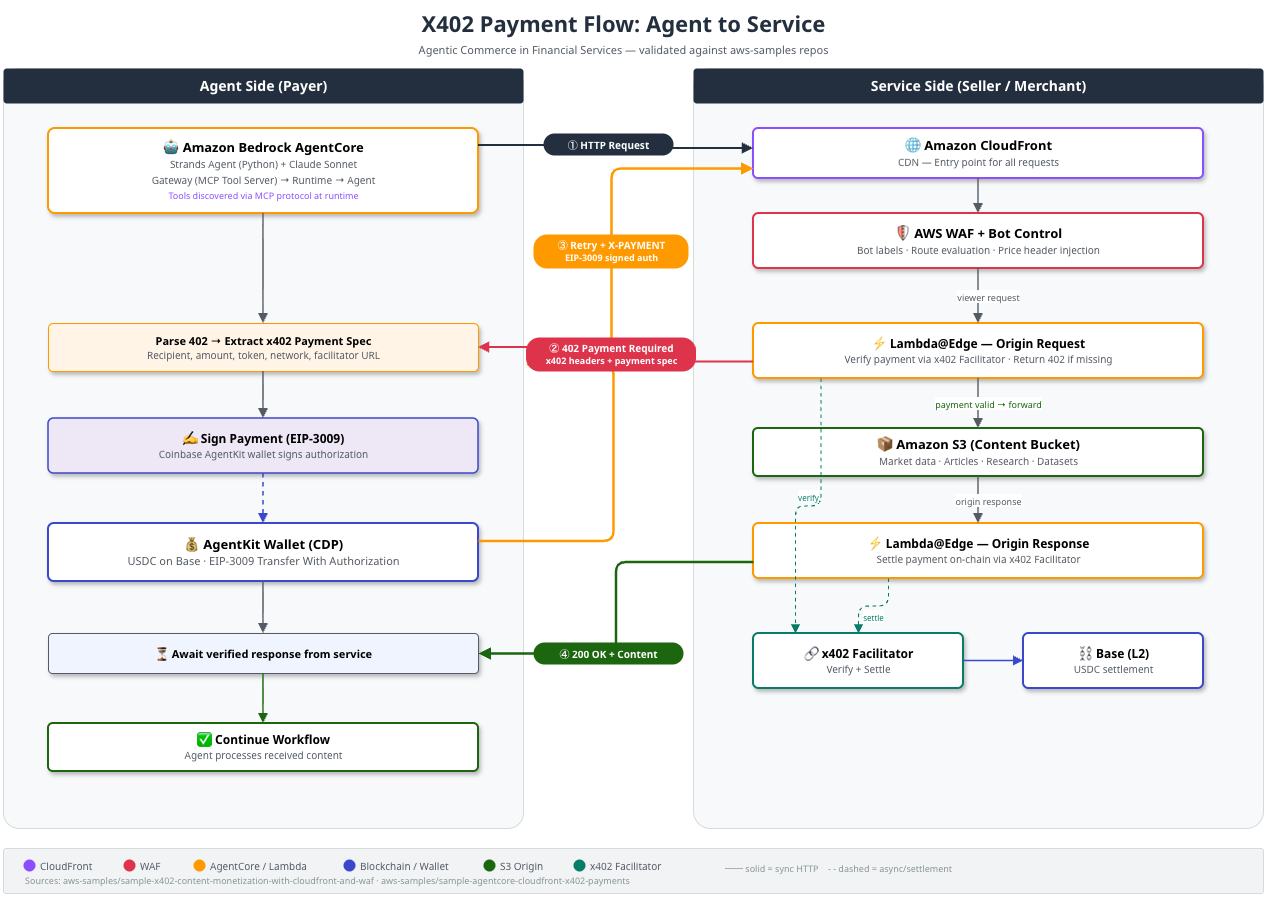
Figure 1: Architecture diagram of the x402 payment flow between an AI agent and a CloudFront-protected content provider on AWS.
This reference architecture shows the x402 handshake between an AI agent built on Amazon Bedrock AgentCore (using Strands SDK and Coinbase AgentKit) and a content provider protected by Amazon CloudFront, AWS WAF, and Lambda@Edge. The agent requests a resource, receives an HTTP 402 response containing payment instructions, signs a USDC micropayment authorization, and resubmits the request, with the x402 Facilitator handling on-chain verification and settlement on Base (the blockchain network used for on-chain settlement in this implementation).
While this example uses AgentCore and CloudFront, the x402 protocol is platform-agnostic. HTTP-capable agent frameworks including LangChain, CrewAI, and AutoGen, as well as HTTP-based origin servers or API gateways can participate, across languages. The only requirement is support for the HTTP 402 response.
For FSI organizations and agent builders ready to explore x402 on AWS:
- Sample: AgentCore + CloudFront + x402 Payments
- Sample: x402 Content Monetization with CloudFront and WAF
- Sample: Monetize Any HTTP Application with x402 and CloudFront + Lambda@Edge
- Amazon Bedrock AgentCore — Managed infrastructure for building and operating production AI agents on AWS
- Coinbase AgentKit Repository — Additional reference implementations and setup guides
- Agentic Payments: The Next Evolution in the Payments Value Chain — Broader context on Agentic Commerce in financial services
Organizations can begin with a testnet deployment using Base Sepolia (Base Sepolia is a testnet: a specialized blockchain used as a testing environment where developers and users can experiment) to validate workflows and compliance requirements before moving to production. AWS account teams can provide guidance on integrating x402 into existing AI and payments infrastructure.
Conclusion
In this post, you learned how x402 closes the payment gap that has limited autonomous AI workflows in financial services, and how AWS infrastructure supports both sides of that transaction. x402 provides the payment layer that autonomous AI workflows in FSI have been missing. Amazon Bedrock AgentCore provides the enterprise infrastructure to deploy those agents at scale. CloudFront with Lambda@Edge gives data providers and merchants the tools to expose their services for autonomous consumption. Together, they give FSI teams a complete foundation that provides reasoning and decision-making to autonomous payment execution and meets the security, compliance, and operational requirements of financial services organizations.
This blog is part of the AWS Financial Services Industry series. For technical implementation details, visit the AWS sample repository and Amazon Bedrock documentation