Migration & Modernization
Accelerating Cloud Migration with AWS Transform and Generative AI
Introduction
Our Cloud Value Framework series explores how AWS delivers business value across five pillars: cost savings, staff productivity, operational resilience, business agility, and sustainability. These pillars focus on benefits after workloads are running in the cloud. Strategic migration planning helps organizations achieve these outcomes faster. But this journey requires investment in the Cost of Change: the resources, time, and effort to move to the cloud. Generative AI technologies, like AWS Transform, are fundamentally changing this equation. By applying Agentic AI, foundational models, and graph neural networks to migration workflows, organizations can dramatically reduce migration timelines and costs.
In this post, we explore how generative AI is revolutionizing cloud migration economics, with real-world results and a quantified business case showing the impact.
The Cost of Change in Cloud Migration
When building a cloud migration business case, organizations often focus on comparing steady-state on-premises and cloud costs. However, the Cost of Change is a substantial investment that must be part of any ROI calculation.
Key components include:
- Discovery and Assessment: application inventory, dependency mapping, infrastructure analysis.
- Planning and Design: migration strategy, wave planning, architecture design.
- Migration Execution: workload migration, testing, validation.
- Training and Change Management: staff upskilling, process changes.
- Dual Running: parallel operation of on-premises and cloud environments during transition.
McKinsey research projects $3 trillion in cloud value for Forbes Global 2000 companies by 2030. The vast majority driven by business innovation and operations improvements, not IT cost savings alone. However, initial migration costs are substantial and impact near-term ROI. Organizations must also consider opportunity costs. Enterprise migrations can span 18+ months, tying up technical resources. The resources could otherwise drive AI-powered products, business process innovation, or customer experience improvements.
This makes reducing Cost of Change critical. Faster migrations lower direct costs and free resources for strategic initiatives sooner.
How Generative AI Transforms Migration Economics
Generative AI is reshaping every phase of cloud migration. AI capabilities now span automated discovery, dependency mapping, predictive risk analysis, intelligent workload prioritization, cost forecasting, and post-migration optimization. Together, these reduce the manual effort, errors, and timelines that traditionally drive up the Cost of Change. McKinsey research indicates generative AI can reduce cloud migration time by 30–40%, with some tasks seeing even greater improvements.
AWS Transform brings these capabilities directly to VMware migrations, using agentic AI across four key areas of the migration lifecycle:
- Automated Discovery and Assessment: AI-powered collectors automatically discover and catalog your VMware environment – including workloads, application dependencies, server specifications, and network configurations. Three flexible discovery options are available: assisted discovery via AWS Application Discovery Service, the open-source Export for vCenter tool, or independent data import. These eliminate weeks of manual inventory effort. Partners report 50% reduction in discovery timelines and improved discovery accuracy.
- Intelligent Planning and Design: AI-driven recommendations build transformation plans tailored to your environment, business goals, and application dependencies. AWS Transform analyzes dependencies to group workloads into optimized migration waves through flexible, conversational workflows – reducing planning from weeks to hours. Partners report network conversion up to 80x faster than manual approaches.
- Automated Migration Execution: AWS Transform accelerates network migration by converting on-premises VMware networking into cloud-native AWS infrastructure in minutes. It generates ready-to-deploy Infrastructure as Code that follows AWS networking best practices. Source servers are converted to run natively on Amazon EC2, with automated replication, testing, and cutover – reducing migration time and eliminating manual errors. AWS Transform supports migrating Windows and Linux servers across supported operating systems.
- Collaborative Workflow and Knowledge Management: A unified, web-based workspace brings teams together in real time, guided by generative AI agents that maintain consistent interaction throughout the migration journey. Teams can modify plans, repeat discovery steps to accommodate infrastructure changes, and skip unnecessary steps – with built-in logic protecting completed work throughout the process.
Explore a step-by-step walkthrough of how AWS Transform’s agentic AI handles discovery, wave planning, network translation, and server migration. For detailed capabilities across each area, visit the AWS Transform User Guide.
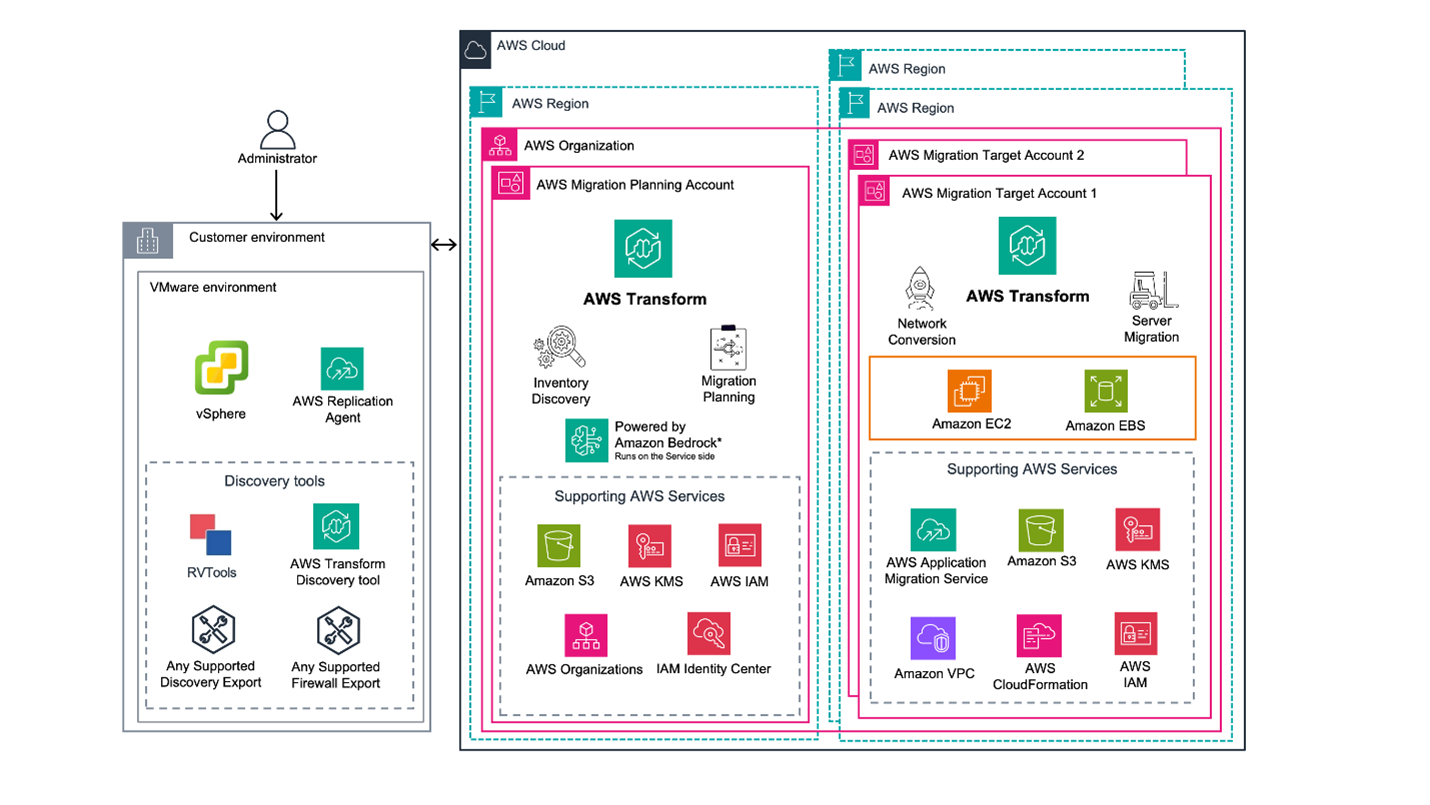
Figure 1: AWS Transform VMware migration architecture showing how agentic AI orchestrates discovery, migration planning, network migration, and server migration across source and target environments.
AWS partners are already seeing significant acceleration in real-world migrations, validating the potential of generative AI to transform migration timelines and costs:
“AWS Transform for VMware can reduce VM migration time to AWS by at least 50%. We’re now integrating AWS Transform into our tooling to enable even faster migrations.” – Neil Redmond, Managing Director, Accenture
“We achieved a 50% reduction in our discovery timeline, translating to a 2x–3x acceleration in the assessment phase alone.” – Stefan Buchman, Head of Solutions, Slalom
Explore additional partner perspectives on AWS Transform.
Real-World Impact: Vector Limited’s AI-Driven Migration
Vector Limited is New Zealand’s largest distributor of electricity and gas serving over 628,000 customers. They became one of the first companies to use AWS Transform for VMware – partnering with AWS Premier Partner Slalom.
The results:
- 34% faster migration compared to traditional methods
- 35% lower five-year Total Cost of Ownership
- 30% increase in team effectiveness through automation
- 60% of wave planning automated: reducing weeks to minutes
“With AWS, we gain near-real-time visibility and the agility to continually refine and improve – turning technology into a true enabler of growth and innovation.” Jerry Li, General Manager of Digital Technology, Vector Limited
AWS Transform’s agentic AI automated traditionally manual tasks. These included document reviews, inventory collection, application mapping, network conversion, and Amazon EC2 right-sizing – enabling a phased migration aligned with business continuity requirements.
Quantifying the Business Impact
Our CVF blogs use a hypothetical large enterprise scenario: 1,800 production servers, 1,200 non-production servers, and 660 TB of storage. Using this scenario, we can model how generative AI reduces the Cost of Change.
Gartner’s 2024 report, “What Would Be Required for a Large-Scale Migration From VMware’s Server Virtualization Platform?” estimates migration costs of $1,000–$3,000 per VM. Storage migration costs range from $50–$150 per TB. For large-scale migrations (2,000+ VMs or 100+ hosts), Gartner estimates timelines of 18–48 months. Using midpoint estimates across these ranges, our scenario yields a 33-month timeline and $4.57M in planning, migration, and training costs. Combined with $3.11M in dual running costs during the transition, the total Cost of Change reaches $7.68M.
These timelines apply Gartner benchmarks, though many customers – including Danske Bank – have migrated significantly faster. This makes our baseline conservative, with AWS Transform’s AI capabilities driving further acceleration.
McKinsey estimates generative AI can reduce cloud migration time by 30–40%. We model a 35% reduction in both cost and timeline — validated by Vector Limited’s 34% result. This reduces the migration timeline from 33 to 22 months, lowering dual running costs and accelerating the ramp to full cloud economics.
We compare three scenarios over five years. Scenario 1: remaining on-premises ($16.24M). Scenario 2: traditional migration using Gartner benchmarks. Scenario 3: migration accelerated by AWS Transform.
Table 1: Business Impact of Generative AI on Cloud Migration Cost of Change.
These ROI figures reflect infrastructure cost savings alone. When factoring in staff productivity, operational resilience, business agility, and sustainability benefits – explored in other CVF posts – the total business value is substantially higher.
Methodology: On-premises costs use AWS benchmarks from the CVF TCO Blog. Migration costs and timelines apply Gartner’s 2024 large-scale VMware migration benchmarks. The 35% improvement reflects the midpoint of McKinsey’s 30–40% estimate.
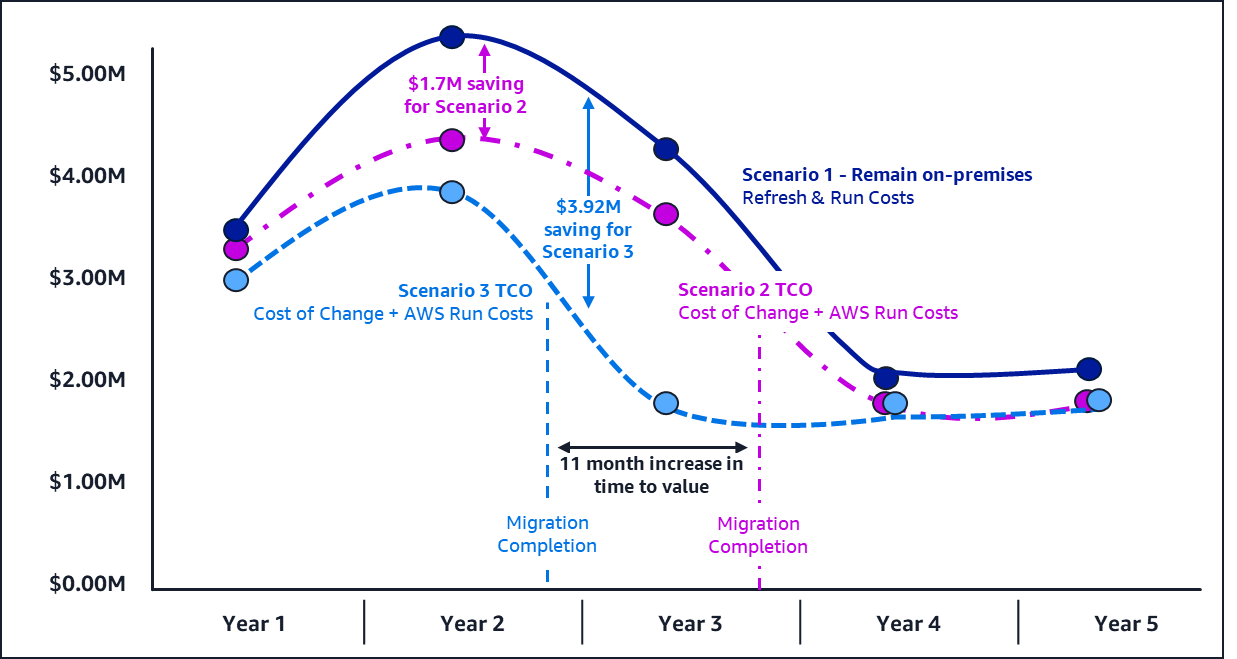
Figure 2: Five-year Total Cost of Ownership comparison – Remain On-Premises ($16.24M) vs. Traditional Migration ($14.53M) vs. AWS Transform Migration ($12.32M)
The 11-month acceleration means earlier realization of cloud benefits across all five CVF pillars and faster redeployment of technical teams to strategic initiatives. Additionally, the 35% improvement represents a baseline: AWS Transform is targeting 50% reduction, with partners reporting results at that level.
Faster migration directly reduces dual running costs. Two additional programs help further reduce the Cost of Change. The AWS Optimization and Licensing Assessment (OLA) provides licensing analysis, while the AWS Migration Acceleration Program offers proven methodology, tools, and AWS investment to offset migration expenses.
Conclusion
Generative AI technologies like AWS Transform are becoming essential tools for cloud migration, reducing the Cost of Change through automation, improved accuracy, and accelerated timelines. The results: improved economics, faster realization of cloud benefits, and earlier access to innovation.
Vector Limited achieved 34% faster migration and 35% cost savings. Your organization can achieve similar results.
Ready to accelerate your migration?
- Explore AWS Transform capabilities on the AWS Transform product page.
- Quantify your potential savings with a complimentary assessment.
- Connect with your AWS account representative to request an AWS Transform demonstration.
- Visit the Cloud Economics Center for additional business value guidance.
- Discover how AWS Transform works end-to-end in Accelerating VMware migration: AWS Transform’s new experience.