AWS Public Sector Blog
Author: AWS Public Sector Blog Team
The Amazon Web Services (AWS) Public Sector Blog team writes for the government, education, and nonprofit sector around the globe. Learn more about AWS for the public sector by visiting our website (https://aws.amazon.com/government-education/), or following us on Twitter (@AWS_gov, @AWS_edu, and @AWS_Nonprofits).

Environmental Problem Solvers: University of California Santa Barbara Builds Machine Learning Tool to Measure Chemical Impact
Currently, there are 150 million chemicals registered and managed by the American Chemical Society. Every day, 15,000 to 20,000 new chemicals are registered. These chemicals are present in everything from our household cleaning products to the food we eat. But how do these chemicals affect us? And how do they affect the environment? A research group at the Bren School of Environmental Science & Management at UC Santa Barbara, with funding from the Environmental Protection Agency (EPA), works to answer those questions for the masses with the Chemical Life Cycle Collaborative (CLiCC) tool.

Sciences Po students tackle common good challenges through the Public Innovation Lab powered by AWS
Today, the Sciences Po School of Public Affairs, an international research university ranked among the best institutions in the world in the fields of humanities and social sciences, announced the launch of a new Public Innovation Lab, powered by Amazon Web Services (AWS). The Public Innovation Lab will focus on building innovative and practical solutions to challenges faced by French public and private organizations, including government, education, and nonprofits.

March 2019 Top Blog Roundup
Spring has sprung in the U.S., global Summit season is abound, and the blog is reaching new milestones. Check out the stories our readers were most excited about last month.
Maritime Operations – Automating Operational Quality Assurance with AWS and Open Data
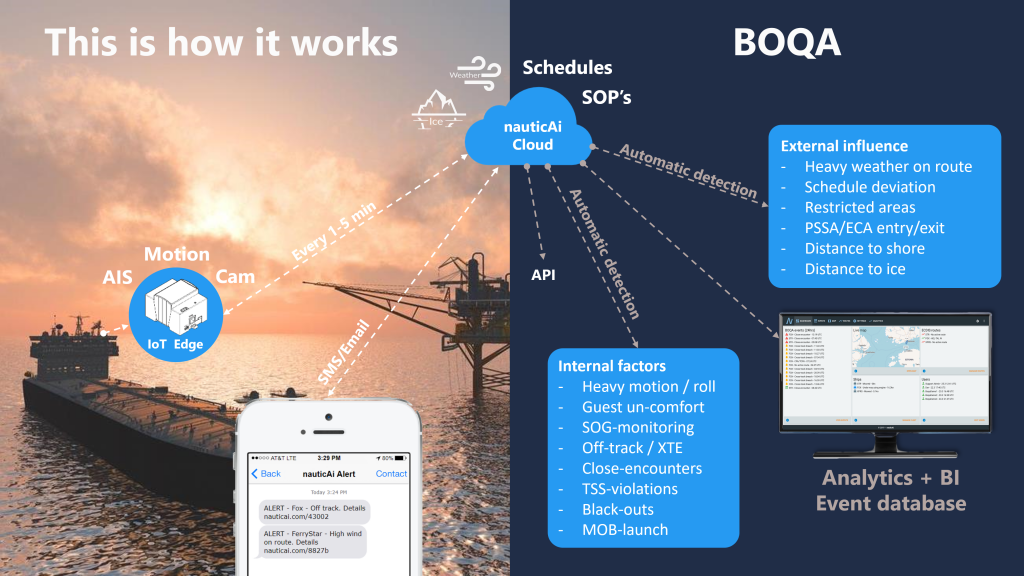
nauticAi is a maritime startup from Finland, specializing in affordable intelligent awareness solutions for ship operators. The company’s BOQA-solution (Bridge Operations Quality Assurance) automates the Operational Quality Assurance of maritime operations with proven methods from the flight industry. A few key components in their solution include open weather data from NOAA and Finnish FMI, Internet of Things (IoT) technology, and a serverless AWS architecture using AWS Lambda and Amazon Aurora. As part of the Amazon Sustainability Data Initiative, we invited Capt. Henrik Ramm-Schmidt, CEO and founder of nauticAi, to share the story of nauticAi with us.

Reaching students and teaching mathematics playfully and rigorously around the world
Matific supports national mathematics curricula and popular textbooks in more than 40 countries and 30 languages. Since founding the company in 2012, the mission was to impact mathematics and science education around the world. To go global, the company needed both scale and reach. And with the complexity of local education regulations, they also needed to meet the security and compliance requirements for each country.

Congratulations to the 2019 Federal 100 Award Winners
Tonight’s Fed 100 gala marks the thirtieth anniversary of the Federal 100 awards. These awards recognize the important work that federal government and industry leaders are doing with the help of technology.
Congratulations to the 100 women and men recognized and a special shout out to these two cloud leaders who are playing a critical role in modernizing government: Kevin Smith, CIO, U.S. Census Bureau, and Richard “Rick” Jack, Distinguished C4ISR Software Engineer (SSTM), SPAWAR Systems Center Pacific, U.S. Department of the Navy.

Texas Homeless Network uses AWS to Prevent and Combat Homelessness
Communities across the country are searching for ways to end homelessness. Many experts point to disparate data as an inhibitor to understand and address the needs of individuals experiencing homelessness. Although the causes of homelessness vary, people who find themselves homeless often interact with multiple agencies – housing, healthcare, law enforcement, and nonprofits providing support services. But those organizations rarely share information with each other – a challenge that, if addressed, can be a game changer in the national efforts to prevent and combat homelessness.

BlueDot Observatory – keeping an eye on our planet’s water resources
Managing water crises is one of the Sustainable Development Goals and the decline in the available quality and quantity of fresh water is ranked as one of the top ten most serious societal risks by the World Economic Forum’s 2018 Global Risks report. Using satellite imagery available through the AWS Open Data Program and the AWS Cloud, BlueDot Observatory is establishing a global monitoring system for all at-risk water bodies. This monitoring reveals a sad truth – the total loss of water bodies is in the not too distant future.
We invited Anze Zupanc, a data scientist who manages the BlueDot Observatory at Sinergise, to share how the AWS Open Data Program and the Amazon Sustainability Data Initiative support this work.

How Ride Data Helps Drive a Car Share Business
The British Columbia Automobile Association (BCAA) started the mobility revolution in B.C. over 100 years ago when a small group of British Columbians, passionate about cars and mobility, joined together to form an auto club. A century later, BCAA continues to help new generations get to where they need to go, and Evo is one way BCAA meets their changing mobility needs. Evo Car Share is Vancouver’s free-floating car sharing service offering a full fleet of 1,500 four-door, hybrid vehicles.

City of Louisville Builds Open Source Traffic Tools using Data, Collaboration, and the Cloud
Cities spend hundreds of thousands of dollars every year to do point-in-time traffic studies. Those studies assist cities in planning traffic signal timings and detours during street-closures. The City of Louisville, Kentucky, was paying every year for traffic studies and analysis and was getting static reports back. Instead, Louisville decided to use real-time congestion data freely available to governments through the Waze CCP (Connected Citizens Program). Combined with other information like built environment data and collision reports, Louisville could bring this together in the cloud for advanced analytics.