AWS Security Blog
Part 2 – Cybersecurity journeys: What even is this job?
If you’ve ever looked at a list of cybersecurity jobs and felt like none of them fit you, you might just be looking at a short list. Most career guides cover the same few roles, like the analyst watching alerts or the pen tester (penetration tester, someone hired to legally break into systems to find weaknesses) looking for a way in. Those jobs matter, but they’re a small slice of a field with room for a lot of different skills. The three people in this post do work you probably won’t find in those guides, and none of them started out qualified for it. What they had in common was a willingness to aim at something before they were ready and to build the skills on the way there. If you’ve ever talked yourself out of a role because you didn’t tick every box, their stories are worth a few minutes, because the move each of them made is one you can make too.
In Part 1: I didn’t plan this, I shared how three people found their way into security from a warehouse floor, a marketing desk, and a teenager’s bedroom. This week is about where people end up after they’re inside. I’ve been in security for over a decade, and while putting this series together I kept running into work I hadn’t come across before: measuring the risk of a million applications at once, building detection tools from the customer service side of the house, and thinking seriously about how to secure infrastructure that’s being launched into orbit.
The skill tree

Jason Lane, Security Engineer
When Jason Lane told me he plans his career like a Dungeons & Dragons character build, I assumed he was being metaphorical, but he meant it literally. “Think of it like a video game skill tree,” he said, and then walked me through the whole framework. You start by picturing your level 20 character, the version of yourself with the skills and the role you actually want, and then you work backward. At level 19, what choices get you to 20? At level 18, what needs to be true so you even have those options? You keep stepping back until you’re standing at level 1, looking at a path you built from the top down.
For Jason, level 20 was vulnerability research (finding unknown security flaws in software before attackers do). At the time he was a systems administrator, keeping servers and networks running, which gave him a solid grasp of how systems fit together but little exposure to picking apart the applications on top of them. That gap, application security, was the next node on his tree, so he called an IT recruiter, laid out his plan, and was honest about where he stood. The recruiter found a credit card processing company that needed an application security engineer and was open to someone who wasn’t one yet. For Jason it was a paid apprenticeship in the exact skill he was after; for the company it was a motivated engineer who would grow into the role. He describes it as a deal where both sides got what they needed, and that framing matters: he wasn’t settling for less, he was trading a steeper learning curve for a faster path to where he wanted to be.
He spent 4 years there taking applications apart to understand what made them breakable, and when he had learned what that role could teach him, he applied the same framework again. A friend offered to get him an interview at Google, and Jason’s honest reaction, that he wasn’t smart enough to work there, is the kind of self-doubt most of us recognize (also known as imposter syndrome). His friend didn’t buy it, the interviewers didn’t either, and they hired him. The lesson he took from it is one worth borrowing: the voice telling you that you don’t belong in the room is often wrong, and the way to quiet it is to put in the work until the skills speak for themselves. He went on to spend nearly 7 years doing Android vulnerability research, the kind of deep technical work most companies don’t have the budget for.
That track record opened the door to Amazon. When the team that measures application risk interviewed him, the hiring manager’s pitch was simple: we could really use your vulnerability research experience. Years of tearing systems apart to find what made them breakable turned out to be the perfect background for judging which systems were most at risk. Today, Jason measures risk across roughly a million applications at Amazon, evaluating which ones would cause the most damage if compromised and which are most likely to be targeted, so the organization can focus on the most dangerous ones first. When his manager recently presented the team’s work to a new senior leader, the example he used was a project Jason had built from scratch. Jason’s name wasn’t on the slide, and he told me he didn’t need it to be, but you could hear the pride in his voice.
When I asked what he’d tell someone with a big vision and no idea where to start, he said to get obsessively clear about where you’re going, because the gaps will show up on their own. He compared it to planning a 100-mile trip and realizing you aren’t wearing shoes; once you see it, you can’t unsee it. And if it turns out the dream is really a hobby, he’s at peace with that too.
| “If you can wait for Saturday, maybe you should just wait for Saturday. There’s nothing wrong with that.” —Jason Lane |
If you’ve been waiting for someone to hand you a career ladder, Jason’s approach offers another option: decide where you want to end up, and let that tell you what to learn next.
Full circle

Jason Goodman, Security Engineer
Where Jason Lane planned his career from the finish line, Jason Goodman’s career has looked more like a pinball machine, bouncing through three security disciplines in about a year and picking up new skills along the way.
The foundation was laid long before he knew it. Eight years ago, before Amazon acquired Ring, he was working in customer service, troubleshooting doorbells and helping customers with their accounts, and before that he sold computers at Best Buy. “That was the most tech I had,” he told me, grinning. What pointed him toward security was partly a nudge from his father-in-law, who worked in IT, and partly what he was seeing on the phones every day: the occasional account access that didn’t look right, the quiet signals that something might be off. Those patterns made him want to understand the systems behind them, so while he was still in customer service he went back to school for a cybersecurity degree.
He didn’t wait until graduation to start building toward the move. He reached out to the manager of the internal threat team (the people who look for misuse of access from inside an organization) and asked a question anyone can ask: what could I do to keep progressing while I’m in school? That turned into stretch projects, and here is the part worth noticing, he earned the bigger ones by delivering the smaller ones first. His standout project was a fraud prevention dashboard that helped the team spot potential misuse of customer account access, a blind spot nobody had flagged. He had the credibility to be handed it because he’d already shown up for the low-stakes work, and it opened the door to his first security engineering role on that same team.
From there he moved to an adversarial threat detection team (the people who watch for outside attackers trying to get in), which meant flipping his mindset overnight: instead of asking what someone on the inside could do with their existing access, he was now asking how someone on the outside would try to break in. A later move took him into application security, where the work shifted from responding after the fact to building security into processes from the ground up.
| “I’m in my third discipline in a year since transitioning out of customer service into security engineering.” —Jason Goodman |
What I find fascinating is how much carried over from one role to the next. The Splunk queries (Splunk is a tool for searching and analyzing large volumes of log data) he learned in customer service carried into internal threat work, the detection logic from insider investigations carried into adversarial detection, and now in application security he has come full circle, working alongside the same customer service teams he started with, except this time he’s helping build the security around them.
Through all of it, he has leaned on four different mentors, and the way he found them is worth stealing. Finding one mentor who truly invests in you is hard; finding four is rare. Jason didn’t wait to be assigned anyone. He reached out to people whose work he admired, starting with that internal threat manager during school, asked specific questions, and stayed in touch over the years as he grew. Each mentor served a different purpose: one for navigating school, one for stretch projects, one for learning to think like an adversary, and one for getting grounded in application security. “I’ve always felt like I could take at least a little nugget from each one of them,” he said. Next on his list is offensive security, meaning pen testing and red teaming (simulating real attackers to test how well an organization defends itself). He figures starting on defense was the right call: learn what attackers do and how to stop them, then learn to think like one.
If your current role feels unrelated to security, Jason’s story is a good reminder that the skills you’re building now may be exactly the ones your first security job needs. The analytical habit of noticing when something is off, the patience to explain a problem clearly, even the instincts you pick up from a completely different field all transfer. The trick is learning to name what you already have and point it at the work you want.
The edge of the map
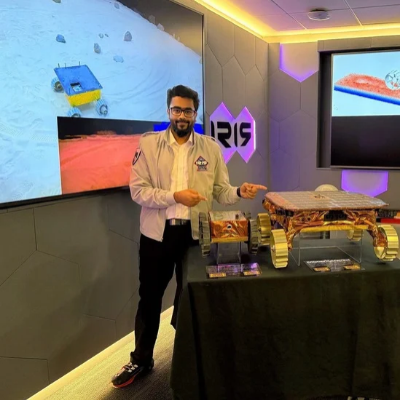
Harshvardhan Chunawala, Solutions Architect, AWS Startups
Harshvardhan Chunawala was still in high school when he started finding security flaws in real products and reporting them to the companies that built them. He had started out building websites and web applications, and after he understood how software was put together, he couldn’t stop wondering how it could be pulled apart. Rather than wait until he had a degree or a job to explore that, he began poking at real products on his own, and when he found a flaw he contacted the company and worked with them to fix it.
Today he advises startup founders at AWS on security and volunteers his time to teach cloud and security courses to students, who often ask him where to start when entry-level work is being automated. His answer has changed over the years. Now that generative AI can answer the surface-level questions, he believes curiosity matters more than credentials, because the people who stand out are the ones who keep asking questions after the tool runs out of answers.
| “AI tools put everyone on the same starting line. Interest and passion has become the driving force.” —Harshvardhan Chunawala |
What surprised me most, though, was where his own curiosity took him. While studying at Carnegie Mellon University (CMU), he ended up working on space missions, including time as a mission operator for the Iris lunar rover (Iris and CMU’s next rover, MoonRanger, appear with him in the photo above). If you had asked me a few years ago whether security belonged anywhere near a rover on the Moon, I wouldn’t have known what to say, but Harshvardhan would have answered right away: anything that can be commanded remotely can be commanded by the wrong person.
When I asked about the future of security, he took the conversation completely off the map. He talked about robots entering people’s homes and about data centers moving from land to underwater to space. A satellite has to be protected in orbit, where nobody can physically reach a compromised system, and on the ground, where the stations that command it are targets too. “So are cyber security specialists going to go under astronaut training?” he asked, grinning, and he was only half joking. He has already written a two-part guide to incident response for satellite operations on AWS, so for him, this corner of the map is already part of the job.
If you’re drawn to an area that doesn’t look like a security job yet, Harshvardhan’s story is worth taking seriously: the move he keeps making is to follow a question past the point where the easy answers run out, into territory nobody has fully mapped. You don’t need a satellite to do that. Pick the corner of technology that genuinely fascinates you, start asking how it could be attacked and defended, and you might find you’re standing at the edge of a role that doesn’t have a name yet.
The thread
These three stories share one thread: the job you end up loving might be one you haven’t heard of yet. Jason Lane mapped his moves in advance, Jason Goodman carried his skills through three disciplines in a single year, and Harshvardhan is already helping AWS customers secure satellites and the ground systems that run them. None of them could answer “what do you do?” in a single sentence, and I suspect that’s true for a lot of people doing interesting work in this field.
If you’re curious about the roles that exist beyond the ones you already know, here are a few places to start exploring:
- The NICE Workforce Framework for Cybersecurity lays out dozens of security work roles and the skills each one needs
- CyberSeek offers an interactive career pathway map showing how entry-level roles connect to advanced ones
- AWS Skill Builder has free security and cloud training you can start today
- CISA’s Cybersecurity Awareness Month page has more resources for this October
In Part 3: The work behind the work, we pull back the curtain on what the day-to-day of security actually looks like compared to what people imagine.
Have you found a corner of security most people don’t know exists? Share your story on LinkedIn!