AWS Storage Blog
AWS Storage at re:Invent 2025: Every session, organized by topic
Hi, I’m Buckets. The official AWS Storage mascot, self-appointed guardian of all things durable, scalable, and correctly permissioned. I’ve attended every re:Invent since 2006, and I have never once missed a storage breakout session. Not even the one scheduled at 8am on a Friday. Some call it dedication. I call it having strong consistency.
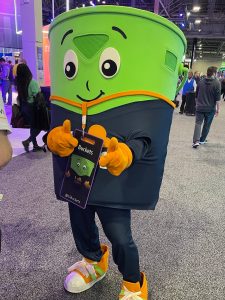
re:Invent 2025 was, one of the biggest years in AWS Storage. And I say that as someone who was there in 2006 when S3 launched and people asked, “but where does the data actually go?” (The answer was: someone else’s computer.)
This year, we launched S3 Vectors, making it possible to store and query AI embeddings natively in S3 with the low costs of S3. Then we continued the rapid innovation of S3 Tables, which launched in 2024, with Intelligent-Tiering and Replication, highlighted by customers like Indeed migrating their analytics infrastructure at scale. And Amazon S3 is approaching a milestone worth marking: Pi Day 2026 (March 14) will be S3’s 20th anniversary. Stay tuned for more Pie/Pi puns.
Together with the AWS Storage Product Marketing team, I’ve organized all 35 re:Invent 2025 breakout sessions into a single guide, sorted by topic so you can find exactly what matters to you. Whether you’re a storage architect, a data engineer, or an AI builder, there’s a session here for you. If you want to skip to the end, you can go here to watch the full playlist.
Here’s what we cover:
AWS Storage Fundamentals: The building blocks. S3, EBS, FSx, and EFS, security best practices, and data protection. Start here if you’re newer to AWS Storage or want to fill gaps.
Data Movement and Transfer: AWS DataSync, Transfer Family, and how to move data to AWS without losing your mind (or your data).
What’s New with AWS Storage: Every 2025 launch across S3, EBS, file storage, and AWS Backup. Straight from the service teams.
Advanced Architecture and Optimization: High-performance patterns, EBS tuning, S3 optimization, and a rare look inside how S3 itself deploys software at scale.
Real Customers, Real Scale: Netflix, Pinterest, Indeed, the New York Times, Spice AI, and Motability share what they built and what they learned.
Data Lakes and Analytics with S3 and S3 Tables: Apache Iceberg at scale, multi-region data lakes, and S3 Tables in depth.
Storage for Generative AI and Agentic Workloads: S3 Vectors, training pipeline storage, and how AWS Storage is the data foundation for the AI era.
Start with the Storage Innovation Talk (INV215). It sets up everything else. Then dive into whichever sections fit your role. And if you finish all seven sections, I will personally add you to my list of people with excellent taste in storage content. The list is very exclusive. It has great durability.
AWS Storage Beyond Data Boundaries: Building the Data Foundation
AWS storage services have evolved into the data foundation powering virtually any modern workload, from massive data lakes to cutting-edge generative AI applications. This Innovation Talk covers new capabilities including S3 Vectors for AI/ML acceleration and seamless NAS migration pathways that eliminate traditional infrastructure constraints.
You’ll learn how customers are building the world’s largest data repositories while simultaneously running real-time analytics, training sophisticated AI models, and running mission-critical applications, all on virtually unlimited, elastic storage. The core message: storage is no longer passive infrastructure. It’s the intelligent data foundation that adapts and scales with your business.
Watch the Storage Innovation Talk (INV215)
Buckets tips: If you only watch one session from re:Invent 2025, make it this one. It provides the strategic context for everything below. Then come back and dive into whichever sections match your role.
AWS Storage Fundamentals
New to AWS Storage, or want to fill gaps in your foundational knowledge? These sessions cover core services, architectural principles, and the security and performance best practices that every storage practitioner should know.
STG407 | Level 400 — Deep Dive on Amazon S3 Go inside the world’s most popular object store. This deep-dive session covers S3’s internal architecture, including how requests are routed, how consistency is achieved, and how S3 delivers eleven nines of durability across multiple Availability Zones. Ideal for engineers and architects who want to build with confidence and understand the system-level guarantees that make S3 a reliable foundation for any workload. Watch.
STG338 | Level 300 — Data Protection and Resilience with AWS Storage Protecting your data is non-negotiable. This session covers the full spectrum of AWS data protection capabilities, from S3 versioning and Object Lock to cross-region replication, AWS Backup policies, and disaster recovery architectures. You’ll learn how to design resilient storage systems that meet RPO and RTO requirements for regulated and mission-critical workloads, with concrete guidance on ransomware protection and compliance controls. Watch.
STG337 | Level 300 — Improve Self-Managed Database Performance and Agility with Amazon FSx Self-managed databases on AWS need fast, reliable, scalable file storage. This session explores how Amazon FSx for NetApp ONTAP, FSx for Windows File Server, and FSx for Lustre serve as high-performance storage backends for Oracle, SQL Server, SAP HANA, and other self-managed databases. Learn how to right-size your FSx deployment, optimize throughput and IOPS, and reduce operational overhead without sacrificing performance. Watch.
STG316 | Level 300 — Amazon S3 Security and Access Control Best Practices S3 security is a shared responsibility. Getting it right requires understanding bucket policies, IAM permissions, Access Points, Object Ownership, Block Public Access, and encryption options. This session walks through the most common misconfiguration patterns and how to prevent them, then covers advanced patterns for multi-account architectures, cross-org data sharing, and meeting compliance requirements for HIPAA, PCI DSS, and SOC 2. Watch.
STG208 | Level 200 — Maximize the Value of Cold Data with Amazon S3 Glacier Storage Classes Cold data doesn’t have to be unused data. This session covers S3 Glacier Instant Retrieval, Flexible Retrieval, and Deep Archive, and how to use S3 Lifecycle policies and S3 Intelligent-Tiering to automatically move data to the most cost-effective storage class. You’ll see real cost models for archive-heavy workloads and learn how organizations in media, financial services, and healthcare are dramatically reducing storage costs while keeping data accessible when it’s needed. Watch.
STG217 | Level 200 — Introducing Amazon S3 Access Points for FSx for NetApp ONTAP A new re:Invent 2025 launch: Amazon S3 Access Points are now available for FSx for NetApp ONTAP, letting you expose FSx data through S3-compatible endpoints. This session covers the architecture, setup, and use cases, including tiering FSx data directly to S3 and enabling S3-native access for analytics and AI workloads against data that lives in your ONTAP file system. A powerful bridge between enterprise file storage and the S3 ecosystem. Watch.
Data Movement and Transfer
Getting data to AWS and keeping it in sync is foundational for hybrid and migration workloads. These sessions cover AWS Transfer Family, AWS DataSync, and file transfer automation at enterprise scale.
Buckets says: Data movement is often where migrations succeed or struggle. The right tool can cut transfer time dramatically. Whether you’re moving petabytes or modernizing an SFTP workflow from the 1990s, these sessions will save you a lot of trial and error.
STG339 | Level 300 — Modernize Managed File Transfer Workflows with Event-Driven SFTP Many organizations still rely on batch SFTP workflows built for a different era. This session shows how to modernize those workflows using AWS Transfer Family with event-driven automation. Learn how EventBridge, Lambda, and Step Functions can replace fragile cron jobs with resilient, observable pipelines that trigger downstream processing the moment a file lands. Includes patterns for financial services and healthcare file-based integrations. Watch.
STG340 | Level 300 — Accelerate and Automate Secure Data Transfers at Scale with AWS DataSync AWS DataSync automates and accelerates data movement between on-premises storage, edge locations, and AWS. This session covers DataSync agents, task configuration, bandwidth controls, and built-in data integrity verification. You’ll see real migration architectures for NFS, SMB, HDFS, and object storage workloads moving to S3, EFS, or FSx, including patterns for ongoing hybrid synchronization after the initial migration is complete. Watch.
STG419 | Level 400 — Modern SFTP: Deploy AWS Transfer Family, Identity, and Automation A deep technical session on deploying AWS Transfer Family at scale. Covers custom identity providers, service-managed users, SFTP connector configurations, and multi-protocol support (SFTP, FTPS, FTP, AS2). You’ll learn how to federate identities with Active Directory or Okta, enforce fine-grained access policies mapped to S3 prefixes, and build automation that scales with partner onboarding. Includes architecture patterns from enterprise deployments. Watch.
STG361 | Level 300 — Beyond SFTP and NFS: Automate Enterprise File Transfers at Scale Enterprise file transfers span dozens of protocols, partners, and compliance requirements. This session explores how AWS Transfer Family’s AS2 support enables EDI trading partner connectivity, and how to build a unified, cloud-native managed file transfer platform on AWS. Covers workflow automation, audit logging, alerting, and the operational patterns that replace expensive legacy MFT platforms from IBM, Axway, and similar vendors. Watch.
What’s New with AWS Storage
re:Invent 2025 brought a full wave of launches across the AWS Storage portfolio. These sessions deliver announcements straight from the service teams who built them.
STG202 | Level 200 — What’s New with Amazon EBS The latest innovations in Amazon EBS block storage include gp3 enhancements, new io2 Block Express capabilities, and improved Elastic Volumes for dynamic resizing. This session covers performance improvements for latency-sensitive applications, new snapshot capabilities, and how EBS is evolving to support AI training workloads that demand consistent, high-throughput I/O. Includes a roundup of every EBS launch from 2025 with guidance on when to adopt each feature. Watch.
STG203 | Level 200 — What’s New with AWS File Storage A comprehensive review of 2025 launches across EFS, FSx for Windows File Server, FSx for Lustre, FSx for NetApp ONTAP, and FSx for OpenZFS. Key highlights include new S3 Access Points for FSx for ONTAP, performance improvements across FSx families, and expanded integration with AWS analytics and AI services. If you work with file storage on AWS, this session keeps you current on everything that launched in the past year. Watch.
STG206 | Level 200 — What’s New with Amazon S3 The headline S3 launch session for re:Invent 2025 covers the full breadth of what’s new, including the GA launch of S3 Vectors, plus updates to S3 Intelligent-Tiering, Express One Zone, and S3 Replication. You’ll get a clear picture of the evolving S3 product family and how each new capability addresses a specific workload, from high-performance analytics to AI embedding storage. Watch.
STG207 | Level 200 — Protect Your Data with AWS Backup: Overview, Use Cases, and What’s New AWS Backup protects over 2.9 exabytes of application data for over 140,000 customers across services including S3, EBS, EFS, FSx, RDS, DynamoDB, and more. This session covers the core concepts of AWS Backup, including backup plans, vaults, lifecycle policies, and cross-region replication, along with 2025 feature launches. You’ll also hear directly from customers about how they use AWS Backup to protect mission-critical workloads and maintain business continuity. Watch.
Advanced Architecture and Optimization
Ready to go deeper? These sessions cover high-performance architectures, optimization techniques, and the engineering practices that help you get the most out of AWS Storage at scale.
STG320 | Level 300 — Optimizing Price Performance with Enhanced Amazon EBS gp3 Volumes gp3 is the go-to EBS volume type for most workloads, delivering consistent IOPS and throughput at a lower cost than gp2. This session explores advanced gp3 configuration, including how to decouple IOPS from storage capacity, right-size volumes for burst versus sustained workloads, and maximize price-performance for databases, containers, and boot volumes. Includes a migration guide from gp2 to gp3 and a real-world cost savings analysis across common workload profiles. Watch.
STG319 | Level 300 — Maximizing Block Storage Performance for High-Intensity Workloads For latency-sensitive applications like Oracle RAC, high-frequency trading, and SAP HANA, sub-millisecond I/O is a requirement, not a nice-to-have. This session covers io2 Block Express architecture, multi-attach configurations, EBS-optimized instance sizing, and the queue depth and I/O patterns that drive maximum throughput. You’ll leave with a tuning playbook for extracting peak performance from EBS in the most demanding production environments. Watch.
STG335 | Level 300 — Amazon S3 Performance: Architecture, Design, and Optimization S3 scales automatically, but your application design determines how much of that performance you actually use. This session covers S3 request rate limits, prefix partitioning strategies, multipart upload optimization, S3 Transfer Acceleration, S3 Express One Zone for latency-critical paths, and how to instrument your workloads with S3 Storage Lens and CloudWatch to identify and eliminate bottlenecks. Packed with architectural patterns for high-throughput data ingestion and analytics workloads. Watch.
STG220 | Level 200 — Private and Secure Web Browser-Based Access to Your Data in S3 A new S3 capability enables direct, browser-based access to S3 data without traversing the public internet. This session covers the architecture and use cases for secure, private data access from web applications, including the role of S3 Access Points, VPC endpoints, and pre-signed URL patterns. Ideal for teams building internal data portals, media review workflows, or secure document access systems that need to keep data off the public internet while remaining easily accessible to authorized users. Watch.
STG352 | Level 300 — Large-Scale Software Deployments: Inside Amazon S3’s Release Pipeline How do you safely deploy software to a service running at the scale of Amazon S3, with billions of requests per second across every AWS Region and zero tolerance for data loss? This session is a rare look inside S3’s own engineering practices: staged rollouts, blast radius reduction, automated rollback, and the operational culture that makes continuous deployment possible at exabyte scale. A must-watch for platform engineers and anyone building for massive scale. Watch.
STG357 | Level 300 — Accelerate Data Discovery with Object Metadata in Amazon S3 Finding the right data in a large S3 data lake has traditionally meant scanning object keys or maintaining a separate metadata catalog. This session covers Amazon S3 object metadata features, including S3 Metadata, S3 Storage Lens, and S3 Inventory, and shows how to use them to build data discovery systems that scale to billions of objects. Includes patterns for tagging strategies, automated metadata enrichment using Lambda, and integration with AWS Glue Data Catalog. Watch.
Real Scale. Real Lessons from customers
The best storage advice comes from customers who’ve done it at scale. These sessions feature engineers and architects from some of the world’s leading organizations sharing what worked, what didn’t, and what they’d do differently.
STG214 | Level 200 — How Netflix Uses Amazon S3 Storage Lens to Track Exabytes of Data Netflix manages exabytes of content and data across AWS. This session explores how Netflix uses S3 Storage Lens dashboards and metrics to gain visibility into their massive S3 footprint, identifying cost optimization opportunities, tracking storage growth trends, and monitoring data access patterns across hundreds of buckets. A practical guide to operating S3 at hyperscale, with actionable takeaways for any organization managing large volumes of S3 data. Watch.
STG211 | Level 200 — Scaling Pinterest: Iceberg Solutions for Petabyte-Scale Challenges Pinterest manages petabytes of user and engagement data with Apache Iceberg on Amazon S3. This session covers how Pinterest solved real-world challenges with Iceberg at scale, including table maintenance, compaction strategies, time travel, and schema evolution, and how they’re preparing their data infrastructure for the next generation of AI-powered recommendation systems. A candid look at what Iceberg adoption actually looks like in a large production environment. Watch.
STG364 | Level 200 — How Spice AI Operationalizes Data Lakes for AI Using Amazon S3 Spice AI builds the infrastructure layer that helps AI teams move from prototype to production. In this session, Spice AI shares how they use Amazon S3 as the foundation for AI-ready data lakes, optimizing data layout, caching strategies, and query patterns to serve both human analytics users and AI inference pipelines from the same data estate. A practical look at the operational considerations of running AI workloads against data in S3. Watch.
STG210 | Level 200 — Indeed’s Migration to Amazon S3 Tables Indeed, the world’s largest job site, migrated their analytics data infrastructure to Amazon S3 Tables to improve query performance and reduce operational overhead. This session covers their migration journey: the evaluation process, technical challenges, performance benchmarks, and the productivity gains their data engineering team realized from S3 Tables’ managed Iceberg capabilities. An honest account of what a large-scale table migration looks like in practice. Watch.
STG212 | Level 200 — New York Times: Best Practices for Migration to Amazon FSx for ONTAP The New York Times migrated enterprise file workloads to Amazon FSx for NetApp ONTAP, retiring on-premises NAS infrastructure while preserving the ONTAP capabilities their teams depend on. This session covers their migration approach, lessons learned, and how FSx for ONTAP’s SnapMirror and SnapVault integration simplified their data protection strategy. An instructive case study for any organization considering a NAS modernization project. Watch.
Motability Operations — Unified Backup Strategy: From Fragmented to Fortified Motability Operations, the UK-based mobility charity, transformed a fragmented backup environment spanning multiple services and accounts into a unified, policy-driven data protection strategy using AWS Backup. This session covers how they consolidated backup management, improved compliance reporting, and built a resilient recovery architecture across their AWS environment. A compelling example of what’s possible when backup strategy evolves from reactive to proactive. Watch.
Data Lakes and Analytics with S3 and S3 Tables
S3 is the foundation of the modern data lake. These sessions cover data lake architecture, Apache Iceberg at scale, S3 Tables for structured data, and how to build analytics infrastructure that performs and scales.
STG358 | Level 300 — Building Multi-Region Data Lakes with Replication for Amazon S3 Tables Multi-region data lakes add resilience and locality, but replicating structured table data adds complexity. This session covers S3 Tables replication: how it works, how to configure table-level replication rules, and how to maintain consistency across regions. You’ll see architecture patterns for global analytics platforms, disaster recovery for data lakes, and how to use S3 Tables replication to bring data closer to regional compute clusters for better query performance. Watch.
STG334 | Level 300 — Amazon S3 Tables: Architecture, Use Cases, and Best Practices Amazon S3 Tables delivers purpose-built Apache Iceberg table storage with automatic compaction, snapshot management, and up to 3x faster query throughput compared to self-managed Iceberg tables on S3. This session dives into S3 Tables architecture, covers the difference between table buckets and general-purpose S3 buckets, and walks through best practices for table design, partitioning, and integration with Amazon Athena, EMR, and AWS Glue. Watch.
STG351 | Level 300 — Inside S3: Lessons from Exabyte-Scale Data Lake Modernization Real lessons from customers and AWS engineers who have modernized data lakes at exabyte scale on Amazon S3. Covers migration from Hive metastore to Iceberg, optimizing table layout for concurrent read/write workloads, managing metadata at scale, and the governance patterns that make large data lakes operable over time. If you’re managing or planning a large-scale data lake, this session offers a candid look at what actually works. Watch.
Storage for Generative AI and Agentic Workloads
Generative AI changes the storage calculus. These sessions cover how AWS Storage is purpose-built for the AI era, from high-throughput training pipelines to vector embedding storage and agentic knowledge systems.
STG218 | Level 200 — Put Your Data to Work for Agentic AI with AWS Storage Agentic AI systems need data access that is fast, structured, and semantically rich. This session shows how S3 Tables (structured data) and S3 Vectors (embeddings) work together as a multi-modal data layer for agentic workloads. You’ll learn how to build data pipelines that populate and maintain AI-ready storage, and how AWS storage services integrate with Amazon Bedrock, Agents for Bedrock, and knowledge bases. Watch.
STG318 | Level 300 — Transforming AI Storage Economics with Amazon S3 Vectors Amazon S3 Vectors is a new purpose-built vector storage capability that lets you store and query embedding vectors natively in S3. This session covers S3 Vectors architecture, the approximate nearest neighbor (ANN) query interface, index management, and cost-performance trade-offs compared to dedicated vector databases. You’ll see use cases for RAG pipelines, semantic search, recommendation systems, and multi-modal AI applications at scale. Watch.
STG201 | Level 200 — Accelerate Generative AI and ML Workloads with AWS Storage Training large language models and fine-tuning foundation models requires storage that can keep GPUs fed without becoming the bottleneck. This session covers the storage architecture for generative AI workflows, from dataset staging in S3 and Mountpoint for S3 for high-throughput training I/O to checkpoint storage patterns that minimize expensive GPU idle time. Includes guidance for both distributed training on SageMaker and self-managed ML clusters on EC2. Watch.
STG336 | Level 300 — High-Performance Storage for AI/ML, Analytics, and HPC Workloads AI/ML training, large-scale analytics, and high-performance computing share a common requirement: storage that delivers maximum throughput with minimal latency. This session compares the performance profiles of Amazon FSx for Lustre, S3 Express One Zone, EBS io2 Block Express, and EFS for compute-intensive workloads. You’ll get a decision framework for matching storage tiers to workload phases, from data preparation to active training to checkpoint and inference, with benchmark data to back it up. Watch.
Closing Innovation Talk · INV201 – Harnessing Analytics for Humans and AI
Presented by Mai-Lan Tomsen Bukovec, VP of AWS Technology, this Innovation Talk explores how the analytics landscape is being reshaped by Open Table Formats, agentic infrastructure, and the growing need for storage that serves both human analysts and AI systems simultaneously.
The session makes one thing clear: the evolution of AWS Storage over the past several years has been deliberately building toward this moment. Every new S3 capability, Tables for structured data and Vectors for AI embeddings, represents AWS meeting the specific data needs of different workloads with purpose-built storage, all anchored on the durability and scale of S3.
AWS Storage has evolved from a single object store into a family of purpose-built services: S3 for objects, EBS for block, EFS and FSx for file, S3 Tables for structured analytics, and S3 Vectors for AI. The result is a complete data estate on AWS, where customers can harness every type of data, for every type of workload, with the analytics and AI tools to put it all to work.
Watch the Analytics Innovation Talk (INV201)
Ready to watch?
The full AWS Storage re:Invent 2025 playlist is available on YouTube. Start with the Innovation Talk, then work through the sections most relevant to your role.
See you next year or at an upcoming AWS Summit!