ADP Reimagines Compliance Infrastructure
Overview
ADP is the number one Human Capital Management (HCM) provider operating in over 140 countries, serving approximately 1.1 million clients ranging from small businesses to Fortune 500 companies. ADP processes one in six payrolls in the United States. Given this scale, clients trust ADP for scalability, reliability, security, and expertise—making tax compliance a mission-critical function. ADP's tax compliance system operates at massive scale, with 77 million+ employee statements processed yearly, $1.6 trillion deposited to agencies on behalf of clients, 8,000 tax jurisdictions supported, over 10,000 forms and variations across different agencies, and over 12 million jobs executed on their systems.
About ADP
ADP is a comprehensive global provider of cloud-based human capital management (HCM) solutions uniting HR, payroll, talent, time, tax and benefits administration, and a leader in business outsourcing services, analytics and compliance expertise. ADP is one of the largest global providers of HCM services across North America, Europe, Latin America and the Pacific Rim, with over 30 years on the Fortune 500.
Challenge | Rapid Response Needed for Compliance and Mainframe Dependency
ADP’s primary challenge is the dependency on regulatory changes from agencies that arrive with short notice, requiring rapid response to maintain client compliance. The company’s legacy tax system has accumulated significant complexity over the years, with numerous processes and rules embedded within the system. “We recognized that simply migrating from one technology stack to another would not be an optimal investment strategy—we required modernization,” said Anuradha Verma, VP of Product Development for ADP. The company faces rising complexity, as tax ecosystems are fragmented and rapidly evolving, requiring quick adaptation to changes. “We have a low tolerance for errors – as a compliance solution, accuracy is paramount to avoid penalties. Our systems must adapt instantly, learn continuously, and validate intelligently rather than rely on static rules,” explained Verma. ADP must also scale globally – during year-end and quarter-end filing periods, millions of filings must be processed within a two-week window.
Solution | Reimagine, Don’t Migrate
ADP decided to build a new system in AWS and then migrate clients. Instead of a complete system replacement, ADP adopted a modular approach: It broke down the large system into smaller components, reimagined and modernized each component individually, then moved them to AWS.
Reimagination is the idea of rethinking a business’s processes and applications. Organizations can retire some business rules and add business rules that are relevant to their current needs. Reimagination can also entail changing or building a new architecture from scratch; For example, moving from a monolithic architecture to microservices. As part of its reimagination journey, ADP rethought what components should remain as code versus what should be externalized as configurable rules. Moving business logic from embedded code to configurable rules would enable faster response to regulatory changes.
The company adopted a module-by-module transformation where all clients receive modernized modules simultaneously. It also adopted a filing-type approach – rather than transforming state-by-state or form-by-form, ADP addresses entire filing types (e.g., SUI filings) across all states at once, allowing efficient testing and validation of state-specific variations.
AWS Transform Collaboration
ADP entered a collaboration with AWS, leveraging AWS Transform to understand its ecosystem and accelerate modernization, while reducing risk and preserving critical business logic. Using AWS Transform, ADP extracted and documented the business logic embedded in their legacy systems. Using Kiro, ADP's engineers then forward-engineered these rules into configuration-driven logic within a modern Apache Spark framework — replacing hard-coded legacy processes with flexible, maintainable configurations.
In AWS Transform, the agent performs, organization-specific transformations like runtime migrations or complex language translations and architectural changes. By learning specific transformation patterns and automating them across entire codebases, customers using AWS Transform have achieved up to 80% reduction in execution time in many cases, freeing developers to focus on innovation. Developers define transformations using code samples, documentation, and natural language descriptions. The service then applies these specific patterns consistently across hundreds or thousands of repositories, improving its effectiveness through both explicit feedback and implicit signals like developers’ manual fixes.
“While we are reimagining our system, it's very critical for us to leverage AWS Transform agents to extract the business rules and processes and understand the interdependencies so that we can focus on rethinking how we want to do tax again rather than thinking about the existing rule base,” said Verma. “It's really proving to be very helpful for us, and it's freeing up resources to focus on doing other tasks while the system is helping us.”
AWS Transform helped ADP write test cases as well as reimagine how the rules should be extracted and represented in its new code base. AWS Transform takes code, assesses the legacy programs and databases, and converts the code into business logic as well as business rules. The service helps ADP analyze the data, and it uses Kiro to finalize code and make any adjustments. “We are not doing an A to B transformation. We are rethinking whether it even makes sense in this new world, and whether we really need to write so much of code? Can it be a configurable system that even our business can help configure?” thought Verma.
ADP then reimagined a new architecture, seeking to modularize its system, separating the front-end, back-end, and persistent layers. The company is building its system across AWS Multi-Region and is modernizing by:
- Containerizing its applications, using Amazon EKS for orchestration and AWS Fargate as a serverless compute engine to run the containers on highly available compute infrastructure.
- Amazon OpenSearch as an open-source fully managed service for secure, real-time search, monitoring, and analysis of large-scale data.
- Amazon Managed Streaming for Apache Kafka (Amazon MSK) for real-time streaming data with options for provisioned or serverless capacity running Apache Kafka applications.
- Amazon RDS Postgres as its open-source relational database for its build environment meeting compliance.
- Built a lakehouse architecture using Amazon S3 and Amazon Redshift, for transactional consistency across data lakes and warehouses, allowing reliable concurrent operations.
“The biggest advantage we are seeing with this is tax being a seasonal business, we can very quickly scale up when it's filing time and scale down, saving a lot of cost compared to the monolithic infrastructure that we had before,” said Verma.
Results | Efficiency Gains and Modernization
ADP has realized measurable results using AWS Transform to accelerate modernization:
- Analyzed thousands of legacy programs in an automated, AI driven approach.
- Extracted thousands of business rules in a number of hours, reducing manual effort by over 90%.
- Cut rule-extraction time by 80% and enabled faster deployment cycles.
ADP is well underway on their transformation journey, and has modernized thousands of processes into AWS, using agentic AI and taking advantage of AWS services. “We must take all the form filings and address for all client types in all markets, simplify the compliance changes by 80% and reduce the manual exception handling by 50%,” concluded Verma. By leveraging AWS Transform's AI-powered capabilities for code analysis, conversion and rule extraction, combined with a modular modernization strategy, ADP is transforming a complex system into a scalable platform capable of meeting evolving regulatory demands while maintaining the accuracy and reliability its 1.1 million clients depend upon.
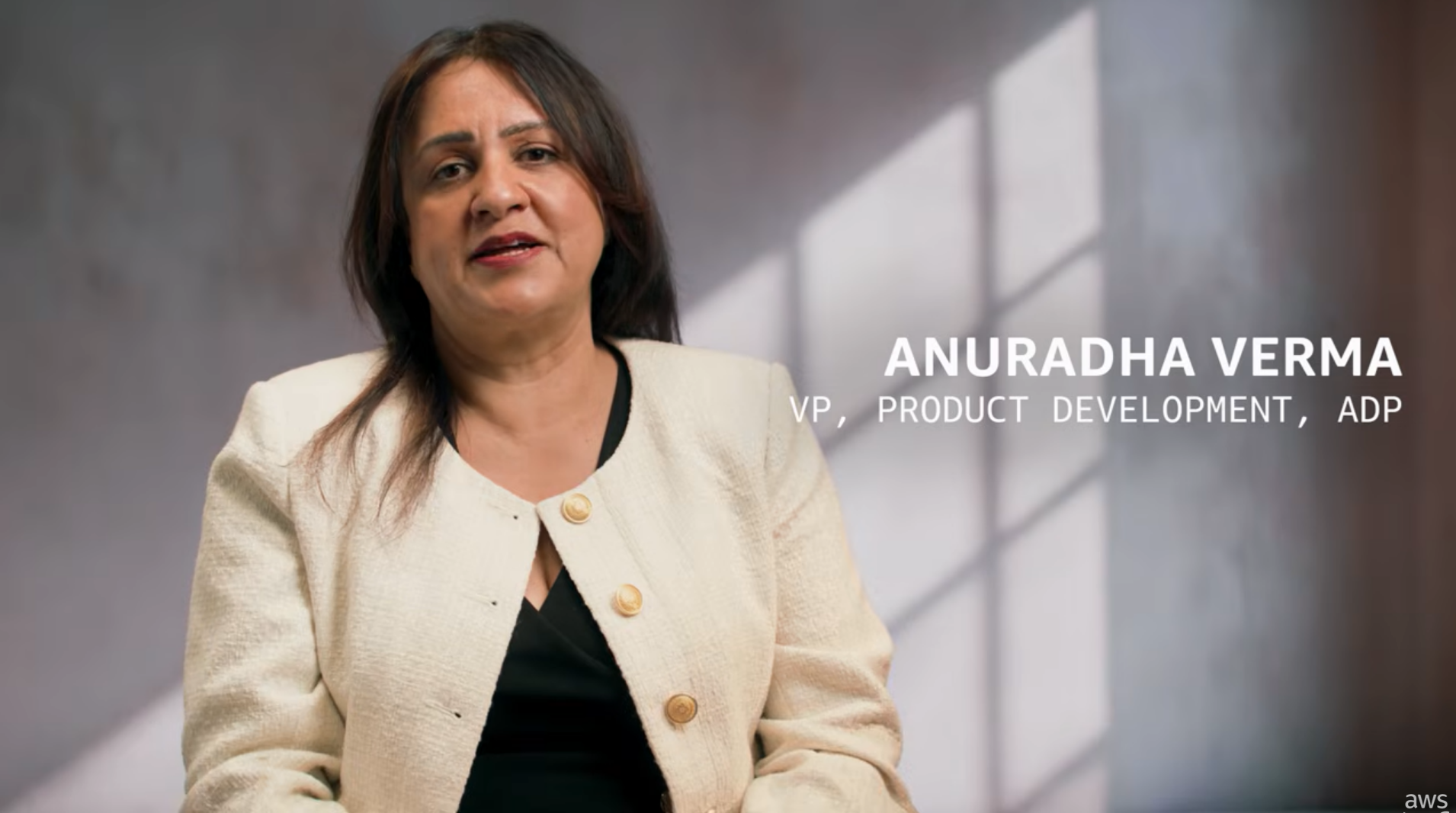
AWS Transform helps us extract rules faster and scale for 1.1M clients—we can deliver results in weeks, not years.
Anuradha Verma
VP Product Development, ADPAWS Services Used
About the authors
 Anuradha Verma is a Global Technology Product Development Executive focused on transforming enterprise platforms through intelligent automation and data-driven innovation. She leads the design and delivery of scalable, AI-enabled solutions that enhance compliance, streamline complex workflows, and elevate customer experiences across global markets. At ADP, Anuradha drives strategic modernization initiatives by integrating AI into core product and operational ecosystems—enabling proactive decision-making, strengthening compliance outcomes, and accelerating end-to-end business efficiency. Over the past four years, she has significantly improved business unit productivity by building and mentoring high-performing engineering teams and fostering a culture of continuous innovation. Known for connecting strategy with execution, Anuradha combines deep technical expertise with a systems-thinking approach to reimagine processes, unlock operational intelligence, and deliver measurable business impact at scale.
 At AWS, Chris Saleski leads Global Customer References for Migration & Modernization, driving customer-led transformation stories. He leverages leadership experience from Intel where he directed marketing for gaming and quantum computing solutions. Chris was a key driver behind the SSD revolution, and led industry initiatives to optimize software for next-generation SSD technology. At Microsoft, he created and led thought leadership campaigns and partnerships focused on DevOps and big data solutions to drive adoption among developers and enterprise customers. Early in his career, Chris was an automotive body designer for Honda.
Did you find what you were looking for today?
Let us know so we can improve the quality of the content on our pages