What Is Human in the Loop?
- What is human in the loop?
- Why is human in the loop important?
- How does human in the loop work?
- What are the types of human-AI control models?
- What are the use cases of human in the loop?
- What are the key considerations for human in the loop?
- What are human-in-the-loop best practices?
- How can AWS support your human-in-the-loop requirements?
What is human in the loop?
Human in the loop (HITL) methods are techniques in machine learning where humans help artificial intelligence (AI) in reaching better outcomes. Humans can evaluate AI outputs, guide towards best practices, provide oversight in important decisions, and handle edge cases. Human-in-the-loop practices can change over time as the AI learns from human input.
Why is human in the loop important?
While there are many automated processes within machine learning (ML), creating and improving ML applications requires human intervention. Occurrences such as model uncertainty, ambiguity in the decision-making process, or uncommon edge cases can all result in inaccurate model outputs. Human-in-the-loop methods add human intervention to manually resolve these issues.
At key points in the machine learning training pipeline, such as data labeling, model validation, correction, escalation, and active learning, a human can review the decisions that an ML tool has made and refine them if needed.
In some cases, a human might not even do anything in their touchpoint check. After reviewing the ML model output and its decisions, the person might agree with the model output and confirm. However, this oversight, to loop a human into the process and confirm, is an important step toward improving ML precision and reducing errors.
Human oversight is especially important in models with high-consequence decisions, such as medical models or legal systems. Having a human check over output helps to avoid errors and verify that a model is acting as expected.
Here are some specific cases where humans are involved in the ML process.
Model accuracy and continuous improvement
Although much of the model improvement in machine learning is autonomous, a human can step in to manually correct certain errors. Specific and detailed feedback or corrective actions can give ML models more information to take forward into retraining cycles. Small amounts of human feedback can go a long way to improving responses and enhancing the decision-making process for future cases.
Some ML models engage in active learning, which is a training strategy where a model requests human intervention at specific moments in the training process. These requests come during least-confidence events. For example, if a model encounters ambiguous data samples, it requests human interaction to give more context. This directed form of learning helps models learn efficiently and improve in areas where they’re weakest.
Critical and regulated decision-making
Fields such as the legal or medical sectors have additional sets of compliance regulations, especially in relation to data processing, handling, and usage.
Many models in clinical practice require the medical practitioner’s oversight to check for correctness. These types of applications are known as human-in-the-loop by design. In some countries, this is regulated by law, such as the EU’s AI Act, which classifies medical applications as high-risk, requiring human intervention.
Edge cases and low-confidence outputs
Machine learning models primarily train on historical data, being able to infer on new data based on their training data sets. When these models have to make decisions or predictions about edge cases or unknown areas, their previous training can’t be used to confidently predict an answer. Instead of models trying to cover these cases that fall outside their area of expertise, data scientists or specialists can give additional context and feedback to help hone the model’s decision-making.
How does human in the loop work?
Human-in-the-loop systems are somewhere between fully autonomous and fully manual processes. A model makes a prediction, the system then evaluates whether or not it’s reliable, and a human steps in to give insight only when required.
Here are the steps and conditions that allow that process to occur.
Confidence thresholds and escalation logic
Models ask for human input only when predefined, configured conditions are reached. Typically, models have a surrounding system with an internal confidence threshold metric. If a prediction has a confidence score below this threshold, the output is flagged for escalation for human review.
Higher-risk areas, like those previously mentioned relating to highly regulated areas, might have lower thresholds before triggering human intervention.
Task routing and workforce management
After a task is flagged by a model for review, it’s entered into a human workflow queue. While the specific delegation system used is company-specific, typically a domain expert or internal team reviews the task. For less complex tasks, crowdsourced reviewers can give feedback rapidly and at scale.
Teams of experts receive the more difficult tasks, often taking longer to review by providing more detailed and nuanced feedback.
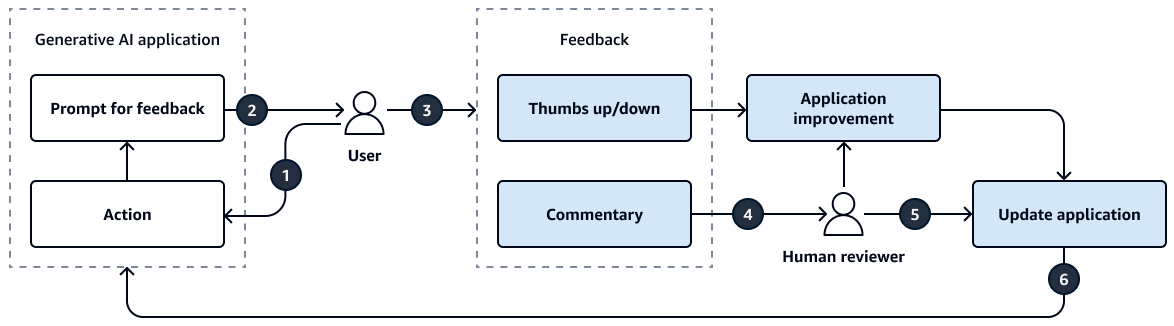
Feedback loops and model retraining
Any corrections that humans provide are sent back to the model and used to update it for retention. The actual feedback that humans provide usually follows a carefully planned structure to remove ambiguities and clearly explain how the machine should use this information going forward.
What are the types of human-AI control models?
There are several different types of human-AI control models that ML systems can use, depending on the extent of control and feedback needed.
Understanding these differences is an important part of AI governance, as their distinctions can lead to different regulatory requirements for a company.
Human in the loop (HITL)
Human in the loop is where a person actively reviews tasks before any action occurs. HITL is a more hands-on approach that requires more effort and contact. Typically, this is used in regulated environments where it is critical to avoid mistakes.
Human on the loop (HOTL)
Human on the loop is where humans are involved in monitoring the system, but don’t have to approve every decision to let a model proceed to the next step. Humans can intervene when necessary, but models still have a level of autonomy to keep processes flowing. HOTL is better for lower-risk industries or higher-volume operations. An example is in chatbot processes.
Human in command (HIC)
Human in command is where humans are fully in charge of a system and can shut it down at any time. A human can intervene at any moment to change the decision-making process or turn off the AI. For autonomous systems such as in robotics or critical infrastructure, this is a popular model of control design.
What are the use cases of human in the loop?
There are many use cases where businesses can use human-in-the-loop systems.
Data labeling and annotation
Human annotators label training data, such as images, text, and audio, for ML consumption. The process of labeling content for models is the foundation of supervised ML, where human inputs directly impact training and eventual model performance. Humans are essential in this process.
Content moderation
When an automated ML system flags content for being harmful or ambiguous, human moderators then step in to confirm these decisions. Businesses need to clearly define their confidence levels within content moderation, as low thresholds can quickly create lots of work for human moderators.
Medical imaging and clinical decision support
In medical imaging systems, AI tools can identify anomalies within medical data. However, the final decision-makers are always the medical practitioners with expertise in that specific area. Although ML can advise, regulatory bodies typically still require a human or human oversight.
Financial services
Human in the loop is common within fraud detection systems, as ML tools flag cases for review. In anti-money laundering workflows, humans receive any escalated cases that the ML tool was unable to make a clear decision on.
Generative AI output review
Businesses that use generative AI in their content production or coding process use human reviewers to check for accuracy before deployment. You can include humans to edit or rewrite AI outputs to align them with your internal policies.
Autonomous systems and robotics
Although autonomous systems can conduct certain processes without interference, any level of uncertainty or ambiguity can trigger a human review. Tasks are escalated to human operators so that they can double-check before mistakes are pushed into production.
What are the key considerations for human in the loop?
Although human in the loop is a useful process for improving accuracy, there are some considerations businesses should be aware of.
Latency vs. accuracy trade-off
By having a human reviewer engage with an ML system and its decisions, you add time to a process. When designing HITL workflows, you need to consider what an appropriate level of latency is for the specific use case.
Reviewer quality and consistency
Reviewers might not always align perfectly when asked to review an ML model’s performance. Human agents might introduce bias into their reviewing process without meaning to, which can lead to conflicting directions. When using a scale to solve this problem, reviewers might also experience a level of fatigue in having to go through so many different cases.
Quality control mechanisms can help to prevent these inconsistencies from impacting your feedback. It’s also a good idea to have a diverse pool of reviewers, structured guidelines, and audit mechanisms to try to mitigate these risks.
Scalability
Human-in-the-loop mechanisms don’t scale linearly, as workforce costs and coordination expand when you need more reviewers. Automatic processes can easily continue to scale, but managing HITL creates a workflow bottleneck within this process.
Data privacy
Human reviewers are often in direct contact with potentially sensitive data. You need to treat that contact with a level of care, using access control mechanisms, data anonymization or data masking, and following compliance requirements where possible.
What are human-in-the-loop best practices?
Here are some best practices you can use to improve HITL within your organization:
-
Define clear escalation criteria, such as confidence thresholds, input types, and decision risk level, to help determine when humans should step in.
-
Use structured annotation guidelines to reduce reviewer inconsistency and provide feedback in a format that your models can use for retraining.
-
Audit human decisions regularly to detect reviewer drift or bias in your review process.
-
Plan to reduce the need for HITL when model performance improves, building toward a more automated system with a higher confidence threshold target.
-
Maintain extensive audit logs for any use cases that fall within highly regulated sectors.
-
Separate reviewer pools by task type to preserve data and feedback quality.
How can AWS support your human-in-the-loop requirements?
AWS offers a range of AI services where you can insert human-in-the-loop practices into your ML workflows. Explore these solutions:
-
Amazon Augmented AI is a fully managed service that makes it easier to incorporate developer reviews of ML predictions, removing the need to build human review systems or manage large numbers of human analysts. Augmented AI allows you to implement human reviews and audits of ML predictions based on your specific requirements.
-
Amazon SageMaker Ground Truth offers the most comprehensive set of human-in-the-loop capabilities. There are two ways to use Amazon SageMaker Ground Truth: a self-service offering and an AWS-managed offering. In the self-service offering, your data annotators, content creators, and prompt engineers can use our low-code user interface to accelerate human-in-the-loop tasks while having the flexibility to build and manage your own custom workflows. In the AWS-managed offering (SageMaker Ground Truth Plus), we select and manage the right workforce for your use case.
Get started with human-in-the-loop machine learning on AWS by creating a free account today.
Browse all cloud computing concepts
Browse all cloud computing concepts content here:
Did you find what you were looking for today?
Let us know so we can improve the quality of the content on our pages