What Is Supply Chain Management?
- What Is Supply Chain Management?
- What is a supply chain?
- What are the benefits of supply chain management?
- What are the different models of supply chain management?
- What are the phases of supply chain management?
- What are the technologies used in supply chain management?
- How can AWS help with supply chain management?
What Is Supply Chain Management?
Supply chain management (SCM) is managing the flow of resources necessary to deliver a product or service. Traditionally, it involved transporting physical raw materials to a product manufacturing site. However, with the increasing scale of global economics, supply chain management includes the management of both digital and physical assets necessary to deliver your final product. Supply chain activities span procurement, inventory planning, maintenance of production lines and enterprise assets, transportation, and fleet and order management. They can also extend to global trade activities, such as managing multinational production processes and global suppliers.
What is a supply chain?
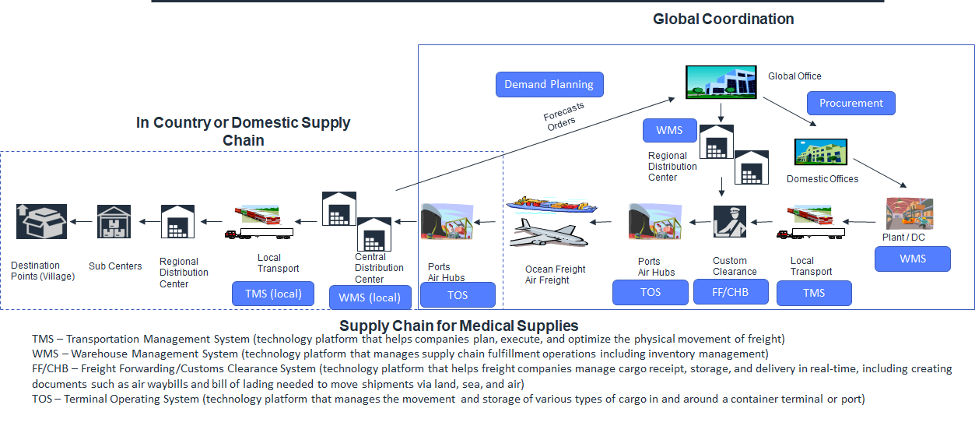
A supply chain is a link of companies, individuals, and distributors that work together to facilitate the movement of goods. The supply chain includes everything from the initial collection of raw materials and the production of goods to their shipment and safe arrival with an end customer.
Supply chain links
Initially, the main element that connected each stage of the supply chain was the physical goods that companies move from phase to phase. Manufacturers, distribution centers, and logistics businesses all support the movement of these products from one location to another.
Data is another element connecting each part of the supply chain in the digital age. By exchanging data between different phases of the supply chain, a business can coordinate, communicate, and plan methods to streamline the movement of goods.
Various technologies that help with supply chain management, planning, demand forecasting, and inventory tracking now connect different phases of the supply chain.
What are the benefits of supply chain management?
Supply chain management offers businesses several benefits.
Improve efficiency
Supply chain management allows businesses to streamline various stages of operations. For example, companies use demand forecasting to effectively allocate resources ahead of time and streamline production and distribution. They also use AI tools to optimize logistics carriers’ routes automatically. These adjustments save time and fuel, enhance efficiency, and reduce costs.
Supply chain management offers the ability to identify and eliminate bottlenecks across every stage. Better management allows businesses to streamline their movement across the supply chain and enhance efficiency gains.
Boost customer satisfaction
Supply chain management provides greater visibility into the location of products in their journey across each chain link. This added precision allows businesses to better predict when a product will arrive to a customer. Accurate delivery times help to satisfy customer expectations and enhance their overall experience.
Optimize inventory management
Inventory management involves balancing the need to procure products and the cost of storing unsold stock for extended periods. Supply chain management helps to optimize inventory by predicting demand patterns, aligning inventory levels, and offering high visibility into inventory systems.
Mitigate risk
Effective supply chain management helps to establish contingency plans, connect with secondary suppliers, and identify potential supply chain delays. Supply chains that use these management features have more time to identify and react to potential disruptions, increasing the likelihood of fixing the problem.
For example, a business identifies that a supply cannot produce enough goods to meet demand. Early identification of this problem gives the vendor enough time to connect with a secondary supplier and acquire the additional product.
Streamline communication
The supply chain represents many businesses, logistics centers, and carriers all working together to deliver a product to an endpoint. Supply chain management provides a centralized platform for communicating with others and coordinating activities. Real-time communication pathways help to reduce delays and lower the chance of an error occurring in transit.
Reduce costs
Supply chain management helps reduce business costs across the supply chain. It improves the efficiency of the supply chain, optimizes transportation, and more effectively manages inventory. These advantages allow suppliers to reduce the cost of several SCM phases.
What are the different models of supply chain management?
Depending on a business’s goals, products, budgets, and limitations, it may opt for a different supply chain management model. Here are some common models.
Continuous flow model
The continuous flow model, also called the push model, is best for businesses with stable demand. Manufacturers continually produce products that are then instantly bought by end users. This model is typical in larger companies where demand is established, and major deviations are unlikely to occur.
Agile model
The agile model, also called the pull model, is best for businesses that work with unpredictable demand. This model is flexible as manufacturers produce goods based on customer demand at any moment. If a customer orders a product, the manufacturer collects raw materials and produces the goods quickly.
Fast chain model
The fast chain model is best for businesses with smaller product lines and shorter life cycles. As the name suggests, this form of producing and distributing products works to bring a high volume of products to market as quickly as possible.
Businesses like fashion designers or those that work with limited edition products use the fast chain model. Its low lead time and quick production cycle are useful for fast-paced industries.
Flexible model
The flexible model allows businesses to adjust production based on the market demand across seasons. The flexible model would be appropriate if a product sells well in winter but not in summer, like a wool coat. This model allows businesses to scale up or down production when required.
Custom model
Finally, there is the customer model for businesses that have specific production or transit requirements. The customer model allows businesses to customize the supply chain based on their needs. For example, if a company only needed to produce a small quantity of prototypes instead of a whole product range, it could use this model.
The custom supply chain management model is typically more costly than other options. However, this cost allows businesses to customize the process as they wish.
What are the phases of supply chain management?
There are five core phases of supply chain management.
Planning and sourcing
The first step of effective supply chain management is to set strategic objectives, define the goals of supply chains, and develop a plan to reach those goals. You must select suppliers that align with your goals, negotiate contracts, and discuss customer demand.
This stage is vital as it lays the foundation for a successful supply chain. Supply chain managers contact raw material vendors, manage supplier relationships, and integrate new suppliers into the plan.
Manufacturing and warehousing
The next phase involves monitoring the process of manufacturing and storing goods. Depending on the capabilities of supply chain partners, this stage may involve assigning additional quality assurance and control teams.
Effective warehousing does more than just store products. You also need to monitor, record, and optimize inventory levels, use predictive analysis to adjust production to demand and streamline the process of picking, packaging, and shipping products.
Distribution and delivery
An essential phase of the supply chain management process is ensuring that goods arrive where they need to go. Supply chains often partner with logistics partners and last-mile delivery services to deliver customer packages.
In the modern economy, businesses have to manage global supply chains and various supply chain partners worldwide. This phase involves complete visibility into distribution methods and delivery pathways that goods take.
Customer service
After a customer receives a product, they may need additional assistance or decide to return it. Alternatively, if you discover a defective product, you may need to recall all the goods you have shipped to customers. Such scenarios create an additional supply chain phase involving moving the product from the customer back to a distribution center.
Continuous improvement
Supply chain management solutions always look for ways to optimize each phase of the supply chain. Continuous improvement refers to collecting data on each phase and identifying potential areas to improve. This last phase is crucial in continually optimizing the supply chain to minimize delays and maximize profit.
What are the technologies used in supply chain management?
Supply chain management uses several technologies to ensure high reliability, efficiency, and resilience across the entire supply chain.
Blockchain
Blockchain technology is an advanced database mechanism that allows transparent information sharing within a business network. A blockchain database stores data in blocks linked together in a chain. The data is chronologically consistent because you cannot delete or modify the chain without consensus from the network. As a result, you can use blockchain to create an unalterable or immutable ledger for tracking orders, payments, accounts, and other transactions.
Blockchain improves traceability, transparency, and visibility in the supply chain. It is helpful for supply chains that need high transparency in processes like inventory management.
Internet of Things
IoT refers to the collective network of connected devices and the technology that facilitates communication between devices and the cloud, as well as between the devices themselves. Smart devices like GPS trackers, truck environmental sensors, and RFID tags track shipments, ensure optimal delivery conditions, and streamline goods tracking. They also play a role in supply chain management, from monitoring and optimization to enhancing visibility.
Artificial intelligence
AI technologies like machine learning and predictive analysis streamline the analysis of vast data quantities. Supply chain professionals then extract actionable insights from this data to optimize the supply chain. AI algorithms have many uses in the supply chain, from improving demand forecasting accuracy and routine planning to enhancing inventory management and risk detection.
Cloud computing
Cloud computing provides supply chain management with a flexible and scalable architecture to collect, store, and process supply chain data. You can also use it to store supply chain data or host existing platforms and tools. Cloud computing offers real-time information sharing between partners, integration with existing tools, and additional agility for users.
Robotics
The supply chain may use robotics solutions, particularly in the manufacturing and warehouse phase, to increase productivity in these environments. Robotic systems that automatically assemble, pick, or package products help to optimize manufacturing and storage.
How can AWS help with supply chain management?
Supply chain management on AWS offers numerous tools you can leverage to enhance your supply chain efficiency while reducing risks. These tools help improve forecast accuracy, reduce inventory costs, and improve capacity utilization. For example
-
AWS Supply Chain is a cloud-based application that unifies data and provides ML-powered actionable insights, built-in contextual collaboration, and demand planning.
-
AWS Panorama adds computer vision to your existing fleet of cameras. This integration uses ML to enhance logistics, recognize texts in labels, or track and optimize freight operations.
-
AWS B2B Data Interchange is a fully managed service that automates the transformation of Electronic Interchange Data (EDI) documents into common data representations to facilitate communication between logistics partners.
-
Amazon Managed Blockchain (AMB) helps power your digital applications with real-time blockchain data and create automatic smart contracts for each supply chain phase.
-
Amazon Forecast offers accurate business outcome predictions. Using machine learning, you can scale your predictive operations, optimize inventory management, and reduce waste in the supply chain.
Get started with supply chain management with AWS by creating a free account today.
Browse all cloud computing concepts
Browse all cloud computing concepts content here:
Did you find what you were looking for today?
Let us know so we can improve the quality of the content on our pages