AWS Partner Network (APN) Blog
Modernizing public sector applications with Sembix Studio on AWS
By: Jack Histon, CTO & Co-Founder – Sembix
By: Kevin McCandless, Sr. Solutions Architect – AWS
 |
| Sembix |
 |
Legacy applications power essential functions within government, education, and other public sector institutions, but are difficult to maintain with limited technical resources and budgets. Common examples include mainframe and monolithic applications that use outdated technologies and have evolved over years of customization. These legacy applications are resource-intensive to operate and maintain, preventing public sector organizations from delivering new features or adapting to changing requirements. Traditional modernization approaches require significant initial investment, extensive expertise, and lengthy project timelines that disrupt daily operations. Despite increasing performance demands and security requirements, these barriers have prevented many organizations from updating systems that desperately need improvement.
Public sector organizations can now modernize mission-critical legacy applications faster and more affordably using generative AI. This technology transforms what was previously a complex, resource-intensive process into a streamlined approach that fits within existing budget and staffing constraints. AI agents and automated workflows can accelerate application modernization while reducing costs and technical complexity.
Sembix Studio on AWS
Sembix is an AWS Select Tier Services Partner whose mission is to transform the way organizations approach application modernization, using a combination of AI powered approaches and expert human guidance. Sembix developed Sembix Studio, a no-code solution that organizations can use to design, run, and monitor AI-powered workflows using a drag-and-drop interface. With Sembix Studio, organizations can use AI to automate and orchestrate the modernization of legacy applications into modern, cloud-centric systems. Instead of refactoring old code, it uses generative AI and specialized workflows to intelligently analyze existing systems and rewrite them to use modern tools and methods. The solution and its workflow packs accelerate every step of the process, including system analysis, code generation, and deployment.

Sembix Studio is built on Amazon Bedrock, a fully managed service that offers a choice of industry leading foundation models (FMs) along with a broad set of capabilities for building generative AI applications and agents. With Amazon Bedrock, Sembix Studio can use generative AI to gain a contextual understanding of software. Sembix Studio uses FMs to analyze codebases and documentation, identify modernization opportunities, and generate new features and build processes.
Each workflow is built for the cloud from the start, so organizations can scale confidently on more secure, cloud-centric foundations. The system aligns with AWS Well-Architected best practices to use the security, performance, and resilience benefits of AWS. By saving time and reducing costs through automation with Sembix Studio, public sector teams can deliver these modernized applications in weeks instead of months or even years.
Assessing legacy applications
Most modernization projects stumble at the first step: understanding what already exists. Legacy applications are often complex, poorly documented, and deeply integrated with business operations. Without a comprehensive, accurate assessment, modernization projects risk wasting valuable time and resources.
The App Modernization Workflow Pack defines the steps of the end-to-end migration process in Sembix Studio. The first phase of the App Modernization Workflow Pack is system and requirements analysis. This analysis doesn’t just translate existing code, it intelligently extracts features and evaluates capabilities to create a comprehensive semantic model of the legacy application, as shown in Figure 2.
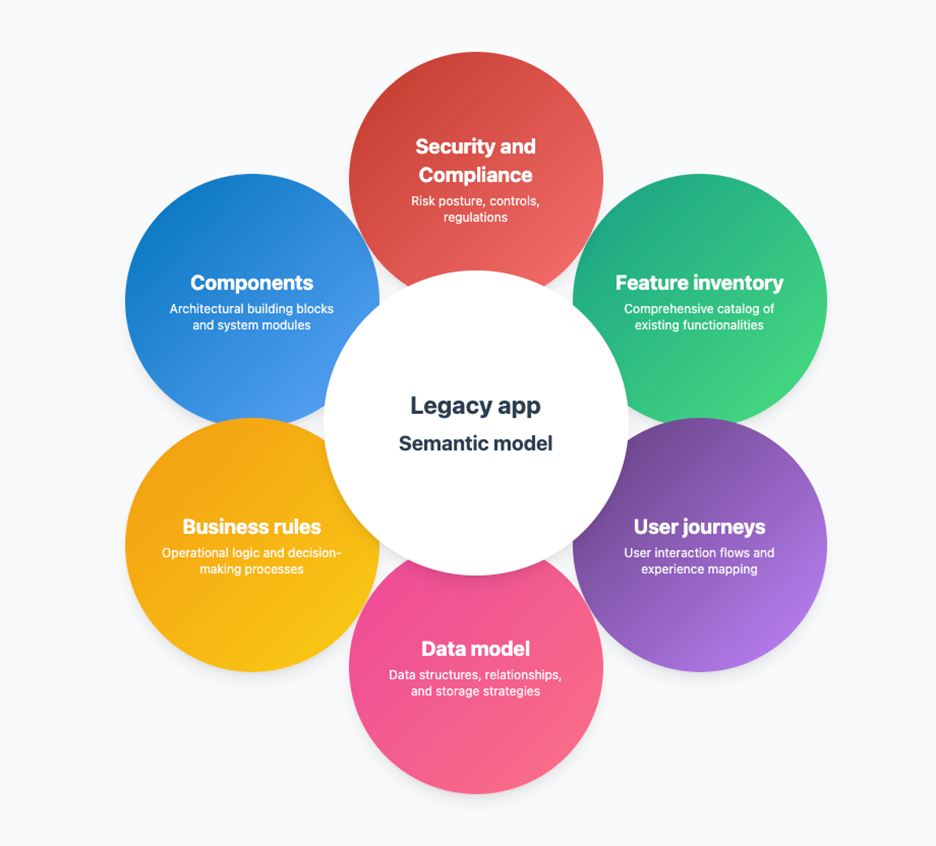
The semantic model is an AI-driven blueprint that reveals:
- Components: Architectural modules and dependencies
- Features inventory: A catalog of system functions, including edge cases
- Business rules: The logic that drives decision-making
- User journeys: How real people interact with the application
- Data model: How information is structured, stored, and related
- Security and compliance: Strengths, gaps, and risks
This model helps leaders accurately evaluate what they have, what they need, and what can be retired. The output is used to generate a data-driven roadmap with credible backlog items, reliable cost estimates, and priorities grounded in real user experience. Instead of guessing what to do next, these assessment results give public sector organizations a clear picture of where they are now and where they need to go next.
The Sembix modernization process
Assessment is only the first step in modernizing a legacy application. The entire Sembix modernization process consists of four comprehensive phases:
- System and requirements analysis:
- AI agents evaluate the existing codebase, discover dependencies, map out business logic, and identify technical debt.
- The App Modernization Workflow Pack generates a semantic model that captures components, features, business rules, user journeys, data structures, and security posture.
- Sembix’s applied AI experts validate and refine the results, closing the gap between documentation, reality, and usage.
- Feature mapping and prioritization:
- With a clear inventory from the semantic model, AI agents categorize features as must-have, should-have, could-have, or won’t-have using the MoSCoW prioritization framework and custom techniques.
- AI agents score features on dimensions such as business value, risk, and stability.
- As part of the feature inventory step of the App Modernization Workflow Pack, AI agents help make sure that prioritized features align with modern design, usability, and AWS best practices.
- Backlog, estimates, and workflows:
- AI translates features into accurate workload, cost, and time estimates to generate detailed backlog items.
- Sembix selects from AI agents that are tailored for common modernization tasks such as refactoring, API extraction, service decoupling, and more.
- This phase incorporates Sembix’s unique blend of curated agent workflows, product expertise, and domain experience so costs remain low with consistent results.
- Code rewrite, generation, and deployment:
- With priorities set, AI-driven tools and agents begin code generation and transformation. Human experts review, refine, and integrate the code.
- AWS services for functions such as compute, storage, orchestration, and monitoring become the foundation of the modernized application as it’s re-architected for cloud-native delivery.
- Quality, security, and maintainability are baked in, not added later.
What sets Sembix apart?
Sembix isn’t just another modernization vendor. Figure 3 shows what sets the Sembix approach apart.
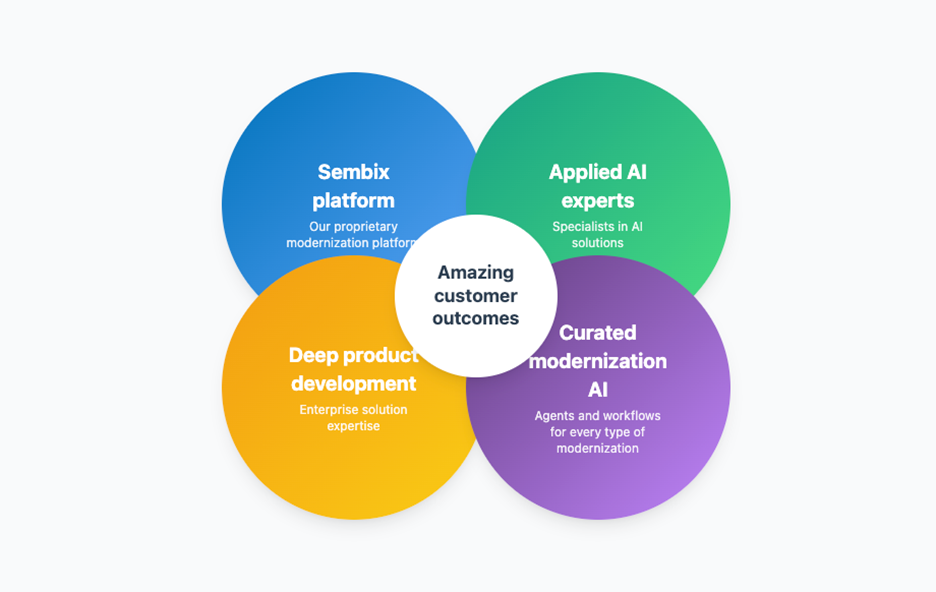
These four key differentiators help Sembix deliver results for customers:
- A purpose-built modernization solution built with comprehensive, flexible, and repeatable use cases, so the process doesn’t have to be reinvented for every project.
- Applied AI experts who understand both legacy system complexity and modern cloud and AI tools. They correct, guide, and supervise.
- Deep product development expertise so that applications are designed for users, maintainability, and future evolution, not just technical specifications.
- Curated modernization AI agents and workflows engineered for recurring modernization tasks, patterns, and templates.
Customer example: Pulse AI teacher assistant for Region 13
Education Service Center Region 13 is one of twenty service centers that serve Texas’ educational needs. Like many educational service agencies, they need to provide tools to support teachers and administrators while facing budget and staffing constraints. Region 13 sought to deliver enhanced educator support using generative AI, but traditional development approaches would have taken months, if not years, and were too costly to be feasible.
With Sembix Studio and AWS, Region 13 was able to build Pulse, an AI-powered teacher assistant. The Sembix App Modernization Workflow Pack assessment results revealed that automation of teacher workflows would deliver the most value to the organization. That insight guided the development of Pulse over the course of just six weeks. Now, the AI capabilities of Pulse help educators track assignments, monitor attendance, and identify at-risk students, freeing up time for teaching rather than paperwork.
The results, compared to estimates for traditional application modernization:
- Up to 18 times faster delivery compared to traditional development
- 84.2% cost savings, freeing resources for other initiatives
- Statewide scalability and reliability, designed from day one to run on AWS
By focusing on what mattered and using the AI capabilities of Sembix Studio, Region 13 avoided wasted effort, reduced risk, and achieved measurable results.
Conclusion
The impact of application modernization with Sembix Studio on AWS is clear. Initiatives that were previously expected to take months or years can now be delivered in weeks. Automation reduces dependency on large development teams, making projects feasible even with limited staff. By modernizing incrementally, organizations can reduce technical debt and future-proof mission critical systems. Applications run natively on AWS, scaling seamlessly with demand. For public sector leaders, this speed, efficiency, and scalability means that modernization becomes practical and achievable. Projects no longer need to be delayed or abandoned due to budget and resource constraints.
If your organization has put off modernization because it seemed too costly, complex, or slow, now is the time to reconsider. Connect with Sembix to explore how Sembix Studio can help you assess legacy systems, design a clear modernization path, and deliver results at a fraction of the time and cost of traditional development.
.

.
Sembix – AWS Partner Spotlight
Sembix is an AWS Select Tier Services Partner whose mission is to transform the way organizations approach application modernization, using a combination of AI powered approaches and expert human guidance.