AWS Architecture Blog
How Thermo Fisher Scientific built AI-powered patient matching on AWS
Clinical trial recruitment is often described as a patient-matching challenge. In practice, it is much broader. Patient Recruitment teams need to understand where potential participants are in the recruitment journey, how sites are performing, which geographies may offer the strongest opportunities, and whether enough patients may meet increasingly complex study criteria. The answers often sit across different systems, datasets, surveys, questionnaires, consent records, marketing interactions, and operational workflows.
For Thermo Fisher Scientific, improving that experience required more than introducing a new application. It required rethinking the data foundation supporting patient recruitment and creating a more scalable way to turn recruitment data into actionable insights.
Using AWS, Thermo Fisher Scientific established a modern patient recruitment data foundation which brings together and curates data for analytics and AI-enabled use cases. Built on this foundation are complementary capabilities including Patient Recruitment’s Central Insights Hub (CIH), which provides recruitment analytics and operational visibility, and Patient Match AI, Thermo Fisher Scientific’s proprietary tool, that supports self-service patient search, feasibility assessment, and cohort discovery through natural-language interaction.
The impact is particularly visible in cohort discovery. Questions that could previously involve days or even weeks of analysis and back-and-forth with technical teams can now be explored and refined in minutes, giving recruitment teams a faster path from a question to an actionable patient population.
As these capabilities moved toward production, Thermo Fisher Scientific also worked with AWS Countdown Premium to strengthen operational readiness, support launch activities, and reduce risk during a critical stage of the transformation.
The challenge
Over time, patient recruitment data had grown across multiple systems and use cases. Patient information, surveys and questionnaires, recruitment funnel activity, marketing interactions, consent information, site data, and other operational datasets did not always exist in a single, consistent form.
That fragmentation created several challenges.
Recruitment teams needed faster ways to identify and refine relevant patient populations across large volumes of records. They also needed a clearer view of recruitment performance across studies, sites, and geographies. At the same time, the organization wanted to introduce AI-enabled capabilities without compromising data quality, privacy, governance, or compliance.
Existing processes often depended on specialized technical teams to translate business or clinical questions into database queries, retrieve the appropriate data, validate the results, and then repeat the process as criteria changed.
For a simple question, that approach could be manageable. For complex cohort discovery involving multiple clinical, demographic, geographic, or consent-related criteria, it could become a lengthy iterative process.
Thermo Fisher Scientific therefore faced two connected challenges: modernizing the patient recruitment data environment and making that data easier for business users to explore and act on.
Building the data foundation first
Rather than treating AI as a layer that could simply be added to existing systems, the team started with the data. Thermo Fisher Scientific established a modern patient recruitment data foundation on AWS to bring together information from previously disconnected sources and prepare it for downstream analytics and intelligent applications.
The new foundation standardizes and curates data from sources such as patient profiles, surveys, questionnaires, recruitment funnel activity, marketing information, consent data, and other recruitment datasets. Data transformations help create more consistent structures and reusable datasets for applications that depend on them.
This approach provides an important separation of concerns: source systems continue to serve their operational purposes, while curated datasets are prepared specifically for analytics, reporting, and AI-driven workloads.
For the business, the result is a more trusted and reusable source of recruitment information. For technology teams, it creates a scalable foundation that can support multiple products instead of building separate data pipelines for every new use case.
Turning recruitment data into operational insight with Central Insights Hub
One of the capabilities supported by this broader modernization is Central Insights Hub (CIH), Thermo Fisher’s in-house custom UI layer built using open-source technologies.
CIH is a centralized clinical trial recruitment analytics platform that helps teams understand how recruitment efforts are performing across studies.
Through interactive dashboards and visualizations, users can follow the recruitment journey from initial patient engagement through milestones such as pre-screening, referral to a study site, consent, enrollment, and randomization.
The platform brings together views of patient progression, site activity, recruitment timelines, geographic performance, and other operational measures. As CIH has evolved, additional capabilities have expanded visibility into areas such as recruitment costs, participant demographics, disqualification trends, site-patient engagement, and marketing-channel performance.
This gives recruitment teams a common place to identify bottlenecks, compare activity across sites and countries, understand where additional attention may be required, and make more timely decisions.
CIH shows how recruitment is performing and where teams should focus.
Making cohort discovery self-service with Patient Match AI
Patient Match AI, an internal tool within Thermo Fisher, addresses a different, but complementary, challenge: helping users quickly determine which patient populations may be relevant to a recruitment need.
Instead of asking a technical team to manually construct database queries, users can describe what they are looking for in natural language.
For example, a user may begin by asking for the number of patients who meet a broad clinical condition. They can then progressively refine that population by age, geography, diagnosis, treatment history, demographic characteristics, consent or contactability criteria, and other available attributes.
The intended experience follows a straightforward progression:
COUNT → REFINE → TARGETED LIST → EXPORT
Users can start by understanding the size of a potential population, refine the criteria as they learn more, and then move toward a targeted patient cohort when appropriate.
This changes the working model from a series of handoffs to a more interactive, self-service experience.
Tasks that previously could require several rounds of analysis over days or weeks can, for many common feasibility workflows, now be explored in minutes. Recruitment teams can test assumptions, adjust criteria, and understand how those changes affect the potential population without restarting the process each time.
Patient Match AI also supports aggregate insights and visualizations, helping users better understand the composition of a cohort before progressing to governed workflows when patient identity information is required.
Privacy, governance, consent, contactability, and personally identifiable information (PII) controls, consistent with applicable regulatory requirements, remain an important part of the design. The objective is not unrestricted access to patient data, but a faster and more intuitive way to work within established recruitment and governance processes.
Architecture overview
The following diagram shows how data moves from source systems through the curated data foundation into Patient Match AI and Central Insights Hub, and the key AWS services involved at each stage.
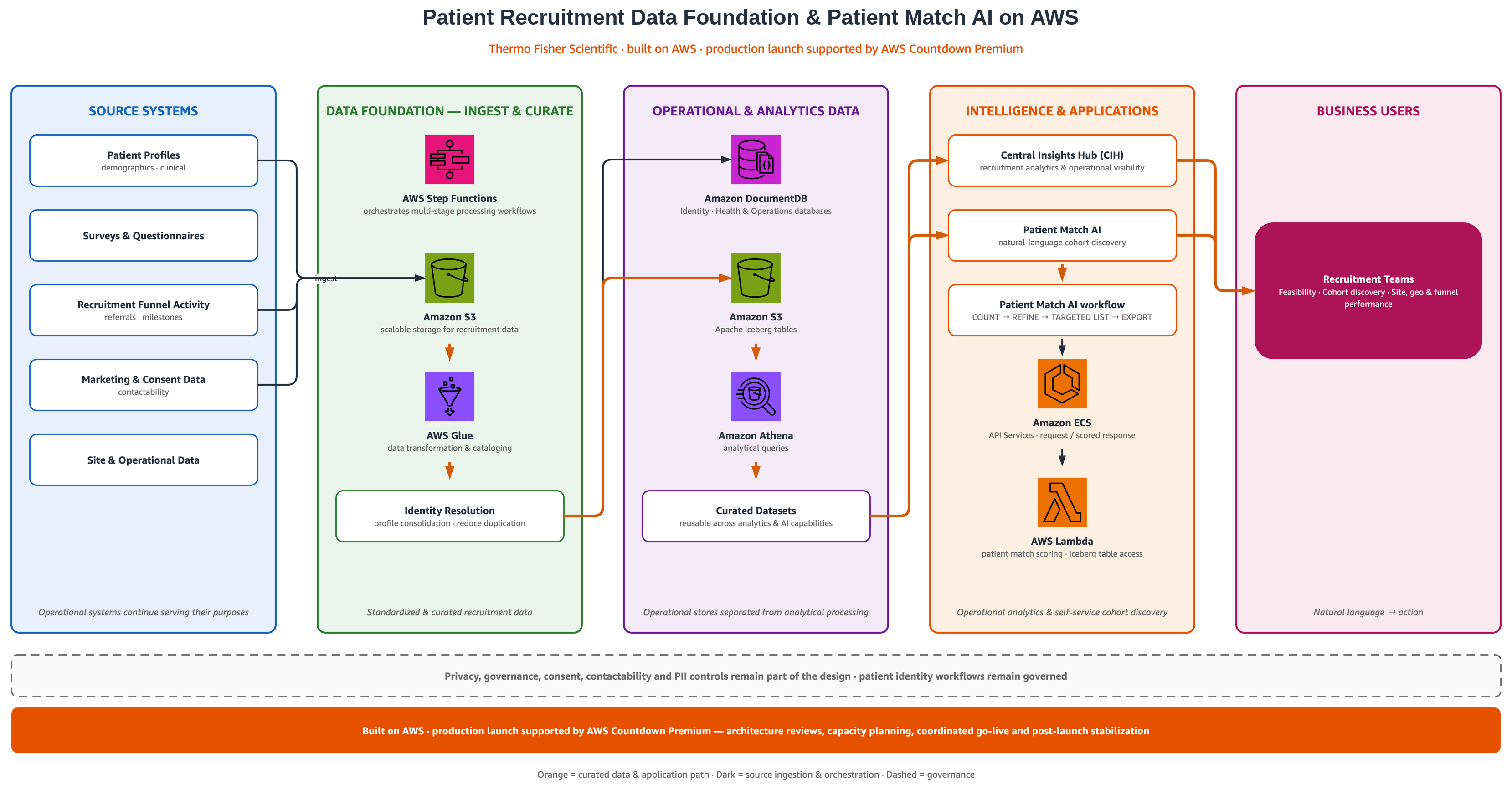
Figure 1: How data moves from source systems through the curated data foundation into Patient Match AI and Central Insights Hub
The solution uses a cloud-native architecture on AWS that combines managed services for data storage, transformation, orchestration, analytics, AI workloads, and application delivery.
Amazon Simple Storage Service (Amazon S3) provides scalable storage for recruitment data, while AWS Glue supports data transformation and cataloging. AWS Step Functions orchestrates multi-stage data processing workflows, and Amazon Athena runs analytical queries across curated datasets.
The analytics layer uses Apache Iceberg tables on Amazon S3, providing a flexible foundation for large-scale analytical workloads and supporting continued growth in both data volume and use cases.
A key architectural principle is the separation of operational application workloads from analytical processing. Complex cohort and eligibility queries can therefore run across large volumes of patient profiles without placing the same workload on transactional application databases.
Thermo Fisher’s identity resolution and profile consolidation processes also help bring together records originating from multiple systems, reducing duplication and establishing a more consistent view for downstream recruitment use cases.
The outcome is not simply a collection of cloud services. It is an architecture designed so that data can be ingested, curated, queried, and reused across analytics and AI capabilities without rebuilding the underlying foundation for every product.
Source systems include patient profiles, surveys and questionnaires, recruitment funnel activity, marketing and consent data, and site and operational data. These sources are ingested into the data foundation. There, AWS Step Functions orchestrates multi-stage processing, Amazon S3 provides storage, and AWS Glue handles transformation and cataloging. An identity resolution step consolidates profiles and reduces duplication.
Curated data then flows into two separated stores. Amazon DocumentDB (with MongoDB compatibility) holds identity, health, and operations data. The team selected it as the closest managed equivalent to the MongoDB database they had previously relied on. Amazon S3 with Apache Iceberg tables, queried through Amazon Athena, holds the analytics data.
These curated datasets feed the intelligence layer. Central Insights Hub provides recruitment analytics, and Patient Match AI supports natural-language cohort discovery through a COUNT, REFINE, TARGETED LIST, and EXPORT workflow. Amazon Elastic Container Service (Amazon ECS) hosts the API layer, and AWS Lambda performs patient match scoring. Results reach recruitment teams for feasibility, cohort discovery, and site, geographic, and funnel performance analysis. Throughout, privacy, governance, consent, contactability, and PII controls remain part of the design.
Preparing for production with AWS Countdown Premium
Building technology was only part of the journey. Moving a large-scale recruitment capability into production required confidence that the architecture, capacity, operating procedures, and support model were ready for launch.
Thermo Fisher Scientific engaged AWS Countdown Premium from the testing phase onward.
AWS Countdown Premium is an engineer-led support service that provides designated expertise and guidance across critical phases of cloud projects. For this engagement, that support helped the team prepare for launch in four key areas.
Designated engineering expertise
A specialist engineer selected from a team of AWS experts served as a consistent technical point of contact and developed a deeper understanding of the Patient Match AI architecture.
That continuity was valuable when working through complex technical issues. Rather than rebuilding context for each support interaction, the team could work with an engineer who was already familiar with the system and could coordinate access to additional AWS subject matter experts when needed.
One example from the engagement:
Pipeline design review: An AWS specialist engineer reviewed key design decisions ahead of launch. The patient scoring logic moved away from retrieving every record before ranking, and the pipeline was parallelized before sorting and querying. For long-running external calls in AWS Step Functions, the team adopted the wait-for-callback pattern, so they pay only for state transitions and not for idle wait time.
Operational readiness and proactive planning
The engagement focused on identifying potential issues before production rather than waiting for them to appear during launch.
Pre-event reviews, capacity planning, operational runbooks, and decision frameworks helped the team validate that the environment was prepared to support large-scale patient recruitment workloads.
Another example from the engagement:
AWS Glue readiness review: An AWS Glue specialist reviewed the team’s extract, transform, and load (ETL) jobs in non-production and shared written recommendations before launch. The team also received guidance on reading Apache Iceberg tables through the AWS Glue Iceberg REST endpoint and on putting AWS Glue Studio visual jobs under source control.
Support during go-live
During launch, coordinated AWS support provided another layer of technical coverage for troubleshooting and issue resolution.
For a production system supporting clinical recruitment workflows, this helped the team move through go-live with greater confidence and a clear escalation path for issues requiring AWS expertise.
Post-launch stabilization
Support continued beyond the initial deployment.
This provided continuity as the team monitored production behavior, addressed early issues, and transitioned from launch activities into normal operations.
Results
By combining a modern cloud architecture with support from AWS Countdown Premium, Thermo Fisher Scientific achieved several key outcomes:
- Unified patient data – More than 20 million patient profile records, about 1.6 TB, were brought together from previously separate sources, including patient profiles, surveys, questionnaires, recruitment funnel data, marketing information and consent data.
- Self-service cohort discovery – With Patient Match AI, recruitment teams can find and refine patient populations by asking questions in plain language, and the shared test queries run in under six seconds against the full dataset.
- Faster feasibility analysis – Cohort analysis now takes minutes as opposed to days for many common feasibility and patient discovery workflows.
- More timely insights – Recruitment data is kept up to date continuously, so it is available right away for AI-driven patient search and shortly afterward for analytics dashboards.
- Modernized data foundation – The move to a data foundation built on AWS reduces reliance on the earlier Snowflake-backed dashboard environment.
- Successful production launch – Patient Match AI went live in production in Q2 FY26. AWS Countdown Premium supported the launch through an architecture review, readiness reviews for Amazon DocumentDB and AWS Glue, and expert guidance on workflow design and query optimization over a four-month engagement.
- Designated engineering support – A dedicated Countdown Premium engineer worked with the Amazon DocumentDB service team and specialists to tune the database, cutting estimated processing time by more than 3x.
- Lower launch risk – Testing at full scale against the complete 20 million record dataset exposed query performance problems early, so they could be fixed before go-live.
Looking ahead
The broader value of this transformation goes beyond any single application. Thermo Fisher Scientific has established a modern, curated patient recruitment data foundation that can support different types of experiences, from operational analytics in Central Insights Hub to AI-powered cohort discovery through Patient Match AI, and that shared foundation creates an opportunity to continue evolving recruitment capabilities without repeatedly rebuilding the underlying data infrastructure.
More importantly, it changes how recruitment teams can work with data.
Instead of waiting for information to move through multiple technical handoffs, teams can increasingly interact with trusted recruitment data directly, using dashboards to understand what is happening and natural-language tools to explore what may be possible.
Conclusion
Thermo Fisher Scientific’s modernization of its patient recruitment environment, including a modern, curated patient recruitment data foundation, Central Insights Hub (CIH), and Patient Match AI, demonstrates how organizations can combine modern data architecture, analytics, and AI capabilities to solve complex, high-stakes business problems.
By using AWS services for data management, orchestration, analytics, and AI, the team created an environment that makes recruitment information easier to access, understand, and act on. Processes that once required substantial manual analysis can now be more timely, interactive, and self-service.
AWS Countdown Premium played an important role in de-risking the transition to production. Designated engineering support, proactive planning, launch assistance, and post-launch stabilization helped the team move these capabilities into production with greater confidence and operational readiness.
For Thermo Fisher Scientific, the result is more than a technology modernization. It is a foundation for helping recruitment teams move from data to insight, and from insight to action, faster.
Other organizations have used AWS Countdown Premium for similar initiatives, from improving manufacturing operations to seamless website migration and accelerating critical cloud migrations.
To learn more about how AWS Countdown Premium can support your next critical cloud initiative, reach out to your AWS account team.
Acknowledgements
Special thanks to everyone who contributed to this launch:
- Patient Recruitment Engineering Team: Prameela Yasa, Madhurendra Singh, Prakash Singh, Karthik Tirumalasetti, Thanmay Jasti Naga Chowdry, Pawan Shah, Arnab Ghosh, Denys Martsynko, Maria Ozirskaya, Daniel Petko.
- AWS Leadership: Kwesi Edwards, Mary Marzak.