AWS for SAP
Expanding Amazon’s Supply Chain Capabilities for SAP Customers: Multi-Channel Fulfillment Accelerator
In May 2026, Amazon brought the reliability, resilience, and convenience of its supply chain capabilities along with the network and technology behind it under one logistics system and name: Amazon Supply Chain Services (ASCS). First built for Amazon, then extended to sellers, now for all businesses and sales channels. Amazon Multi-Channel Fulfillment (MCF) is a key pillar of the network. With MCF, you can use the same fulfillment network that powers Amazon.com to pick, pack, and ship orders from multiple sales channels. That includes your own website, social commerce, and third-party marketplaces, each from a single pool of inventory. One network, multiple channels. Amazon’s Supply Chain Services – MCF motto is “Our network is your network – From inbound to last mile”
Today, we’re excited to bring the next chapter in Amazon’s commitment to SAP on AWS customers: The accelerator for Amazon Multi-Channel Fulfillment (MCF) and SAP.
At Amazon, every product decision starts with the customer and works backwards. In early 2026, we launched the Amazon MCF and Buy with Prime Accelerators for SAP S/4HANA. We are now extending the native MCF capabilities to customers running SAP ECC or SAP S/4 HANA on AWS. With these Accelerators, you can use Amazon’s logistics network to grow your business, improve customer experience, and strengthen supply chain resilience.
Thousands of enterprises run SAP on AWS for their most mission-critical business processes. With these SAP accelerators, we bring Amazon’s supply chain capabilities directly into your SAP environment, with no disruption to the business processes you run today.
Here’s how customers are already doing it:
Adidas runs its mission-critical SAP ERP on AWS and uses Amazon’s Buy with Prime to bring Prime benefits to its own direct-to-consumer channel. Those benefits include fast, free delivery, easy returns, and 24/7 shopper support. Across merchants, Buy with Prime has delivered an average 16% lift in revenue per shopper, and 95% of shoppers say they’d use it again.
3M migrated critical ERP workloads to AWS using SAP on AWS. It uses Amazon’s freight services to move products from its manufacturing sites to distribution centers worldwide.
How do you leverage Amazon MCF for SAP
The integration for Amazon MCF and SAP works with your existing SAP system on AWS. With the accelerator, you can use SAP BTP and Amazon’s MCF APIs to connect your existing order management to Amazon’s fulfillment systems. Your business processes stay intact, the initial implementation is simpler, and Amazon’s fulfillment network does the heavy lifting in the background.
The high-level diagram shows how a delivery request flows from SAP to Amazon MCF and back
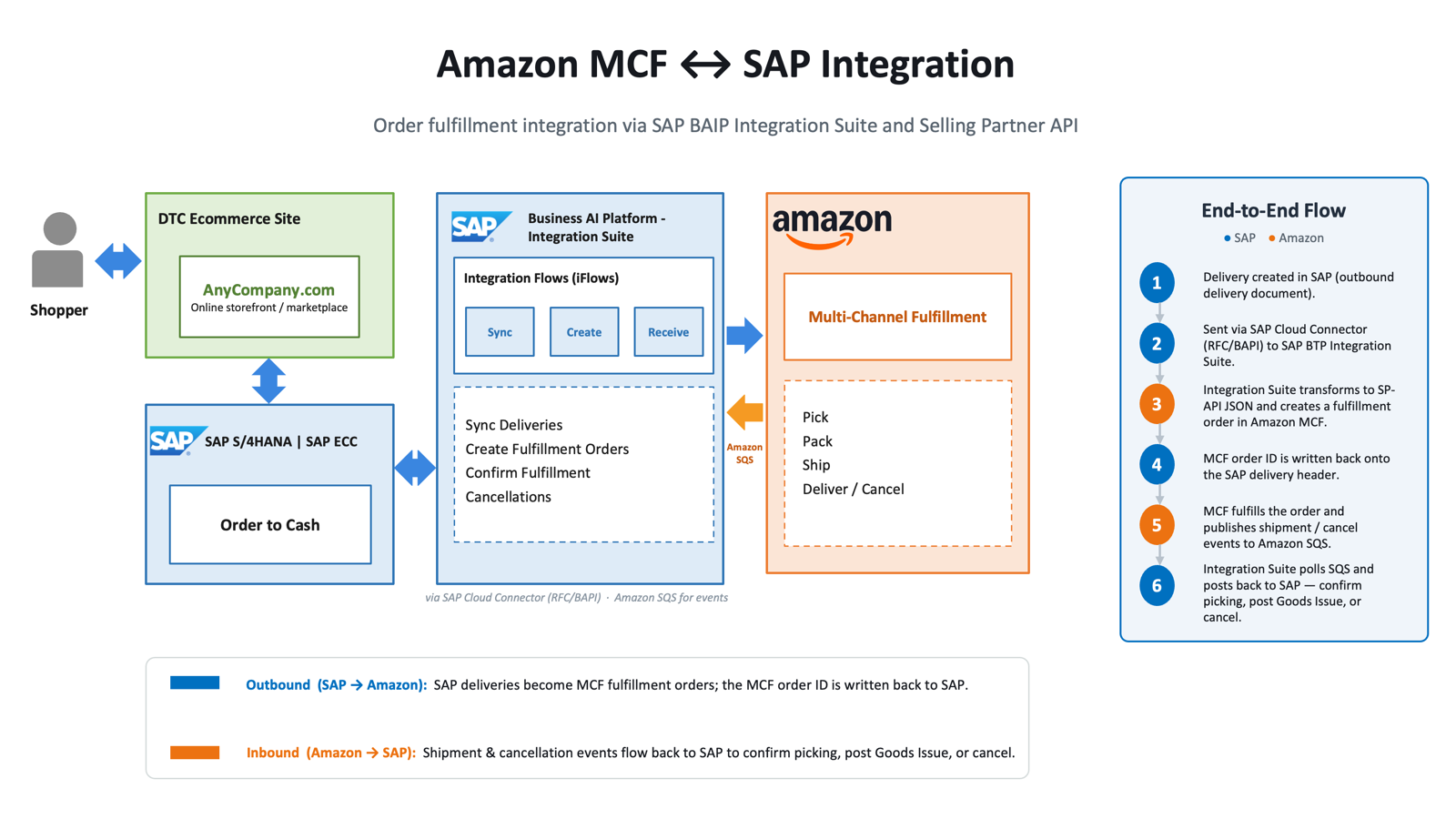
Figure -1 – Amazon MCF and SAP Integration
You can access a wide variety of fulfillment use-cases that work directly with your existing workflows and configuration. Orders are created in SAP exactly as they always have been. The moment a delivery is ready, the accelerator picks it up and submits it to Amazon MCF. Inbound events from Amazon MCF such as shipment status changes and delivery updates are automatically synced back into SAP. The integration supports multiple delivery patterns, including Amazon Simple Queue Service (Amazon SQS) giving businesses the flexibility to configure the connection that fits their existing architecture. The result is a complete, closed loop: orders submitted through the accelerator reach Amazon’s fulfillment network, and status updates flow back into SAP automatically. This delivers benefits across the customer’s organization:
- Operations teams gain confidence that the day-to-day workflow stays in SAP. Nothing changes about how deliveries are created, tracked, or closed
- IT teams benefit from having no custom code to write or maintain. The accelerator ships as a ready-to-configure package on SAP Integration Suite. It can be used as-is, extended, or used as a reference implementation
- Business leaders and executives gain faster time to value, a lower total cost of integration, and the ability to tap into Amazon’s Multi-channel fulfillment network without a transformation journey
Accelerators require SAP Integration Suite. Customers can either use their existing SAP Integration Suite investment or subscribe to SAP Integration Suite from AWS Marketplace.
The following modules are currently available:
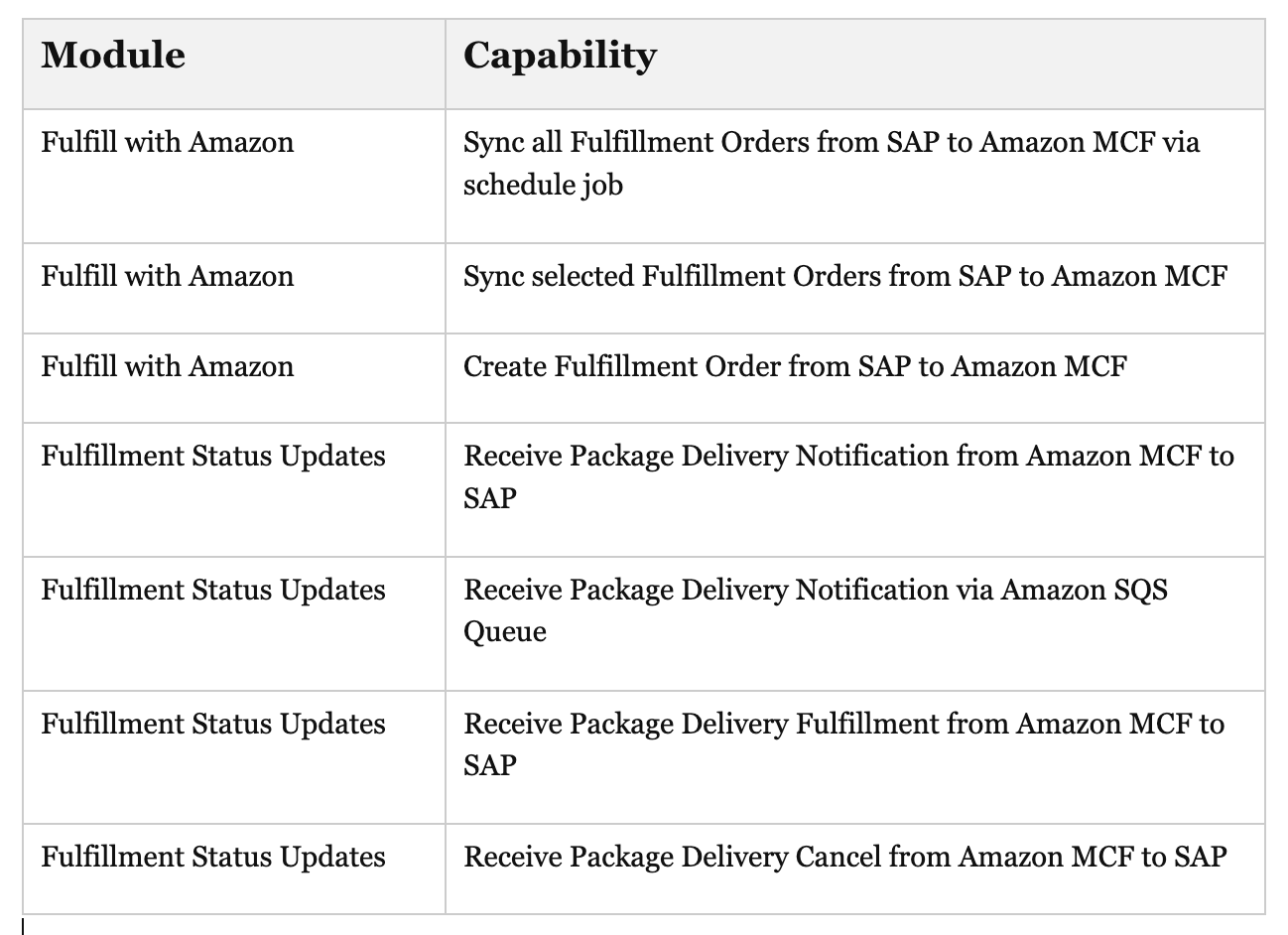
Table 1 – Modules for SAP and Amazon MCF Integration
Prerequisite
Before you install the accelerator, verify you have met the following pre-requisite requirements.
- When an order is placed on your eCommerce site, SAP system must be set up to capture the order details generated by your eCommerce site
- Subscribe to SAP BTP Integration Suite with Cloud integration capabilities
- Configure SAP Cloud Connector
- Configure Amazon Selling Partner API credentials (client ID, client secret, refresh token)
- You must align SAP master data values with corresponding SKUs in your Amazon Supply Chain catalog
Looking Ahead: SAP and Amazon MCF to Data Advantage
AWS for SAP opens the door to something bigger – data to work through AI Agents. A supply chain leader shouldn’t have to export data, put together spreadsheets, or wait days for a custom report to answer a simple question like:
- Where are my orders stuck?
- Which SKUs are about to stock out?
- What did we ship today?
The answer should be one question away, grounded in data from the system of record. The high-level diagram shows how to unlock SAP, and Amazon MCF data for research, business insights, and automation .
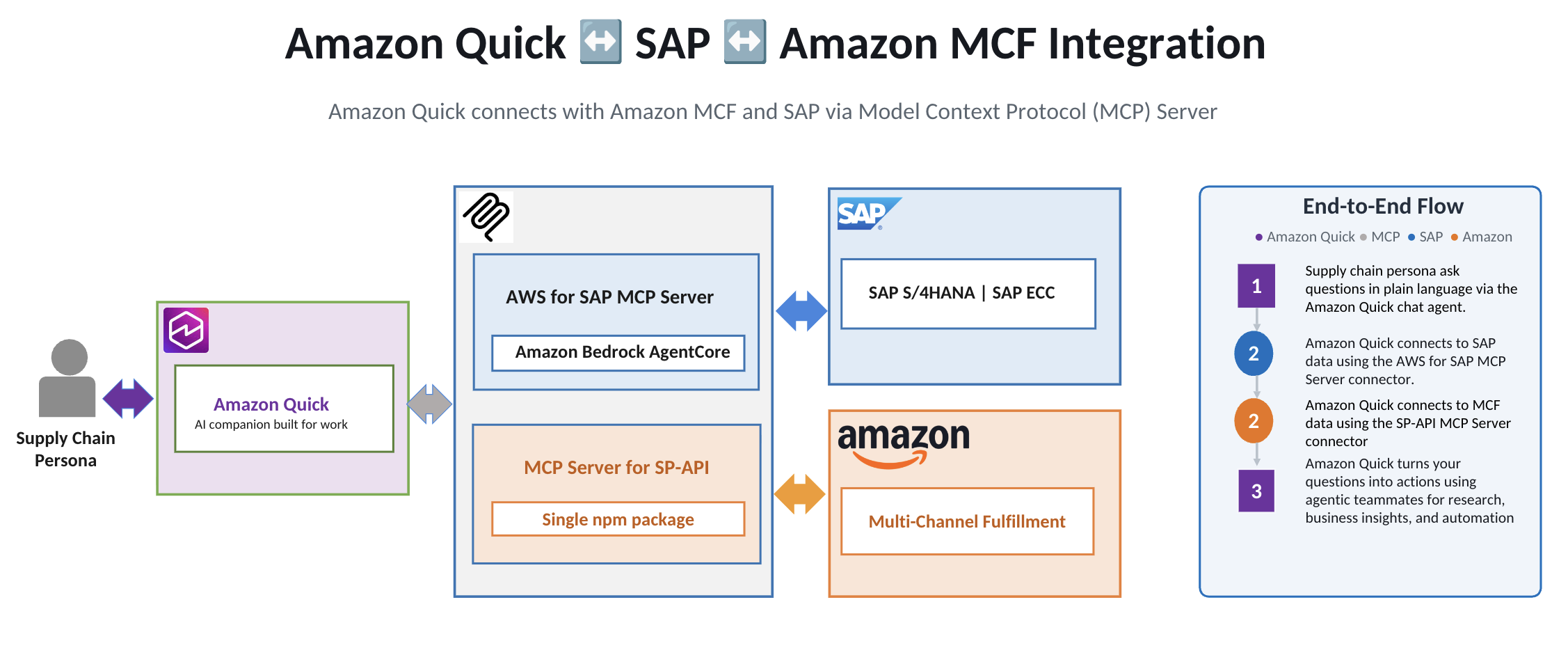
Figure -2 – Amazon Quick – SAP – Amazon MCF Integration
As a centralized place Amazon Quick connect to each system through a purpose-built Model Context Protocol (MCP) server. Instead of building and maintaining custom, point-to-point integrations, each system connects to Amazon Quick the same standardized way. Two MCP connectors make this real:
- SAP, through the AWS for SAP MCP Server. Built on Amazon Bedrock, it gives secure, protocol-driven access to SAP data over OData services.
- Amazon MCF, through the MCP for SP-API. A single npm package that bundles Amazon’s Selling Partner API developer tools.
The result is one user interface across many systems, and the payoff is speed to business insights. Instead of moving data around, teams ask questions in plain language and act on data across SAP, and Amazon MCF from a single place. Customers who intend to use the AWS for SAP MCP Server should review SAP’s Third-Party MCP Access to SAP Solutions.
Get Started Today
To get started, you can download the accelerator for Amazon Multi-channel Fulfillment and SAP ECC from the GitHub. Amazon Multi-Channel Fulfillment and Buy with Prime Accelerators for SAP S/4HANA from the GitHub or SAP Business Accelerator Hub.
To learn more about modernizing your ecommerce and order fulfillment capabilities, visit Amazon Supply Chain Services page, Amazon’s MCF page, and Buy with Prime page. To learn how AWS and SAP can unlock the full potential of your AI, data, and applications with a technology platform visit SAP on AWS page.