AWS Business Intelligence Blog
How PDI Technologies cut 300 hours of manual reporting with Amazon Quick
By modernizing reporting with Amazon Quick, PDI Technologies saves more than 300 hours annually, while delivering trusted, real-time insights to customers and internal teams alike. As a 40-year industry leader supporting more than 200,000 customers across 60 countries, PDI has long provided the technology backbone of the convenience retail and petroleum wholesale ecosystem. Through PDIQ, our purpose-built artificial intelligence (AI) foundation, we’re now applying advanced intelligence to reduce manual effort and help our customers make better decisions faster.
In this post, we share how PDI Technologies implemented Amazon Quick Sight to transform their business intelligence infrastructure, cutting manual reporting from hours to minutes and expanding analytics from one team to seven. The result is a modern technology foundation that supports company-wide analytics deployment while improving reporting efficiency across our organization.
Breaking down data silos across a growing organization
As part of our strategic cloud transformation initiative, we recognized the need to alter our business intelligence infrastructure. Our teams were previously relying on multiple systems and manual processes, including complex spreadsheet templates, to derive operational insights. While these tools offered flexibility, they also created silos of information across the organization and required significant manual effort to generate reports and analysis.
After experiencing over 30 acquisitions in the past several years, we realized the limitations of our previous approach. Teams across different functions spent countless hours manually compiling and analyzing data, sometimes leading to delayed reporting and decision-making. One team dedicated approximately 24 hours per month compiling financial data from the enterprise resource planning (ERP) system and translating it into a usable dataset. During the month-end close period, they performed uploads multiple times per day, consuming nearly 300 hours annually. The lack of a unified analytics platform meant that valuable insights were often isolated within individual departments, preventing us from gaining a comprehensive view of our operations—a common result in a highly acquisitive organization.
We needed a solution that could handle massive data transformation across multiple data lakes while providing embedded analytics capabilities for our software solutions. Additionally, we sought to allow company-wide business intelligence (BI) deployment and substantially improve reporting efficiency by reducing manual processes. The solution had to be scalable, secure, and capable of supporting both our internal analytics needs and our customers’ requirements.
Why we chose Amazon Quick
After conducting an extensive evaluation of several tools, we selected Amazon Quick for three primary reasons:
- To deliver analytics directly within PDI’s software products, we needed a platform with native embedding capabilities. Amazon Quick Sight’s support for embedding dashboards and analytics aligned with this need, enabling us to provide our customers with real-time insights within their existing workflows.
- To maintain a consistent technology stack and use existing infrastructure investments, we needed native integration with our AWS environment. Quick connects directly with Amazon Simple Storage Service (Amazon S3) and Amazon Redshift, sitting atop our data pipeline built on AWS Glue, AWS Lambda, and Amazon AppFlow. This approach simplifies our data architecture and reduces complexity across the organization.
- To support company-wide deployment and handle massive data transformation across multiple data lakes, we required a platform that could scale with our growing usage. Quick Sight’s SPICE (Super-fast, Parallel, In-memory Calculation Engine) provided the performance we needed to analyze large datasets quickly while scaling as our organization expanded.
Implementation and usage
We began our Quick implementation in August 2025, focusing initially on training subject matter experts across various functional business areas, including finance, sales, and human resources (HR). Our approach centered on creating standardized datasets to provide consistent self-service analytics capabilities throughout the organization. This standardization was essential for establishing a single source of truth for our business metrics and enabling meaningful cross-departmental analysis.
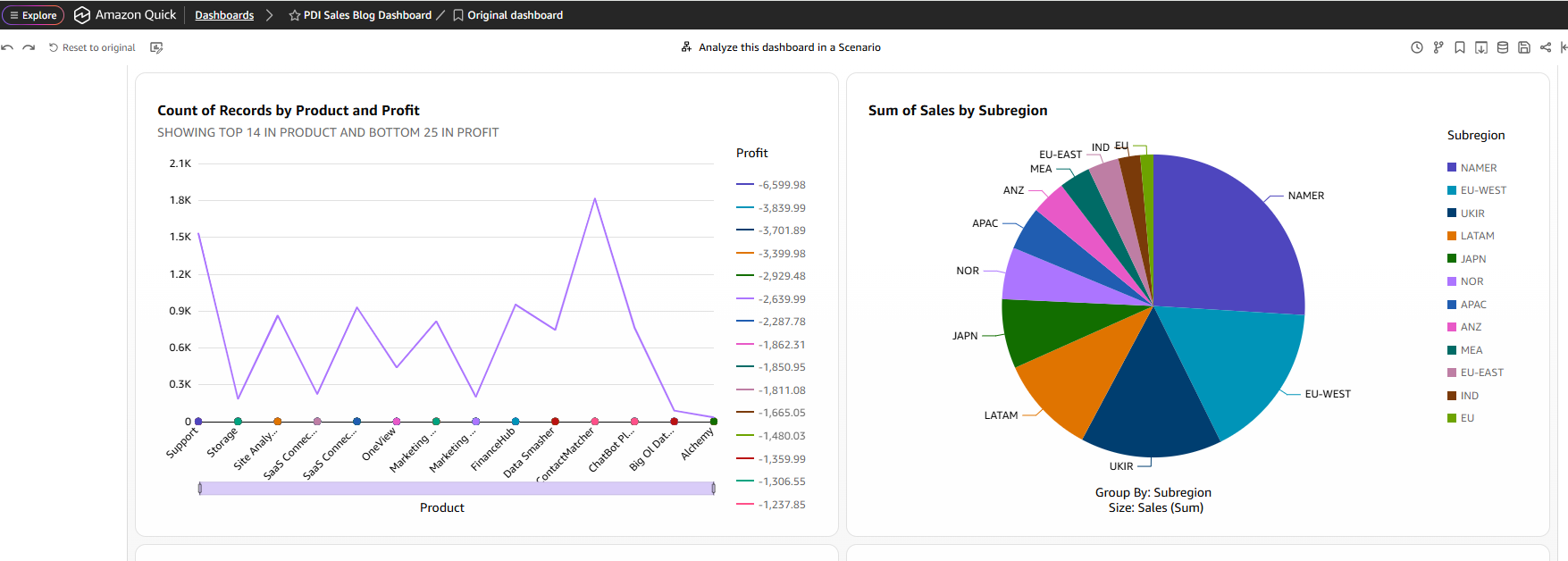
Quick Sight sales analytics dashboard
The implementation has enabled quick ad-hoc analysis capabilities as we develop comprehensive dashboards for various functional teams, including sales, revenue, HR, and marketing. Our sales teams get instant access to pipeline metrics, revenue forecasts, and customer behavior analysis. HR teams use dashboards for workforce analytics, tracking key metrics like employee engagement and departmental performance.
PDI realized a 1600% return on investment (ROI) after moving from manual, non-systemic ad-hoc analysis within finance to using Amazon Quick Scenarios. The ROI gain was realized through previous hours spent by the finance team to manually build models and configurations which required high-touch effort. They can now support ad-hoc and in-depth analysis requests in significantly reduced time using Scenarios within Quick, saving an estimated 22 hours of an analyst’s time per month.
The ability to respond in minutes, rather than hours, has resulted in faster decision-making for leadership during strategic planning and monthly forecast reviews. This demonstrates the tangible value of Quick’s built-in AI capabilities for PDI Technologies.
Technical architecture
Our technical architecture was designed to address three core challenges: unifying data from over 30 acquired companies, enabling real-time analytics at scale, and supporting both internal and customer-facing use cases. Quick connects to multiple data lakes as part of this extensive data transformation initiative, with the architecture specifically designed to support the unique needs of the convenience retail and petroleum wholesale industries we serve.
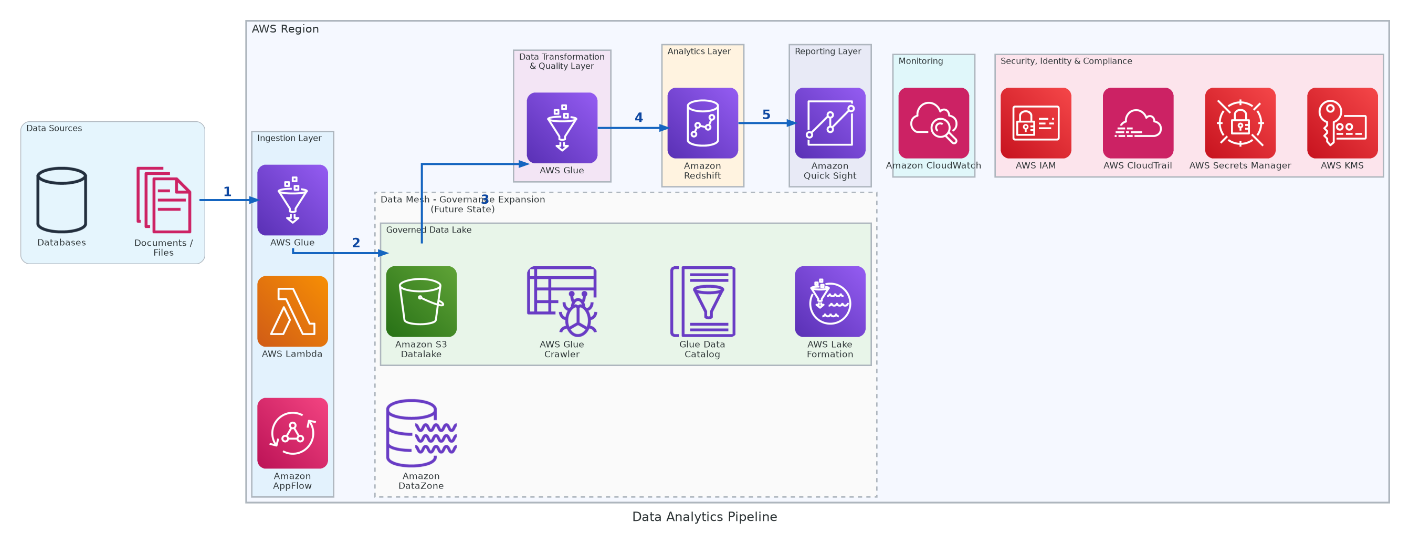
- Ingestion: Data from external sources (documents, files, and databases) is ingested into AWS through AWS Glue, AWS Lambda, and Amazon AppFlow. Glue handles batch extract, transform, and load (ETL) jobs, Lambda processes event-driven or lightweight transformations, and Amazon AppFlow pulls data from software as a service (SaaS) applications.
- Storage (Governed Data Lake): Ingested data lands in Amazon S3 as the central data lake. AWS Glue Crawlers automatically discover and catalog the data schema, populating the Glue Data Catalog as a centralized metadata repository. AWS Lake Formation enforces fine-grained access controls and governance policies over the lake. A future-state expansion to a Data Mesh pattern is planned using Amazon DataZone for domain-level data ownership and cross-team data sharing.
- Transformation & Quality: Raw data in S3 is processed through AWS Glue transformation jobs that clean, enrich, deduplicate, and reshape the data into analytics-ready formats. This layer handles data quality checks and business logic before data moves downstream.
- Analytics: Transformed data is loaded into Amazon Redshift for high-performance SQL analytics, aggregations, and complex queries across large datasets.
- Reporting: Amazon Quick Sight connects to Amazon Redshift to deliver dashboards, visualizations, and self-service BI to business users.
The platform’s AI-powered capabilities have been particularly valuable in identifying patterns and anomalies in our data that might otherwise go unnoticed. These insights have helped us optimize operations and identify new business opportunities. The architecture’s flexibility allows us to continuously add new data sources and expand our analytics capabilities as our business needs evolve.
Benefits and results
Using Quick reduced reporting time from over 10 hours to minutes, the single largest efficiency gain across the organization. This reduction in manual data entry also decreased the risk of human error while improving data accuracy. As a result, PDI Technologies achieved an 83% increase in efficiency by moving a manual operational reporting process for sales into Amazon Quick Sight dashboard reports. In addition to the efficiency gained, the sales operations team can now use AI capabilities on top of the data in Quick that were not available within manual processes.
Quick’s AI-powered capabilities for natural language querying, machine learning (ML)-powered anomaly detection, and automated forecasting have democratized data exploration and analysis. Now, end users can perform complex analysis that previously required specialized resources. We’ve seen a remarkable increase in BI adoption across the organization, with at least seven functional areas, including finance, sales, revenue operations, HR, marketing, customer success, and executive leadership now actively using Quick, compared to only one when we started.
Our customer-facing applications have also benefited from enhanced embedded analytics capabilities, strengthening our value proposition in the market. The ability to provide real-time insights and interactive dashboards has improved our customers’ decision-making capabilities and operational efficiency. This has led to increased customer satisfaction and stronger relationships with our client base.
The standardization of our data analysis processes will continue to foster collaboration between internal teams and enable more strategic decision-making across the organization. Teams now work from the same datasets and metrics, eliminating discrepancies and reducing time spent reconciling different versions of reports.
Future plans
PDI Technologies is committed to advancing toward a cloud-based operating model, and Quick plays an important role in supporting this transformation goal. While many of our analytics use cases are already delivering value, additional Quick capabilities, particularly executive-level dashboards and AI-assisted insights, are actively being developed as our data foundation continues to mature.
As part of this roadmap, we are transitioning additional workloads from our legacy BI platform to Amazon Quick. After evaluating multiple solutions, we determined that Quick Sight’s SPICE engine provides the performance and scalability required to manage large datasets efficiently while supporting our long-term product growth.
We have expanded our use of Quick’s AI-powered capabilities to support executive dashboards and customer-facing analytics. These include Amazon Q in Quick Sight for natural language data exploration, automated narrative generation for executive summaries, and ML-driven forecasting models. PDI Technologies’ procurement team lead can go into the Procurement Dashboard and ask, “Which vendors do we have the highest spend with and within what spend categories?” and get results immediately through Chat Agents, eliminating the dependency on finance partners for ad-hoc analysis. That response is grounded in PDI-specific context: preferred vendors, category taxonomies, and contract terms. Spaces stores their institutional procurement knowledge so every team member gets consistent, organization-aware responses.
From those insights, Stories auto-generates executive-ready narratives on vendor performance and spend trends that previously took analysts days to compile manually. These features enable more intuitive data exploration and AI-driven insights, helping users make faster, more informed decisions.
Looking ahead, we are working on embedding these dashboards and insights into our customer relationship management (CRM) system, meeting our sales and marketing teams where they work. This integration will improve user adoption by providing relevant insights within the tools our teams use daily. The embedded analytics capability has become a key differentiator for our software products, allowing our customers to access powerful analytics without leaving their primary work environment.
Our work with AWS demonstrates how Quick can serve both as an internal corporate BI tool and as an embedded analytics platform for customer-facing applications. This includes exploring Quick’s machine learning capabilities to develop industry-specific analytics models and expand our suite of pre-built dashboards for common use cases across the convenience retail and petroleum wholesale sectors.
Expanding beyond dashboards with AI-powered capabilities
As our partnership with AWS continues to grow, so does our adoption of the AI capabilities within the larger Amazon Quick. PDI is actively using additional Quick capabilities such as Chat Agents, Spaces, Stories, Topics, and Scenarios to create a more intelligent, AI-enabled analytics experience. By layering AI directly on top of governed, trusted enterprise data, Amazon Quick helps our users spend less time building dashboards. They spend more time accelerating insight generation, exploring trends conversationally, modeling what-if scenarios, and driving business decisions. The ability to generate analyses and executive-ready insights from trusted data using AI instantly will continue to provide immense value to PDI as we evolve as a data- and AI-driven organization.
Conclusion: Early wins and a plan for continued success
Our journey with Amazon Quick represents a complete BI transformation as part of our broader cloud modernization strategy, built on a strong data and AI foundation. The platform’s ability to unify our corporate data, provide embedded analytics capabilities, and scale across our organization has been instrumental in driving value for both our internal teams and customers.
Through standardization, automation, and embedded analytics, we’ve improved our operations and enhanced our service delivery across the convenience retail and petroleum wholesale. As we look to the future, we’re excited about the continued innovation and possibilities that our relationship with AWS and Quick will bring. We look forward to further embedding AI-driven insights into how we operate and serve our industry.
To learn more about building your own BI solutions with Amazon Quick, visit https://aws.amazon.com/quicksuite/quicksight or explore these resources:
- Read technical documentation to get started with Quick Sight.
- Learn about embedding analytics with Quick Sight in your applications.
- Explore other AWS customer success stories about business intelligence transformations.