AWS Compute Blog

Author: Eric Johnson
Eric Johnson is a Principal Developer Advocate for Serverless Applications at Amazon Web Services and is based in Northern Colorado. Eric is a fanatic about serverless and enjoys helping developers understand how serverless technologies introduces a major paradigm shift in how they approach building and running applications at massive scale with minimal administration overhead. Prior to this, Eric has worked as a developer, solutions architect and AWS Evangelist for an AWS partner company.

Building TypeScript projects with AWS SAM CLI
This post written by Dan Fox, Principal Specialist Solutions Architect and Roman Boiko, Senior Specialist Solutions Architect The AWS Serverless Application Model (AWS SAM) CLI provides developers with a local tool for managing serverless applications on AWS. This command line tool allows developers to initialize and configure applications, build and test locally, and deploy to […]

Using the circuit breaker pattern with AWS Step Functions and Amazon DynamoDB
This post is written by Anitha Deenadayalan, Developer Specialist SA, DevAx Modern applications use microservices as an architectural and organizational approach to software development, where the application comprises small independent services that communicate over well-defined APIs. When multiple microservices collaborate to handle requests, one or more services may become unavailable or exhibit a high latency. […]

Offset lag metric for Amazon MSK as an event source for Lambda
This post written by Adam Wagner, Principal Serverless Solutions Architect. Last year, AWS announced support for Amazon Managed Streaming for Apache Kafka (MSK) and self-managed Apache Kafka clusters as event sources for AWS Lambda. Today, AWS adds a new OffsetLag metric to Lambda functions with MSK or self-managed Apache Kafka event sources. Offset in Apache […]

Modernizing deployments with container images in AWS Lambda
This post is written by Joseph Keating, AWS Modernization Architect, and Virginia Chu, Sr. DevSecOps Architect. Container image support for AWS Lambda enables developers to package function code and dependencies using familiar patterns and tools. With this pattern, developers use standard tools like Docker to package their functions as container images and deploy them to […]
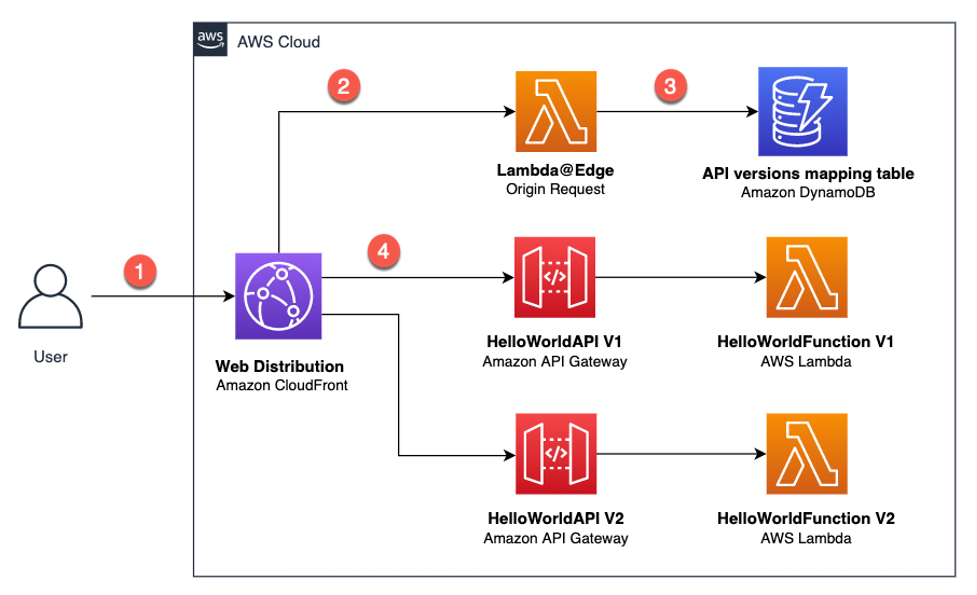
Implementing header-based API Gateway versioning with Amazon CloudFront
This post is written by Amir Khairalomoum, Sr. Solutions Architect. In this blog post, I show you how to use Lambda@Edge feature of Amazon CloudFront to implement a header-based API versioning solution for Amazon API Gateway. Amazon API Gateway is a fully managed service that makes it easier for developers to create, publish, maintain, monitor, […]

Introducing cross-account Amazon ECR access for AWS Lambda
This post is written by Brian Zambrano, Enterprise Solutions Architect and Indranil Banerjee, Senior Solution Architect. In December 2020, AWS announced support for packaging AWS Lambda functions using container images. Customers use the container image packaging format for workloads like machine learning inference made possible by the 10 GB container size increase and familiar container […]

Accelerating serverless development with AWS SAM Accelerate
Building a serverless application changes the way developers think about testing their code. Previously, developers would emulate the complete infrastructure locally and only commit code ready for testing. However, with serverless, local emulation can be more complex. In this post, I show you how to bypass most local emulation by testing serverless applications in the […]

Visualizing AWS Step Functions workflows from the AWS Batch console
This post written by Dhiraj Mahapatro, Senior Specialist SA, Serverless. AWS Step Functions is a low-code visual workflow service used to orchestrate AWS services, automate business processes, and build serverless applications. Step Functions workflows manage failures, retries, parallelization, service integrations, and observability so builders can focus on business logic. AWS Batch is one of the […]

Accepting API keys as a query string in Amazon API Gateway
This post was written by Ronan Prenty, Sr. Solutions Architect and Zac Burns, Cloud Support Engineer & API Gateway SME Amazon API Gateway is a fully managed service that makes it easier for developers to create, publish, maintain, monitor, and secure APIs at any scale. APIs act as the front door to applications and allow […]

Configuring CORS on Amazon API Gateway APIs
Configuring cross-origin resource sharing (CORS) settings for a backend server is a typical challenge that developers face when building web applications. CORS is a layer of security enforced by modern browsers and is required when the client domain does not match the server domain. The complexity of CORS often leads developers to abandon it entirely […]