AWS Compute Blog

Author: Rachel Richardson

Register for the Modern Applications Online Event
Earlier this year we hosted the first serverless themed virtual event, the Serverless-First Function. We enjoyed the opportunity to virtually connect with our customers so much that we want to do it again. This time, we’re expanding the scope to feature serverless, containers, and front-end development content. The Modern Applications Online Event is scheduled for […]

ICYMI: Serverless-First Function
On May 21 and May 28, AWS hosted the first-ever serverless-focused virtual event, the AWS Serverless-First Function. These two free virtual events covered important aspects of a successful serverless approach: Serverless for your Organization and Serverless for your Application. Serverless for your Organization, on May 21, focused on real-world tactics for transforming your organization to […]

Register now for the first virtual AWS Serverless-First Function
This post is courtesy of Rebecca Marshburn, Sr. Product Marketing Manager, Serverless AWS is hosting the first-ever completely serverless-focused, free virtual event: the AWS Serverless-First Function. The event takes place across two Thursdays – May 21 and May 28 – and focuses on two important themes of building on serverless: May 21: Serverless for your […]
Integrating B2B using event notifications with Amazon SNS
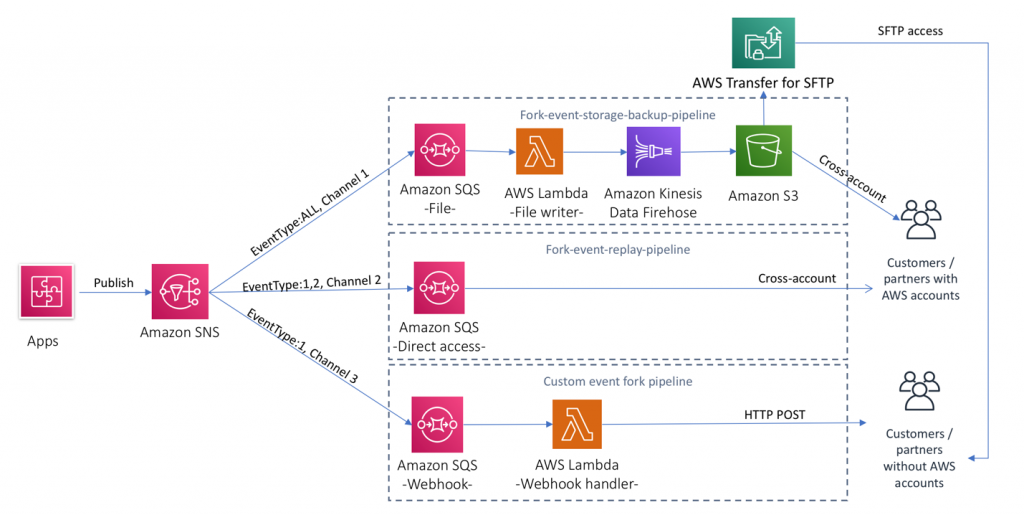
This post is courtesy of Murat Balkan, AWS Solutions Architect Event notification patterns are popular among B2B integrations. Their scalable and decoupled structure helps implement complex integration scenarios in a variety of enterprises. This post introduces a generic serverless architecture that applies to external integrations that use event notifications with Amazon SNS and Event Fork Pipelines. […]

Migrating from IBM MQ to Amazon MQ using a phased approach
This post is contributed by Mithun Mallick, Solutions Architect and Christian Mueller, Solutions Architect Message-oriented middleware (MOM), or message brokers, are the backbone that integrates business critical applications in many industries. MOMs are used to integrate systems like inventory management, payment systems, and CRM systems. They are also used to orchestrate order-processing workflows across multiple systems, […]

Application integration patterns for microservices: Fan-out strategies
This post is courtesy of Dirk Fröhner, Sr. Solutions Architect The first blog in this series introduced asynchronous messaging for building loosely coupled systems that can scale, operate, and evolve individually. It considered messaging as a communications model for microservices architectures. This post covers concrete architectural considerations, focusing on the messaging architecture. Part 3 covers running […]

Understanding asynchronous messaging for microservices
This post is courtesy of Dirk Fröhner, Sr. Solutions Architect One of the implications of applying the microservices architectural style is that much communication between components happens over the network. After all, your microservices landscape is a distributed system. To achieve the promises of microservices, such as being able to individually scale, operate, and evolve each service, this […]

Designing durable serverless apps with DLQs for Amazon SNS, Amazon SQS, AWS Lambda
This post is courtesy of Otavio Ferreira, Sr Manager, SNS. In a postal system, a dead-letter office is a facility for processing undeliverable mail. In pub/sub messaging, a dead-letter queue (DLQ) is a queue to which messages published to a topic can be sent, in case those messages cannot be delivered to a subscribed endpoint. […]

Creating static custom domain endpoints with Amazon MQ to simplify broker modification and scaling
Update – Nov 9, 2021: AmazonMQ also supports RabbitMQ – read Creating static custom domain endpoints with Amazon MQ for RabbitMQ for more information This post is courtesy of Wallace Printz, Senior Solutions Architect, AWS, and Christian Mueller, Senior Solutions Architect, AWS. Many cloud-native application architectures take advantage of the point-to-point and publish-subscribe (“pub-sub”) model of message-based […]

Simple Two-way Messaging using the Amazon SQS Temporary Queue Client
This post is contributed by Robin Salkeld, Sr. Software Development Engineer Amazon SQS is a fully managed message queuing service that makes it easy to decouple and scale microservices, distributed systems, and serverless applications. Asynchronous workflows have always been the primary use case for SQS. Using queues ensures one component can keep running smoothly without losing […]