AWS for Games Blog
Level up your AI-powered game backend with Amazon DynamoDB new features
The most difficult engineering problem when employing AI for gaming isn’t selecting the correct model—it’s selecting the infrastructure that supports the functionality needed to create compelling user experiences. A generative non-player character (NPC) that forgets every conversation, an AI dungeon master that loses narrative context mid-quest, or an agentic loop that drops state across an AWS Lambda cold start all produce sub-par experiences for the same reason: no durable, globally consistent state storage layer.
For most production game backends, that storage layer is already Amazon DynamoDB, which handles inventory, leaderboards, player profiles, and session state at millions of requests per second. Over the last 12–18 months, DynamoDB has shipped four improvements that directly advance AI-native game backends:
- Global strong consistency for worldwide player state
- Zero-extract, transform, and load (ETL) pipelines feeding machine learning (ML) training and real-time analytics
- Durable agent state through the LangGraph DynamoDBSaver connector
- A 50 percent price reduction on on-demand throughput that reshapes serverless game infrastructure economics.
This post walks through each of these improvements—with game-specific examples—and demonstrates how to connect them into a modern AI game backend.
Multi-Region strong consistency
Global tables have long offered multi-AWS Region replication with eventual consistency, which is acceptable for leaderboards, but not for premium currency or AI agent state. If a player spends gems in us-east-1 and an AI quest event reads their balance from us-west-2 milliseconds later, a stale read can produce a negative balance or a duplicate item grant.
Multi-Region strong consistency (MRSC)—generally available in 2025—solves this. Writes are synchronously replicated to at least one other Region before returning success, and ConsistentRead=True from any replica is guaranteed to return the latest version. ConsistentRead=True is a DynamoDB API parameter that instructs the service to return the most recently written version of an item, regardless of which replica serves the request; helping to ensure correctness for currency balances and agent checkpoints at the cost of a bounded single-digit millisecond latency overhead that is imperceptible to players. The mechanism used in the backend is a multi-Region journal, an append-only log spanning three Regions where changes are acknowledged after two of three nodes perform a commit. A witness option (a lightweight quorum node that doesn’t serve reads) lets you meet the three-node requirement at lower storage cost. See the Create and manage DynamoDB global tables with Multi-Region Strong Consistency using an AWS SDK for code examples covering MRSC global table setup and management.
MRSC matters most for two categories of game data: transactional data where stale reads have real-money consequences (premium currency, loot box grants, battle pass purchases) and AI agent state where an agent resuming in a different Region must recover its exact last checkpoint. Such as cross-Region currency transactions, where a gem purchase in Paris is guaranteed visible in Frankfurt before rewards are granted; and distributed AI agent state, where a game master agent resuming in a different Region after failure always recovers its exact last checkpoint.
The following figure shows how DynamoDB MRSC guarantees that writes to premium currency balances, agent state, and inventory are synchronously committed across all three EU Region set nodes—Ireland, Paris, and Frankfurt—using the multi-Region journal before returning success to the caller.
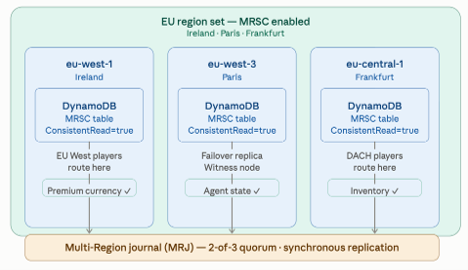
Figure 1 – MRSC scoped to the EU Region set
Time to Live (TTL) or Local Secondary Indexes (LSIs) aren’t supported under MRSC. Design your MRSC tables around global secondary Indexes (GSIs) and implement your own expiry logic using conditional writes or a cleanup Lambda function if you need automatic expiration of old agent state. Additionally, MRSC is currently supported only within defined Region sets: US (N. Virginia, Ohio, Oregon), EU (Ireland, London, Paris, Frankfurt), and AP (Tokyo, Seoul, Osaka). Cross-continent strong consistency is not yet supported, so deploy your MRSC tables within the Region set closest to your player base.
For studios with a truly global player base spanning multiple-continent Region sets, use MRSC within each Region set and fall back to eventual consistency for cross-continent reads such as global leaderboards. Design your routing so that premium currency and agent state operations always resolve within a single Region set. Additionally, transaction operations (TransactWriteItems, TransactGetItems) are atomic only within the invoking Region on multi-Region eventual consistency (MREC) tables and aren’t supported at all on MRSC tables. For operations requiring multi-item atomicity, use a single-Region DynamoDB table where full transaction support is available.
Zero-ETL integration with Amazon SageMaker Lakehouse
If you’re new to analytics pipelines in gaming, see the Guidance for Game Analytics Pipeline on AWS for a primer on stream-based architectures. Historically, moving DynamoDB data into a training or analytics pipeline meant wiring together DynamoDB Streams, Lambda, or AWS Glue, Amazon Simple Storage Service (Amazon S3), AWS Glue Data Catalog, and Amazon Athena before writing a line of ML code. The zero-ETL integration with Amazon SageMaker Lakehouse, introduced at re:Invent 2024, eliminates this. Configure it once using the AWS Management Console for AWS Glue and DynamoDB replicates your table into the SageMaker Lakehouse in Apache Iceberg format, with automatic Data Catalog registration and change data capture (CDC)-based incremental sync, typically within minutes. From there, SageMaker tools can query, train on, and serve insights from your operational game data; all without impacting your production DynamoDB workloads or consuming any table read capacity.
For a live-service game, this means session-level player behavior, AI NPC interactions, and item economy data flow automatically into a format where data scientists can query and train on data that’s minutes old; not hours. Practical patterns include NPC dialogue quality evaluation, continuous personalization model retraining, game balance analysis, and cheat detection combining operational and historical data.
The following figure shows how replacing a custom multi-service ETL pipeline with a Zero-ETL integration simplifies the path from DynamoDB game session data to SageMaker ML workloads.
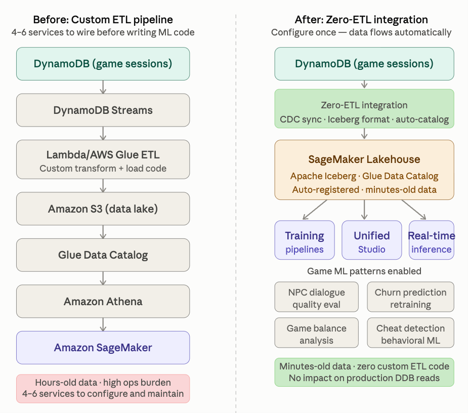
Figure 2 – Before and after comparison of a custom ETL pipeline and a Zero-ETL integration
Setup requires enabling PITR on the source table, configuring arole-based access control (RBAC) policy that grants AWS Glue export permissions, and creating the integration through the AWS Glue console; queries then run directly in SageMaker Unified Studio against live-synced Lakehouse tables. For details, see DynamoDB zero-ETL integration with Amazon SageMaker Lakehouse.
DynamoDB as the memory layer for AI agents – LangGraph DynamoDBSaver
AI agents, ML-backed systems that autonomously chain tool calls, branching logic, and multi-step reasoning to complete a goal, are stateless by default. Every Lambda cold start, player reconnect, or cross-service handoff loses state unless you’ve built a persistence layer. The langgraph-checkpoint-aws library provides a production-ready DynamoDB checkpointing backend for LangGraph agents.
DynamoDBSaver stores checkpoint metadata and agent state (conversation history, tool results, NPC relationship scores, and active quest context) in DynamoDB, automatically offloading payloads above 350 KB to Amazon S3 without any application routing code—well before the DynamoDB 400 KB item limit. Each player session gets a unique thread_id; agents resume from exact state on reconnect. For implementation details, see Using DynamoDB as a checkpoint store for LangGraph agents.
Three game patterns this unlocks:
- An NPC with persistent memory. Consider a blacksmith the player helped three sessions ago. Without DynamoDBSaver the blacksmith greets them as a stranger. With it, the agent loads the full conversation history and relationship score at session start, and the blacksmith’s opening line reflects their history: “I remember you.”
- An AI dungeon master that resumes mid-encounter after a disconnect without replaying completed steps, because the exact agent checkpoint is always recoverable from DynamoDB.
- Human-in-the-loop content moderation where an agent pauses at a review node and waits for an async approval signal, which is impossible without durable state.
Price reduction and warm throughput
On November 1, 2024, AWS reduced DynamoDB on-demand throughput pricing by 50 percent and global tables replicated write pricing by up to 67 percent. This materially shifts the break-even point between on-demand and provisioned capacity. For variable game workloads—especially those with AI inference calls creating unpredictable write bursts—on-demand is now the recommended default.
To put this in context: a mid-size live service game writing 10 million items per day across two global table replicas previously paid approximately $1.25 per million replicated write request units (WRUs). At the new pricing, that same workload costs approximately $0.625 per million WRUs, a savings of roughly $6,250 per month, or $75,000 per year, with no architecture changes required. For studios running AI agent checkpointing at scale, where write volume increases with agent interaction frequency, the savings compound further.
DynamoDB warm throughput enables tables to instantly accommodate traffic up to pre-established peak levels, though actual performance can vary based on hot partitions, provisioned capacity settings, or configured on-demand limits. For more information, see the Understanding DynamoDB warm throughput in different scenarios.
Reference architecture
The four features described in this post compose into a coherent stack. Use a single DynamoDB table with a player_id partition key and record_type sort key, profile, inventory, agent checkpoints, NPC relationship scores, and conversation history all in one table, fetched in a single GetItem call or targeted query.
Deploy separate MRSC-enabled tables for each Region set. Use ConsistentRead=True for currency and agent checkpoint loads and eventually consistent reads for leaderboards and non-critical attributes. Enable zero-ETL to SageMaker Lakehouse on your game-sessions table and retrain personalization models weekly, writing updated embeddings back to DynamoDB for real-time inference. Run all tables on-demand at new pricing; pre-warm to 2 times the expected peak before major events.
The following figure shows the four DynamoDB features—single-table design, MRSC read consistency, Zero-ETL integration with SageMaker Lakehouse, and on-demand pricing—composed into a single coherent AI game backend stack, with all MRSC-governed record types sharing one table and the game-session table serving as the dedicated zero-ETL source for ML pipelines.
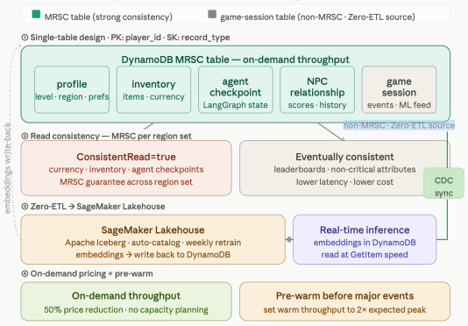
Figure 3 – DynamoDB reference architecture for an AI game backend
Conclusion
DynamoDB is now more than a database for leaderboards and player profiles. Multi-Region strong consistency makes globally consistent agent state practical. Zero-ETL integration feeds ML pipelines without custom infrastructure. LangGraph checkpointing makes durable AI agents a one-library integration. And the 2024 price reduction makes all of it accessible to studios of almost any size. The best AI-powered game experiences need a data layer fast enough to not add inference latency, scalable enough to absorb viral spikes, and durable enough to treat agent state as critical. DynamoDB, with these additions, is that layer.
Resources and next steps
-
- Amazon DynamoDB Developer Guide
- Multi-Region strong consistency documentation
- DynamoDB zero-ETL with SageMaker Lakehouse, Part 1
- DynamoDB zero-ETL with SageMaker Lakehouse, Part 2
- Build durable AI agents with LangGraph and Amazon DynamoDB
- langgraph-checkpoint-aws on PyPI
- DynamoDB Data Modeling MCP server
- AWS for Games blog
- Using Amazon DynamoDB global tables