AWS for Industries
Henry Schein One goes AI-native with AI Product Discovery and Strategy
Development teams have artificial intelligence (AI) collaborators. Code assistants help write code. Testing tools generate test suites. Documentation generation is increasingly automated. For builders, AI has become a thinking partner, not replacing judgment, but amplifying it.
Product leaders, strategists, and business decision-makers haven’t had the same. The work of figuring out what to build, understanding customer pain points, evaluating which opportunities to pursue, articulating a vision clearly enough that an engineering team can act on it, still runs on intuition, experience, and a lot of meetings. The output is usually a slide deck. It’s static. It doesn’t run. And by the time it reaches developers, context has been lost in translation.
Henry Schein One serves more than 100,000 dental practices worldwide with cloud infrastructure on Amazon Web Services (AWS). The company’s mission is simple: help practitioners spend less time on technology and more time on patient care. The leadership team could see dozens of opportunities where AI could accelerate that mission, not just in how the company builds software, but in how it decides what to build in the first place. They wanted their product leaders to have the same kind of AI-assisted workflow that their developers were already benefiting from.
That ambition led the team to AWS and a new way of working called AI Product Discovery and Strategy.
The gap that needed closing
Henry Schein One’s product leaders had no shortage of ideas. Scheduling intelligence. Clinical imaging workflows. Revenue cycle automation. Patient communication. The challenge wasn’t imagination, it was translation.
A product or business leader would spend weeks crafting a vision, such as gathering customer feedback, building a business case, and writing requirements. By the time that vision reached the development team, it had been compressed into a document. The nuance was gone. The “why” had to be re-explained in meetings. And leadership couldn’t truly evaluate whether an idea had merit until it was already deep into being built.
The company needed a way to move faster, without losing the strategic rigor that good product decisions require.
The foundation: how AI-DLC changed software development
The answer started with the AI-Driven Development Lifecycle (AI-DLC), a methodology created at AWS. AI-DLC redesigned software development around one principle: AI proposes, humans decide. AI handles planning, clarifying questions, and maintaining context, so people focus on decisions that require human judgment. As detailed in the AI-DLC white paper, teams work in collaborative sessions called “bolts” that are intense cycles measured in hours, not weeks.
AI-DLC proved development teams build faster when AI orchestrates the process. But it started after someone had already decided what to build. Henry Schein One’s question: can the same model work upstream for the people making strategic decisions?
Giving business leaders an AI collaborator
AI Product Discovery and Strategy (AI-PDS) agentic implementation applies the same model to the people who shape what gets built. The AI-PDS framework defines six capabilities for product discovery and strategy.
- Envision: Analyze pain points, conduct customer research, synthesize voice of customer, and capture requirements in any format.
- Use Case Intake: Document and analyze use cases in a structured, repeatable format.
- Prioritize: Score use cases on weighted dimensions using a value measurement framework.
- Prototype: Generate no-code prototypes using agentic or traditional apps, iterate in natural language, validate with users, and make build decisions.
- Product Strategy: Define positioning, business model, and KPIs.
- Go-to-Market: Plan sales motions, launch sequencing, and customer segmentation.
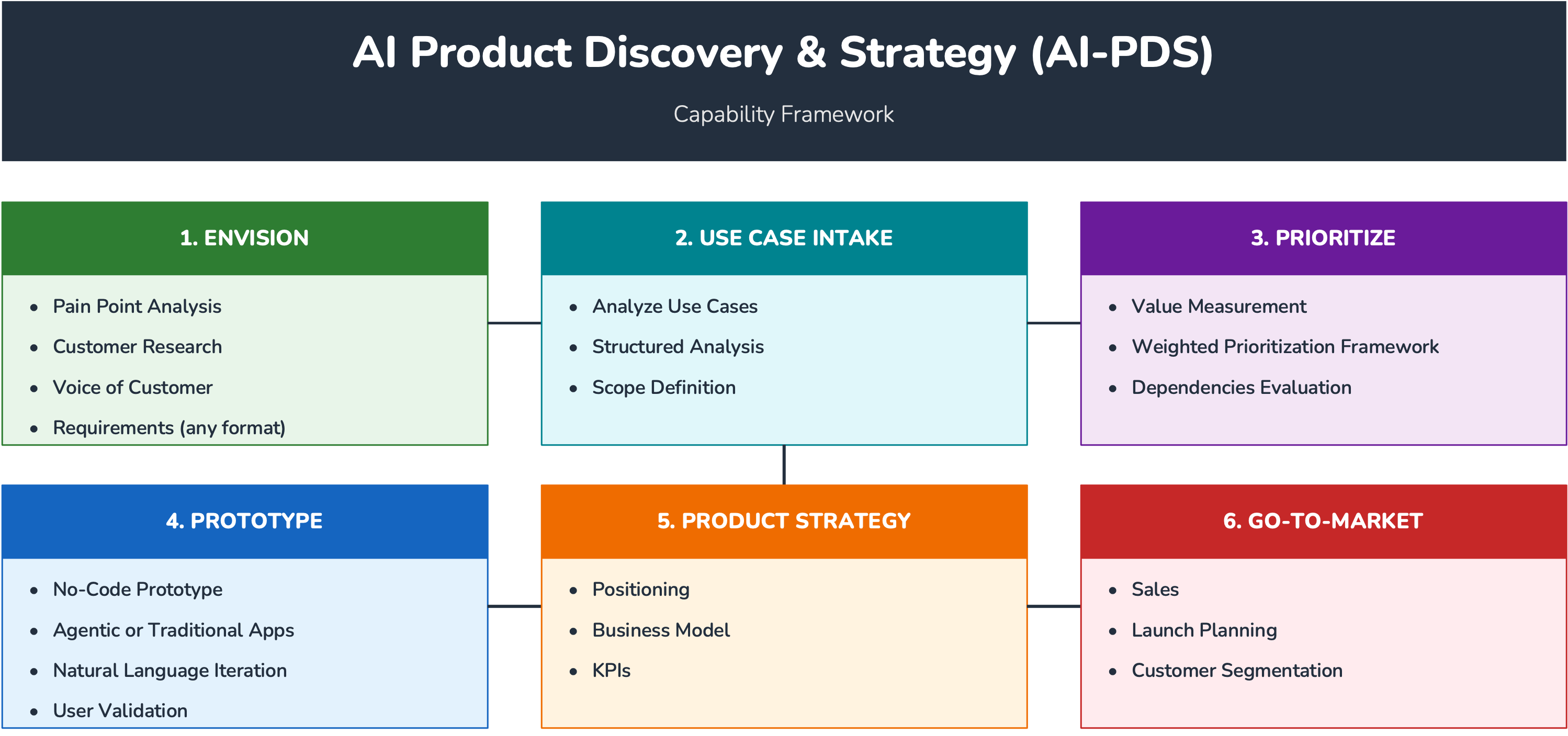
Figure 1: The AI-PDS framework: six stages from pain point analysis through go-to-market
The breakthrough, leaders could turn their best ideas into working prototypes, not wireframes or slide decks, but running applications. They walked into stakeholder meetings and said, “let me show you” instead of “let me describe what I’m imagining.” AI-PDS supports three entry points (customer pain points, existing use cases, or pre-built specifications), captures every decision in an auditable trail, and generates portable prototype specs any development team can pick up.
How Henry Schein One put this into practice
The engagement ran in two parts, borrowing from AI-DLC’s collaborative processes. First, Mob Discovery: all 17 senior leaders together in a facilitator-driven session to define business context, pain points, and prioritized use cases with AI as a partner. Then, small teams of four to five split off to build prototypes, each taking one prioritized use case.
AI helped them articulate pain points, structured their thinking into concrete use cases, scored opportunities against weighted criteria, and generated prototype specifications. The leaders weren’t learning to code. They were doing what they do best by applying business judgment, debating priorities, and shaping direction while AI gave structure and momentum to that work.
The prototypes made everything click for everyone in the room. Ideas that had lived in slide decks for months became applications you could touch. A concept that would normally take weeks to communicate was now something you could demo in minutes.
The results:
- A total of 17 senior leaders participated
- Four working prototypes built in under 24 hours, work that would typically take 8 to 12 weeks or more to reach the same fidelity
- Two prototypes now advancing toward production
- Full strategic context carried forward, no handoff documents, no re-explaining the “why”
Because AI Product Discovery feeds directly into AI-DLC’s Inception phase, the development team started with a complete understanding of why something was prioritized, not just what to build. The context that leadership built up didn’t get flattened into a handoff document. It carried forward intact.
“AI is moving faster than most organizations are ready to act, and in dentistry, that gap has a real cost. Every moment a dental practice spends managing inefficiencies that technology could solve is a moment with less patient focus, and that is an unacceptable problem for all of healthcare. What this new approach with AWS has proven is that we don’t have to choose between moving quickly and moving thoughtfully — when AI carries the operational burden of discovery and development, leaders can make better decisions faster and deliver benefits to patients faster. Fewer delays. Fewer errors. More time for delivering care that actually matters.”
— Dr. Ryan Hungate, Chief Strategy Officer, Henry Schein One
The vision: becoming an AI-native enterprise
For Henry Schein One, this experience crystallized a broader strategic thesis. Becoming an AI-native enterprise isn’t about deploying AI into products, it’s about deploying AI into how the organization thinks, decides, and builds.
When product and business leaders have the same caliber of AI collaboration as the development team, the entire lifecycle accelerates. Strategy connects to delivery without the usual loss of fidelity. Ideas get validated faster. Weak concepts are identified early, saving months of development effort. And strong ideas get to market while they still matter.
AI-DLC proved that software development works better when AI orchestrates the process and humans own the decisions. AI Product Discovery and Strategy extend that principle to everyone upstream. Together, they create a continuous, AI-supported lifecycle from the strategist asking, “What should the company build?” to the developer shipping the last line of code.
That’s the AI-native enterprise. And for Henry Schein One, it’s no longer a future state. It’s how the company works today.
Get started
The AI-PDS workflow is available with various implementations, for use with Agentic IDEs like Amazon Kiro or others. Start with the open-source workflow files that are fully customizable markdown you can adapt to your organization’s strategy frameworks.
You can also use Amazon Quick for defining AI driven workflows for AI-PDS. To explore facilitated AI Product Discovery and Strategy (AI-PDS) workshops, contact your AWS account team.
Learn more:
- AI-PDS on GitHub. Open-source product discovery workflow
- AI-DLC Blog Post. Full methodology overview
- AI-DLC White Paper. Phases, rituals, and implementation guidance