AWS for Industries
Manage ESG data and simplify Sustainability reporting with Amazon Quick
Emerging sustainability reporting requirements demand standardized, auditable processes with flexibility to adapt to evolving frameworks. For many organizations, the challenge isn’t data availability, it’s synthesizing fragmented information into coherent, audit-ready disclosures.
Sustainability data resides across facility management systems, procurement platforms, HR tools, carbon accounting solutions, and operational databases. Many traditional business intelligence tools are not designed to interpret regulatory text, identify data gaps, or generate structured narrative explanations.
Amazon Quick, AWS’s AI-powered digital workspace, helps address these challenges by combining AI search, custom agents, deep analytical capabilities (Quick Research), business intelligence (Quick dashboards), and workflow automation (Quick Flows) to create a central sustainability intelligence hub (Spaces). This hub connects data sources, interprets regulations, and generates compliance-ready outputs through AI agents that help analyze data, identify patterns, and support workflow automation with appropriate human oversight.
In this blog, we walk through how these capabilities can work together to support an integrated sustainability reporting workflow. We present a phased approach – from requirements analysis through data assessment, monitoring, and report generation – along with a reference architecture, and explore how the same platform can extend beyond regulatory compliance to broader ESG objectives. Readers will learn how agentic AI, business intelligence, and workflow automation can help reduce manual effort, improve data quality, and accelerate time to audit-ready disclosures.
Core Capabilities for Sustainability Reporting
Amazon Quick offers several interconnected capabilities that can support different stages of the sustainability reporting lifecycle. Below, we describe each capability and how it can contribute to a more streamlined reporting process.
Unified data access with Spaces
Quick Spaces helps organize sustainability resources – Environmental, Social, and Governance (ESG) data exports, European Sustainability Reporting Standards (ESRS), prior reports, supplier questionnaires, and internal policies – into focused collections. This helps reduce manual searches across shared drives, email threads, and disparate systems when preparing disclosures or responding to stakeholder queries.
Sustainability teams can maintain separate Spaces for sustainability reporting requirements, voluntary frameworks (Carbon Disclosure Project (CDP), Task Force on Climate-related Financial Disclosures (TCFD), Global Reporting Initiative (GRI), Sustainability Accounting Standards Board (SASB)), and internal KPI tracking. Teams can then share relevant Spaces with finance, legal, procurement, and operations to access consolidated sustainability data.
Deep analysis with Quick Research
Quick Research is a specialized agent for long-form analysis and reporting. To prepare for a climate disclosure, it helps analyze applicable regulatory requirements and voluntary frameworks, review emissions data across facilities, identify potential data gaps, such as outdated emission factors or incomplete data coverage, and generate draft disclosure narratives with citations to source data. Teams collaborate on these outputs inside Amazon Quick and export them as foundations for sustainability report sections, management commentary, and board-level summaries.
Business Intelligence & Reporting with Amazon Quick
Amazon Quick integrates with ESG and operational data sources to provide interactive dashboards that track sustainability KPIs with regular dashboard updates, such as Scope 1–3 emissions, energy intensity, water use, and waste diversion. Business users can ask natural language questions like “Show our Scope 2 emissions trend by region over the last 12 months” and instantly see visualizations without writing SQL.
These dashboards can support sustainability reporting by providing current views of KPI data and ongoing insight for operational decision-making, rather than static, point-in-time views.
Workflow automation with Quick Flows
Quick Flows turns repetitive sustainability processes into reusable automations that users can configure using natural language prompts. For sustainability reporting requirements and broader ESG operations, Quick Flows can schedule monthly data pulls from carbon accounting platforms and ERP systems, run data quality checks, refresh Quick dashboards, and trigger Quick Research runs.
Because Quick Flows connects to both APIs and user interfaces, flows can orchestrate UI interactions (downloading supplier statements from a portal) and API calls (posting tasks to Jira or ServiceNow) in a single end-to-end workflow.
Custom agents for continuous guidance
Organizations can define custom agents trained on specific reporting framework, internal policies, and sector-specific context to provide on-demand guidance on questions like “What evidence is required for ESRS E1?” or “Which team owns Scope 3 Category 4 data?”.
As regulations continue to evolve (e.g., EU Deforestation Regulation), the same agentic pattern can be extended by updating the underlying Spaces, knowledge sources, and guardrails.
Amazon Quick connects with many systems through action connectors (pulling emissions data, triggering workflows), knowledge base integrations (utility data, regulatory feeds), and intelligent document processing (extracting sustainability data from PDFs, invoices, and supplier reports).
Sustainability Reporting Compliance Workflow with Quick
The following phased approach illustrates how organizations can operationalize sustainability reporting using Amazon Quick.

Figure 1: Sustainability reporting workflow
Phase 1: Requirements analysis
- Use Quick Research to analyze sustainability reporting and ESRS, determine which disclosure topics apply to your organization, and generate a structured compliance roadmap.
- Create a dedicated sustainability reporting Space containing the roadmap, regulatory text, internal guidance, and prior reports to anchor subsequent phases.
Phase 2: Data assessment
- Configure Quick Flows to inventory existing data across carbon accounting systems, ERP, HR, and facility systems, using connectors and document processing to pull samples into the sustainability reporting Space.
- Ask Quick Research to assess coverage against sustainability reporting requirements and flag missing data, inconsistent units, or insufficient granularity, outputting a prioritized remediation plan.
Phase 3: Monitoring infrastructure
- Build Quick dashboards for each relevant ESRS topic (for example, climate, water, circularity, workforce) using data ingested through Spaces, connectors, and document pipelines.
- Use Quick Flows to automate recurring data collection (monthly or quarterly), run validation checks, and refresh dashboards; flows can also trigger Quick Research for updated commentary when material changes occur.
Phase 4: Ongoing compliance with Quick Flows
- Define sustainability reporting compliance Flows that orchestrate the end-to-end process for each reporting cycle: collecting and validating data, updating dashboards, generating draft narratives, and routing content for review and approval.
- Embed custom sustainability reporting agents into these flows so they can request missing data from business owners, initiate approvals in tools like Jira or ServiceNow, and track completion status for each disclosure requirement.
In this model, flows act as reusable blueprints. Once defined, they can run on a schedule or on demand, ensuring that sustainability reporting processes are consistent, auditable, and far less dependent on manual spreadsheet orchestration.
Phase 5: Report generation
- At reporting time, Quick Research compiles data, dashboards, and documentation from the sustainability reporting Space into structured draft report sections aligned to ESRS topics.
- Quick Flows then package these outputs into the desired formats, route them for legal and management review, and archive final versions for audit readiness in appropriate repositories
Architecture Overview
The following diagram illustrates how Amazon Quick’s layered architecture connects data sources, agentic intelligence, and workflow automation to support sustainability reporting.
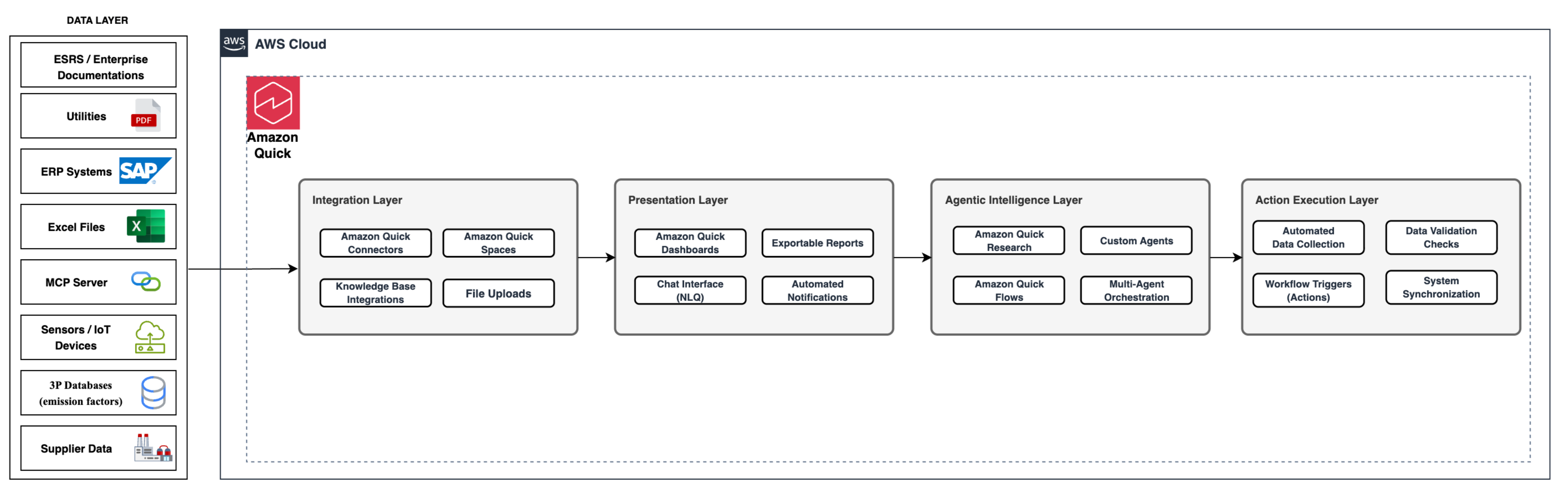
Figure 2: Amazon Quick reference architecture for sustainability reporting
- Data layer: Operational systems (ERP, EHS, carbon accounting tools), external datasets, document repositories, and intelligent document processing pipelines.
- Integration layer: Quick integrations including connectors, knowledge bases, flows and document processing connecting data and applications.
- Agentic intelligence layer: Custom chat agents, Research, ML insights, and multi-agent orchestration with natural language understanding.
- Presentation layer: Quick Sight dashboards, exportable reports, chat interfaces, embedded analytics, and automated notifications.
- Action execution layer: Automated data collection, validation checks, document processing, workflow triggers, and system synchronization via Quick Flows and action connectors.
This architecture helps support ongoing compliance efforts: sustainability data stays current, agents orchestrate the movement from raw data to insight, and flows execute repeatable tasks required for reporting.
Full-spectrum Sustainability Management with Amazon Quick
Amazon Quick extends beyond sustainability compliance to comprehensive sustainability management.
For greenhouse gas emissions, it can help automate Scope 1-2 data collection (fuel, electricity, on-site generation) and processes Scope 3 supplier invoices and shipping documents, extracting metrics from PDFs and routing them to calculation engines and dashboards.
For water stewardship and waste management, Amazon Quick can be configured to aggregate usage data, ingest waste manifests and certificates, detect consumption trends, and recommend conservation strategies. Recurring Quick Flows can assess risks for high-stress basins and elevated waste facilities.
For circular economy initiatives, Quick Research can evaluate lifecycle impacts across design alternatives, while Amazon Quick aggregates data into digital product passports and calculates EPR obligations.
Multi-framework reporting agents trained on CDP (Carbon Disclosure Project), TCFD (Task Force on Climate-related Financial Disclosures), GRI (Global Reporting Initiative), and SASB (Sustainability Accounting Standards Board) help teams map one data foundation to multiple disclosure regimes, generating tailored outputs and eliminating parallel reporting processes.
Conclusion
Sustainability reporting compliance is no longer just a regulatory exercise; it’s an opportunity to build an AI-native sustainability operating system. Amazon Quick helps sustainability teams consolidate fragmented ESG data and generate insights by supporting decision-making with dynamic dashboards that inform supplier selection, capital allocation, and product design. This enhances stakeholder engagement through on-demand views tailored to executives, investors, customers, and employees.
Amazon Quick helps organizations improve operational efficiency and help organizations meet compliance requirements while gaining operational insights. It enables continuous improvement through integrated KPI monitoring, strengthens risk management with early detection of climate and supply chain risks, and unlocks innovation through agentic insights. By combining agentic AI, business intelligence, and workflow automation in a single platform, Amazon Quick helps organizations address sustainability compliance requirements while supporting broader ESG management objectives.