AWS for Industries
Transforming energy trading by managing complexity and driving growth with Cloud ETRM
Today’s energy market is more dynamic than ever. The acceleration of renewable energy integration, increasingly variable generation patterns, and more frequent extreme weather events have increased energy market volatility. Evolving regulatory requirements add another layer of complexity to market operations. Meanwhile, increasing demand from electrification efforts and the increase of AI data centers further complicates matters by straining grid capacity. In this environment, managing risk and capitalizing on market changes requires a better solution than using spreadsheets.
An Energy Trading and Risk Management (ETRM) solution is designed to manage the full lifecycle of energy commodity trading activities, from capturing the initial transaction to handling final settlement. These centralized solutions help electric utilities, independent power producers (IPPs), and other market participants optimize their trading portfolios across power, fuels, and environmental products, while effectively measuring and hedging against volatile price risks.
In this post, we explore how modern, cloud-based ETRM solutions, like PCI’s ETRM, can help energy leaders better manage portfolio risks and navigate volatile markets with confidence.
If you or your team would benefit from an overview on how energy markets, trading workflows, and ETRM fundamentals fit together, explore PCI’s new ETRM Fundamentals Training Series.
The changing energy trading environment
The electricity industry has shifted from centralized generation models to distributed systems. Historically, utilities built generation assets—coal, gas, nuclear, or hydroelectric plants—near load centers or fuel sources. When wind, solar, and battery storage were added to generation portfolios, optimization became far more complex. These asset developers typically optimized placement for lower-cost real estate and prevailing weather conditions (such as solar in rural Arizona or wind in Oklahoma and Kansas).
Market structure has also evolved. Lower development costs for renewable assets have drawn institutional investors, such as banks and private equity firms, who develop generation projects specifically for wholesale market participation. This proliferation of market participants and asset types has strained legacy trading systems.
Many legacy ETRM solutions struggle to keep pace in this environment. On-premises solutions require substantial effort to update or scale. Spreadsheet-based workflows create operational inefficiencies and scaling constraints for smaller entities.
Modern cloud ETRM solutions
Modern cloud-based ETRM solutions address these limitations through centralized data management and automated updates. Crucially, they use integrated workflows that avoid manual handoffs between trading, scheduling, risk, and settlement functions.
PCI’s ETRM on AWS provides an end-to-end solution for trade capture, scheduling, position management, risk analytics, and settlement—purpose-built for renewable energy integration and energy markets volatility. The solution ingests market data and telemetry in near real time, normalizes and enriches it, and exposes a unified data model to trading, risk, and operations. Integrated workflows minimize manual handoffs: traders capture orders and strategies; schedulers execute the transactions; risk teams run VaR, stress, and scenario analyses; settlements reconcile volumes and prices with automated checks and audit trails.
Real-world success: Ørsted’s journey to a modern cloud ETRM
Ørsted, one of the world’s largest renewable energy companies, faced a challenge many utilities know well: their legacy on-premises system had become too rigid and costly to adapt to the fast-changing US power market. Customizations made over time slowed new product implementations and created reluctance to make changes for fear of breaking downstream processes. As their US portfolio expanded beyond 5 GW of onshore wind, solar, and storage—with even more capacity planned—Ørsted needed an ETRM solution that could provide a reliable data foundation and automate connectivity with downstream risk systems.
After evaluating multiple vendors, Ørsted selected PCI Energy’s cloud-based ETRM solution on AWS for its purpose-built design, strong automation, and API capabilities. “We knew we had to reset,” said Soren Hansen, Head of Asset and Trading Risk for Ørsted Americas. “Our old on-prem solution had become so customized that adding new products was slow and risky. We needed a lightweight, purpose-built system that got the fundamentals right and could scale with our growing portfolio.”
The implementation was carefully paced and highly collaborative, with a small, focused team of Ørsted and PCI specialists working side by side to ensure a smooth transition. The AWS Cloud provided a secure, resilient foundation, alleviating the burden of on-premises infrastructure management and enabling reliable, all-day system availability.
“Today, I don’t think about the system every day—and that’s a good thing,” Hansen added. “It just works, allowing our team to focus on trading and seizing market opportunities.”
Ørsted’s story was featured in the recent webinar, Optimizing for Growth: Ørsted’s Journey to a Modern ETRM Solution, where Hansen, PCI, and AWS shared lessons learned and practical advice for other market participants looking to modernize their energy trading operations.
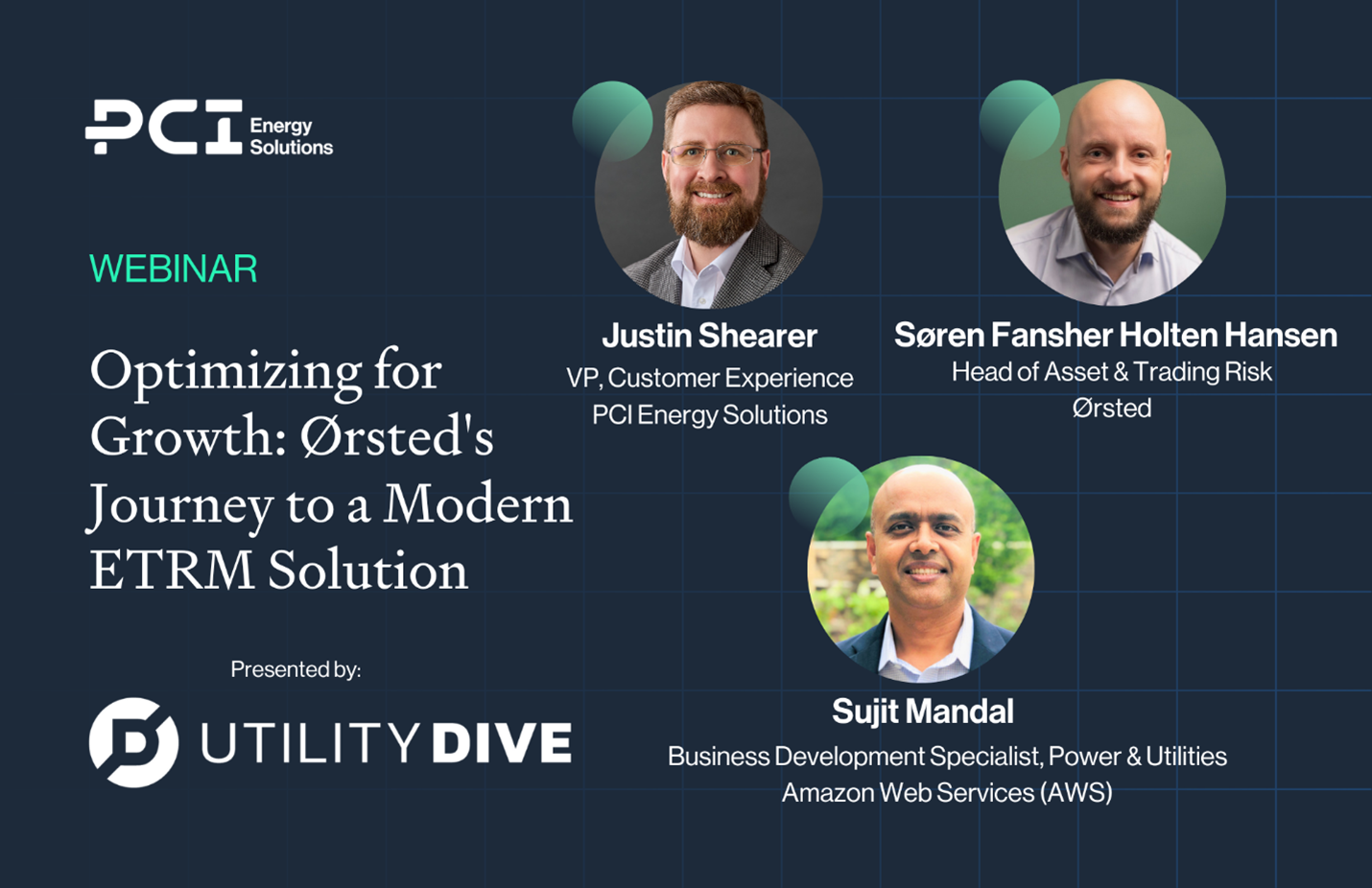
Figure 1: Opening slide from the webinar “Optimizing for Growth: Ørsted’s Journey to a Modern ETRM Solution”
Solution overview
The reliability that Hansen describes stems from PCI Energy’s ETRM solution architecture on AWS. The solution runs across multiple Availability Zones within an AWS Region to provide continuous trading operations even during local disruptions.
The following diagram illustrates the solution architecture.
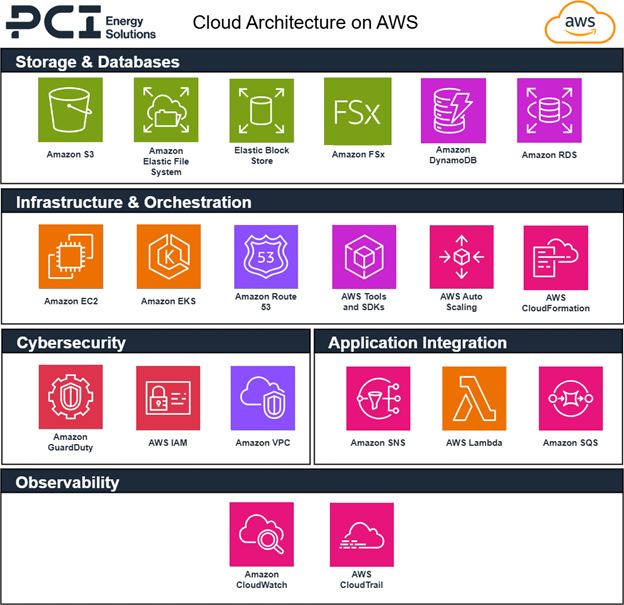
Figure 2: Solution architecture
The solution is designed for secure access, high availability, and operational resilience.
Inbound traffic is encrypted in transit and restricted through IP allowlisting. Amazon Route 53 provides DNS resolution within the AWS environment, routing requests privately without exposing application workloads to the public internet.
Trading and operational services are deployed across multiple Availability Zones, supporting business continuity during infrastructure failures or volatile market events. Application Load Balancers distribute traffic intelligently across compute resources, and Amazon RDS Multi-AZ deployments provide automated failover for relational databases. Shared file storage services, Amazon FSx for Windows File Server and Amazon Elastic File Server (Amazon EFS), deliver resilient, scalable data persistence.
This architecture combines network isolation, Multi-AZ redundancy, and elastic scaling to support continuous energy trading operations. As portfolios grow and market conditions evolve, the solution scales dynamically to meet demand without compromising performance or availability, reducing the hardware procurement delays typical of on-premises systems.
This cloud-based solution enables additional operational benefits:
- Accelerated implementation – Infrastructure as code automation reduces implementation time from years to months while minimizing configuration errors.
- Security and compliance – The solution meets energy sector compliance requirements, including SOC 1, SOC 2 Type II, and FISMA NIST 800-53 certifications. Regional deployment options keep transaction data and trading records within designated geographic boundaries to satisfy data sovereignty requirements.
- Evergreen updates – Regular updates deploy without the service disruption and lengthy upgrade cycles typical of traditional systems, keeping organizations current with evolving market and regulatory requirements. There is no need to end the life of one system just to re-implement the next version. You can progress smoothly from one version to the next, retaining the configurations previously set up.
- Disaster recovery – AWS automated backup services protect trading data with configurable retention periods and point-in-time recovery capabilities. Organizations also have the option to implement cross-Region replication for additional disaster recovery protection.
Conclusion
The energy trading landscape is changing significantly, and the pace of change is only accelerating. Ørsted’s journey demonstrates what’s possible when energy companies are freed from legacy constraints. As renewable portfolios grow and market complexity increases, your ETRM solution should enable growth, not limit it. PCI Energy’s ETRM solution on AWS provides the reliability, scalability, and automation needed for modern energy trading.
Ready to modernize your energy trading infrastructure?
- Visit PCI Energy Solutions to see the solution’s capabilities and schedule a demonstration
- Visit AWS for Energy to learn how AWS supports energy business transformation