Artificial Intelligence

Use AWS DeepLens to give Amazon Alexa the power to detect objects via Alexa skills
April 2023 Update: Starting January 31, 2024, you will no longer be able to access AWS DeepLens through the AWS management console, manage DeepLens devices, or access any projects you have created. To learn more, refer to these frequently asked questions about AWS DeepLens end of life. August 30, 2023: Amazon Kinesis Data Analytics has been […]

Amazon Comprehend introduces new Region availability and language support for French, German, Italian, and Portuguese
Amazon Comprehend is a natural language processing (NLP) service that uses machine learning to find insights and relationships in text. The service does the following for you: Identifies the language of the text. Extracts key phrases, places, people, brands, or locations. Understands how positive or negative the text is. Analyzes text using tokenization and parts […]

Track the number of coffees consumed using AWS DeepLens
April 2023 Update: Starting January 31, 2024, you will no longer be able to access AWS DeepLens through the AWS management console, manage DeepLens devices, or access any projects you have created. To learn more, refer to these frequently asked questions about AWS DeepLens end of life. AWS DeepLens is a deep-learning-enabled video camera for developers. It […]

Shopper Sentiment: Analyzing in-store customer experience
Retailers have been using in-store video to analyze customer behaviors and demographics for many years. Separate systems are commonly used for different tasks. For example, one system would count the number of customers moving through a store, in which part of the store those customers linger and near which products. Another system will hold the store layout, whilst yet […]
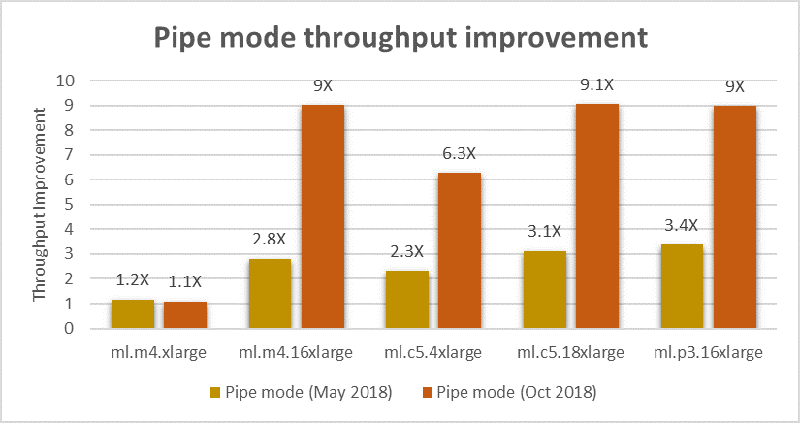
Accelerate model training using faster Pipe mode on Amazon SageMaker
Amazon SageMaker now comes with a faster Pipe mode implementation, significantly accelerating the speeds at which data can be streamed from Amazon Simple Storage Service (S3) into Amazon SageMaker while training machine learning models. Pipe mode offers significantly better read throughput than the File mode that downloads data to the local Amazon Elastic Block Store […]

Amazon SageMaker Neural Topic Model now supports auxiliary vocabulary channel, new topic evaluation metrics, and training subsampling
In this blog post, we introduce three new features of the Amazon SageMaker Neural Topic Model (NTM) that are designed to help improve user productivity, enhance topic evaluation capability, and speed up model training. In addition to these new features, by optimizing sparse operations and the parameter server, we have improved the speed of the […]
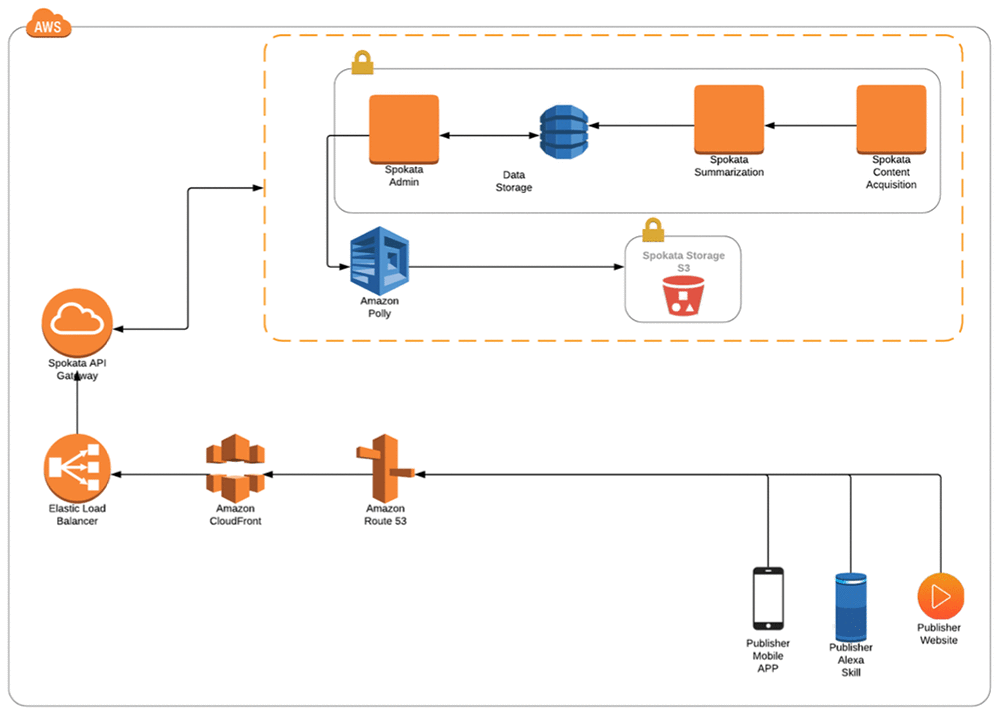
Beyond text: How Spokata uses Amazon Polly to make news and information universally accessible as real-time audio
Just as television transitioned from black and white to color, the web has been moving from a text-based medium to one dominated by sound and vision. Accordingly, content creation has both exploded and changed. Publishers of all types are struggling through this transition as they try to meet the demands of users while keeping their business models intact.
On-demand audio is attracting significant interest from publishers as mobile listening grows and in-car technology begins to disrupt traditional radio. This trend is most visible in the mainstream adoption of podcasts. But podcasts are just the beginning of a rapidly emerging, and diverse, ecosystem of new digital audio formats. Amazon Echo and advanced text-to-speech services such as Amazon Polly are enabling the creation of these new audio products.
In this blog post we describe how Spokata leverages these Amazon technologies to make text-based news and information universally accessible as real-time audio.

Segmenting brain tissue using Apache MXNet with Amazon SageMaker and AWS Greengrass ML Inference – Part 2
In Part 1 of this blog post, we demonstrated how to train and deploy neural networks to automatically segment brain tissue from an MRI scan in a simple, streamlined way using Amazon SageMaker. We used Apache MXNet to train a convolutional neural network (CNN) on Amazon SageMaker using the Bring Your Own Script paradigm. We […]

How to use common workflows on Amazon SageMaker notebook instances
Amazon SageMaker notebook instances provide a scalable cloud based development environment to do data science and machine learning. This blog post will show common workflows to make you more productive and effective. The techniques in this blog post will give you tools to treat your notebook instances in a more cloud native way, remembering that […]

PyTorch 1.0 preview now available in Amazon SageMaker and the AWS Deep Learning AMIs
Amazon SageMaker and the AWS Deep Learning AMIs (DLAMI) now provide an easy way to evaluate the PyTorch 1.0 preview release. PyTorch 1.0 adds seamless research-to-production capabilities, while retaining the ease-of-use that has enabled PyTorch to rapidly gain popularity. The AWS Deep Learning AMI comes pre-built with PyTorch 1.0, Anaconda, and Python packages, with CUDA and […]