Artificial Intelligence
Category: Artificial Intelligence
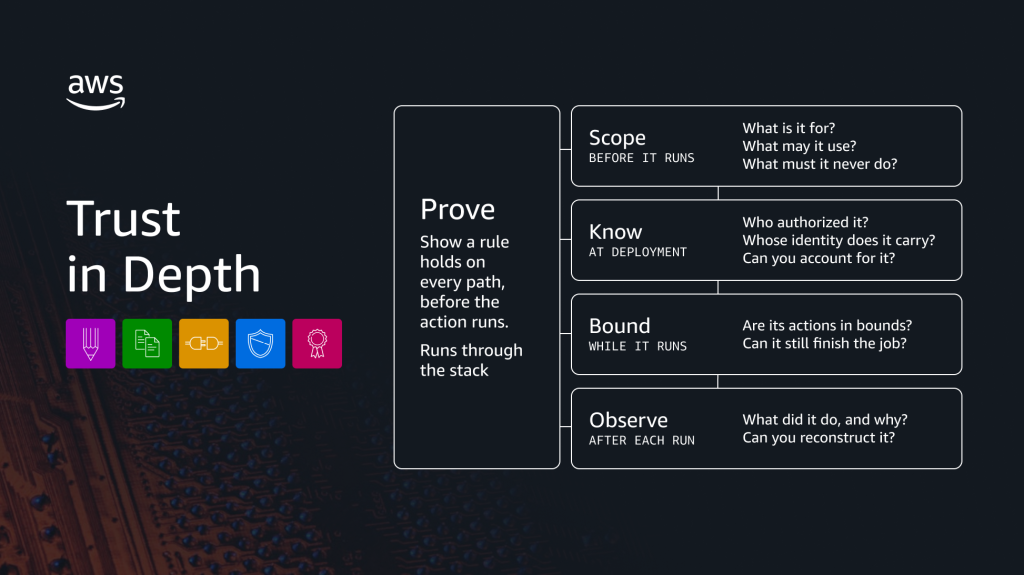
Trust in Depth: Giving agents more autonomy without losing control
Enterprise leaders want AI agents to take on more work but don’t fully trust them to act correctly every time. Trust in Depth is AWS’s layered approach-scope, know, bound, observe, and prove-that lets agents act on their own when their actions can be verified, reserving human judgment for the decisions that need it.
Build self-improving document processing using Amazon Bedrock AgentCore
Learn how to build an agentic intelligent document processing (IDP) system using Amazon Bedrock AgentCore that classifies, extracts, validates, and learns from business documents with minimal human intervention, automatically handling new document formats without manual template configuration.
Generate presentations with Amazon Bedrock AgentCore
This post walks you through building an AI agent system with Amazon Bedrock AgentCore that automates PowerPoint presentation creation from enterprise documents. A supervisor agent, Retrieval Augmented Generation, and Amazon Bedrock Guardrails generate grounded presentations in under 90 seconds.
How Tamnoon built AI-powered cloud security remediation with Amazon Bedrock
Learn how Tamnoon built Tami, an agentic cloud remediation orchestrator on Amazon Bedrock that autonomously investigates and safely remediates cloud security findings from CNAPP and cloud-native sources. The approach drove a 90%+ reduction in critical cloud exposure in 90 days with zero production issues.
Deploy and evaluate models with Amazon SageMaker JumpStart
Learn how to deploy an available model from Amazon SageMaker JumpStart, run a lightweight and repeatable performance test using the SageMaker Python SDK, and delete the endpoint when testing is complete.
Building agents that transact with Anchor Browser and AgentCore payments
Learn how the AWS Generative AI Innovation Center Partner Agent Factory and Anchor Browser built AI agents that autonomously pay for x402-protected web resources and APIs. Amazon Bedrock AgentCore payments checks budgets, signs transactions, and retries requests without exposing wallet credentials to the agent runtime.
Manage private pricing offers for Amazon Bedrock with managed entitlements
Managing AI model access across dozens or hundreds of AWS accounts creates friction when each account must accept AWS Marketplace Private Pricing Offers individually. This post shows two ways to activate MPPO entitlements in AWS License Manager: a lightweight script for a one-time fix, and CDK automation for ongoing event-driven processing.
Natural language security queries at Orca Security using Amazon Bedrock
Orca Security built Discovery AI, a natural language query agent on Amazon Bedrock that converts plain-English questions into Sonar queries. The post shares the multi-stage architecture and the results: 90% lower query cost, 93% fewer input tokens, and 75% lower latency than the initial baseline.
How ShipStation Global built an AI IT help desk on Amazon Bedrock AgentCore
ShipStation Global’s engineering team built Deckhand, an AI IT help desk agent for Slack on Amazon Bedrock AgentCore. It answers routine IT questions from a curated knowledge base, reads error-message screenshots, and files Jira tickets. In its first three months it resolved 97.5% of channel queries with a 96% positive feedback rating.
Build long-horizon agents with Grok 4.7 on Amazon Bedrock
Grok 4.7 is now available on Amazon Bedrock. In this post, we build a tool-calling agent on Grok 4.7 and evaluate it on three reasoning tasks at four reasoning effort levels, measuring correctness and token cost per completed task. We show how to tune the trade-off per request and monitor it in production.