Artificial Intelligence
Category: AWS Trainium
Train Qwen3 on AWS Trainium with torchtitan
Train Qwen3 on AWS Trainium with torchtitan three ways on a single trn2.48xlarge: the Hugging Face Transformers v5 modeling backend, torchtitan’s native Qwen3, and NKI mixture-of-experts kernels. The same torchrun launcher and config structure work unchanged across all three paths, including loading and saving published Hugging Face safetensors.
Beyond the KV cache: Training and serving i14’s Laplace 3B linear attention model on AWS Trainium2 with native PyTorch
Learn how i14 trained and served Laplace 3B, a linear attention model, on AWS Trainium2 using native PyTorch. Its recurrent state stays fixed at 29.5 MB per sequence regardless of context length, avoiding the growing key-value cache of transformer models and keeping serving memory predictable.
How Deepgram optimized voice AI at scale with AWS Trainium
Deepgram worked with the AWS Forward Deployed Engineering team to port its Nova-3 speech-to-text model to AWS Trainium2 for offline batch inference. This post covers porting to the AWS Neuron stack, kernel-level tuning, a data-parallel Rust runtime, and the throughput and cost results on batch transcription.
Accelerating decode-heavy LLM inference with speculative decoding on AWS Trainium and vLLM
In this post, you will learn how speculative decoding works and why it helps reduce cost per generated token on AWS Trainium2.

Splash Music transforms music generation using AWS Trainium and Amazon SageMaker HyperPod
In this post, we show how Splash Music is setting a new standard for AI-powered music creation by using its advanced HummingLM model with AWS Trainium on Amazon SageMaker HyperPod. As a selected startup in the 2024 AWS Generative AI Accelerator, Splash Music collaborated closely with AWS Startups and the AWS Generative AI Innovation Center (GenAIIC) to fast-track innovation and accelerate their music generation FM development lifecycle.
How Amazon scaled Rufus by building multi-node inference using AWS Trainium chips and vLLM
In this post, Amazon shares how they developed a multi-node inference solution for Rufus, their generative AI shopping assistant, using Amazon Trainium chips and vLLM to serve large language models at scale. The solution combines a leader/follower orchestration model, hybrid parallelism strategies, and a multi-node inference unit abstraction layer built on Amazon ECS to deploy models across multiple nodes while maintaining high performance and reliability.
Boost cold-start recommendations with vLLM on AWS Trainium
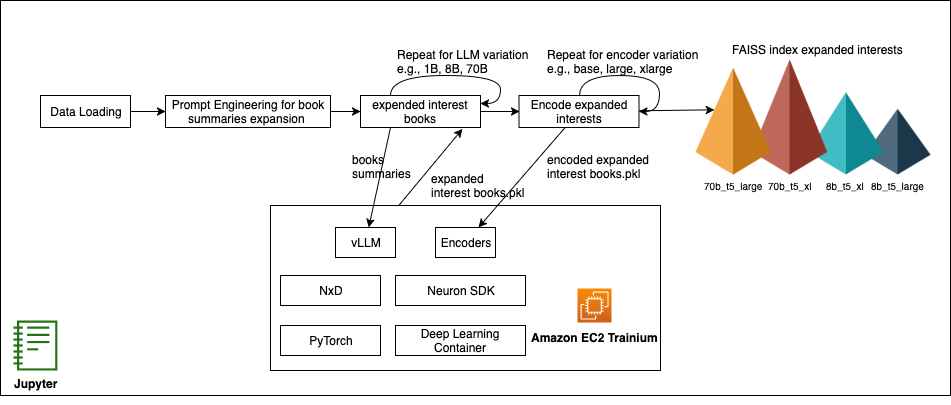
In this post, we demonstrate how to use vLLM for scalable inference and use AWS Deep Learning Containers (DLC) to streamline model packaging and deployment. We’ll generate interest expansions through structured prompts, encode them into embeddings, retrieve candidates with FAISS, apply validation to keep results grounded, and frame the cold-start challenge as a scientific experiment—benchmarking LLM and encoder pairings, iterating rapidly on recommendation metrics, and showing clear ROI for each configuration
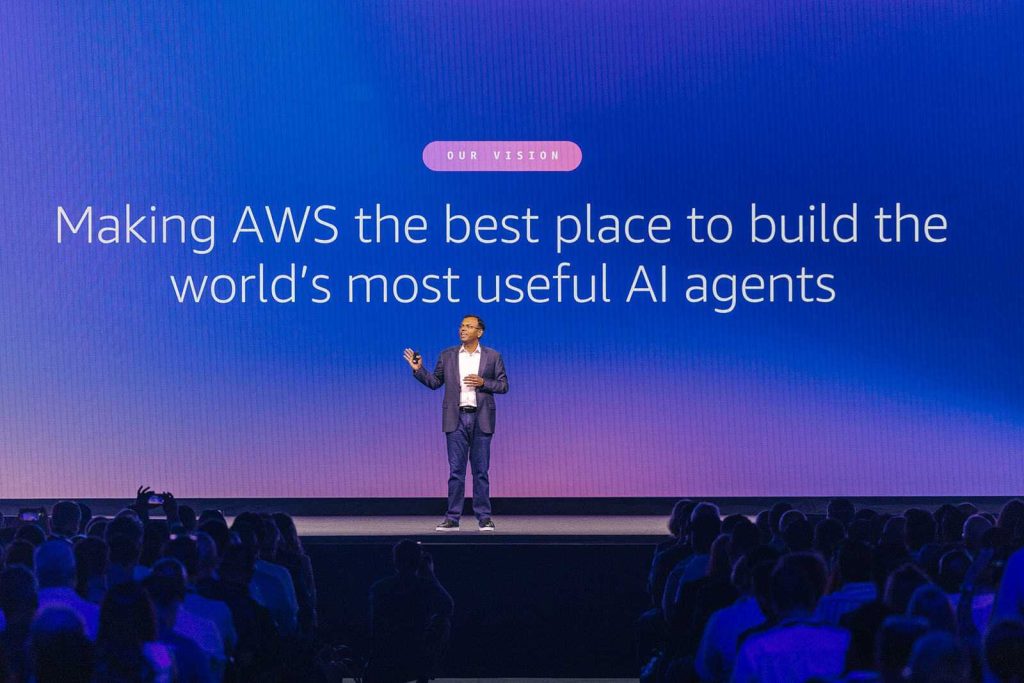
Enabling customers to deliver production-ready AI agents at scale
Today, I’m excited to share how we’re bringing this vision to life with new capabilities that address the fundamental aspects of building and deploying agents at scale. These innovations will help you move beyond experiments to production-ready agent systems that can be trusted with your most critical business processes.

How Rufus doubled their inference speed and handled Prime Day traffic with AWS AI chips and parallel decoding
Rufus, an AI-powered shopping assistant, relies on many components to deliver its customer experience including a foundation LLM (for response generation) and a query planner (QP) model for query classification and retrieval enhancement. This post focuses on how the QP model used draft centric speculative decoding (SD)—also called parallel decoding—with AWS AI chips to meet the demands of Prime Day. By combining parallel decoding with AWS Trainium and Inferentia chips, Rufus achieved two times faster response times, a 50% reduction in inference costs, and seamless scalability during peak traffic.

Cost-effective AI image generation with PixArt-Sigma inference on AWS Trainium and AWS Inferentia
This post is the first in a series where we will run multiple diffusion transformers on Trainium and Inferentia-powered instances. In this post, we show how you can deploy PixArt-Sigma to Trainium and Inferentia-powered instances.