AWS Open Source Blog
Open Protocols for Agent Interoperability Part 4: Inter-Agent Communication on A2A
Welcome to Part 4 of our blog series on Open Protocols for Agent Interoperability where we will cover the Agent-to-Agent (A2A) protocol, AWS’ involvement with the Linux Foundation-based open standard, and our support of A2A in the Strands Agents SDK. Here is what we’ve covered so far:
- Part 1: How the Model Context Protocol (MCP) facilitates inter-agent communication and how AWS has been working on MCP specification enhancements to better support inter-agent communication.
- Part 2: Details on recent MCP specification updates around Authentication.
- Part 3: How to build inter-agent systems with the new Strands Agents SDK and MCP.
Standard protocols are the primary way to connect networked services. Often multiple protocols exist to address different ways of making network connections. In the networking layer, two primary protocols exist: TCP and UDP. Each are suited to specific needs and neither is universal. The same is true when connecting AI agents. In part 4 of our inter-agent communication blog series we will cover what A2A is, how to use it for communicating between agents, and the ways AWS is supporting customers building systems with A2A.
MCP was initially created to connect agents to tools but can also be used to connect agents to agents. A2A was created to connect agents to agents and can also be used in conjunction with MCP for agents to communicate with tools. Which protocol you use for agent-to-agent connections depends on your needs. AWS supports both protocols, enabling customers using MCP, A2A, or a mixture of the two to deploy their code on AWS.
As the inter-agent protocols and the frameworks around them evolve, likely they will become like TCP & UDP where most developers focus more on building their agents instead of underlying protocols. The first step towards that is for agent frameworks to support the protocols and build ecosystems around them. At AWS we’ve taken that first step by joining the A2A standard community and adding support for A2A in our open source Strands Agents SDK. Swami Sivasubramanian, VP of AWS Agentic AI, summarizes this effort:
At AWS, we believe agentic AI will be critical to nearly any customer experience. We welcome A2A joining The Linux Foundation and envision it will create broader opportunities for anyone building AI-powered apps. We intend to support the community with project contributions, and access to the broadest and deepest set of agentic frameworks, protocols, and services.
In the same way we are helping evolve MCP, we are also helping evolve A2A to meet the needs of our customers. There are a number of areas we plan to work on so that A2A works great on AWS, including Amazon Bedrock AgentCore support, A2A protocol extensions for ephemeral task storage and SigV4, improved multi-task management, and improvements to the Java A2A SDK.
A2A Overview
The A2A protocol addresses a critical challenge in the AI landscape. It enables AI agents built on diverse frameworks, and by different companies running on separate servers, to communicate and collaborate effectively — as agents, not just as tools. A2A represents a significant advancement in creating interoperable AI systems that can work together across organizational boundaries. The protocol is backed by a growing ecosystem of partners including over 50 technology companies such as Google, Atlassian, Confluent, Salesforce, SAP, and MongoDB.
Before A2A, organizations faced significant challenges in deploying multi-agent AI systems at scale. Without a standardized protocol, each agent pairing required custom integration code, leading to excessive development overhead and maintenance complexity. This created siloed AI systems where specialized agents couldn’t easily share their capabilities or coordinate on complex tasks. The protocol gives agents a common language that allows them to retain their autonomy and special skills while cooperating – agents communicate as peers, not as mere tools. This distinction is crucial as it enables agents to engage in sophisticated back-and-forth interactions, negotiate task requirements, and maintain their independent decision-making capabilities while working toward shared goals.
For AWS customers, A2A offers several compelling features that align with enterprise requirements. The protocol enables enterprise capabilities including secure agent discovery through standardized agent cards, authentication and authorization mechanisms for controlled access, support for multiple communication modalities (text, forms, media), and the ability for agents to collaborate on long-running tasks without exposing their internal state or implementation details.
A2A addresses the unique challenges of multi-agent collaboration through features that enable sophisticated workflows, handling complex, real-world business processes with the observability and control that production environments require. In particular, it offers support for agent cards, structured tasks, multiple transport options, and authentication/authorization primitives.
Agent Cards
Effective multi-agent communication requires agents to discover and understand each other’s capabilities. A2A facilitates this through Agent Cards — metadata documents that capture the semantic meaning of what each agent can do, how it prefers to work, and what kinds of tasks it excels at. Agent cards allow other agents to make intelligent decisions about when and how to collaborate. Agent Cards also describe the authentication/authorization requirements of an agent, and support progressively increasing exposed capabilities after authentication, using Authenticated Extended Agent Cards.
Structured Task Execution
Agents work together to solve problems by leveraging tasks to structure their communications; they organize their messages into intelligent work units that carry context, track progress, and store output artifacts. Through tasks, agents can reference previously-generated artifacts, understand dependencies between tasks in a workflow, and make informed decisions based on the complete conversation history. Tasks support both sequential and parallel execution for complex workflows. Agents can spawn multiple follow-up tasks simultaneously and create chains of dependent operations. This gives application developers the flexibility to model real-world business processes.
By leveraging task and context IDs, applications can track task provenance, following a chain of tasks to its root to recover information about how an output was created. This improves observability by giving agents the ability to emit rich operation logs for debugging and auditing.
Diverse Transport Options
A2A empowers application developers by supporting three equally-capable core protocols: JSON-RPC 2.0, gRPC, and REST. This allows developers to choose the transport that best matches a team’s expertise, existing infrastructure, and performance requirements. For long-running operations, A2A enhances each transport with Server-Sent Events (SSE) for streaming and webhook-based push notifications. Developers get intuitive options to handle asynchronous task updates and real-time progress monitoring without complex polling logic.
A2A Security
Enterprise-grade security is a non-negotiable requirement for agentic systems. A2A enables robust security architectures by providing support for several authentication schemes; including OAuth 2.0, OpenID Connect, and mTLS, allowing organizations to integrate agents with their existing identity infrastructure, while skill-specific authorization metadata and secondary authentication support enables fine-grained access control policies that can be enforced at the application level.
A2A’s decision to keep agents opaque relative to each other supports zero-trust architectures by treating each agent as an independent security boundary, and the protocol’s support for task auditing provides the foundation for comprehensive security monitoring and compliance reporting.
Inter-Agent with Strands Agents & A2A
The unique features of A2A make it a great fit for agent framework interoperability. A number of open source agent frameworks are already supporting it. The open source Strands Agents SDK recently added support for A2A so agents can easily communicate with other agents.
Strands Agents takes a model-driven approach to building and running AI agents in just a few lines of code. Strands scales from simple to complex agent use cases, and from local development to deployment in production. Multiple teams at AWS already use Strands for their AI agents in production, including Amazon Q Developer, AWS Glue, and VPC Reachability Analyzer.
With the built-in A2A support in Strands Agents you can easily expose an agent as an A2A server and communicate from a Strands Agent to other A2A agents. To illustrate this let’s walk through an example of a Human Resources (HR) agent which can answer questions about employees. To do this you could imagine the HR agent communicating with a number of other agents like an employee data agent, an Enterprise Resource Planning (ERP) agent, a performance agent, goal agent, etc. For this example, let’s start with a basic architecture where a REST API exposes access to an HR agent which connects to an Employee Info agent: Architecture of the inter-agent system containing two agents (HR & Employee Info), connected using A2A.
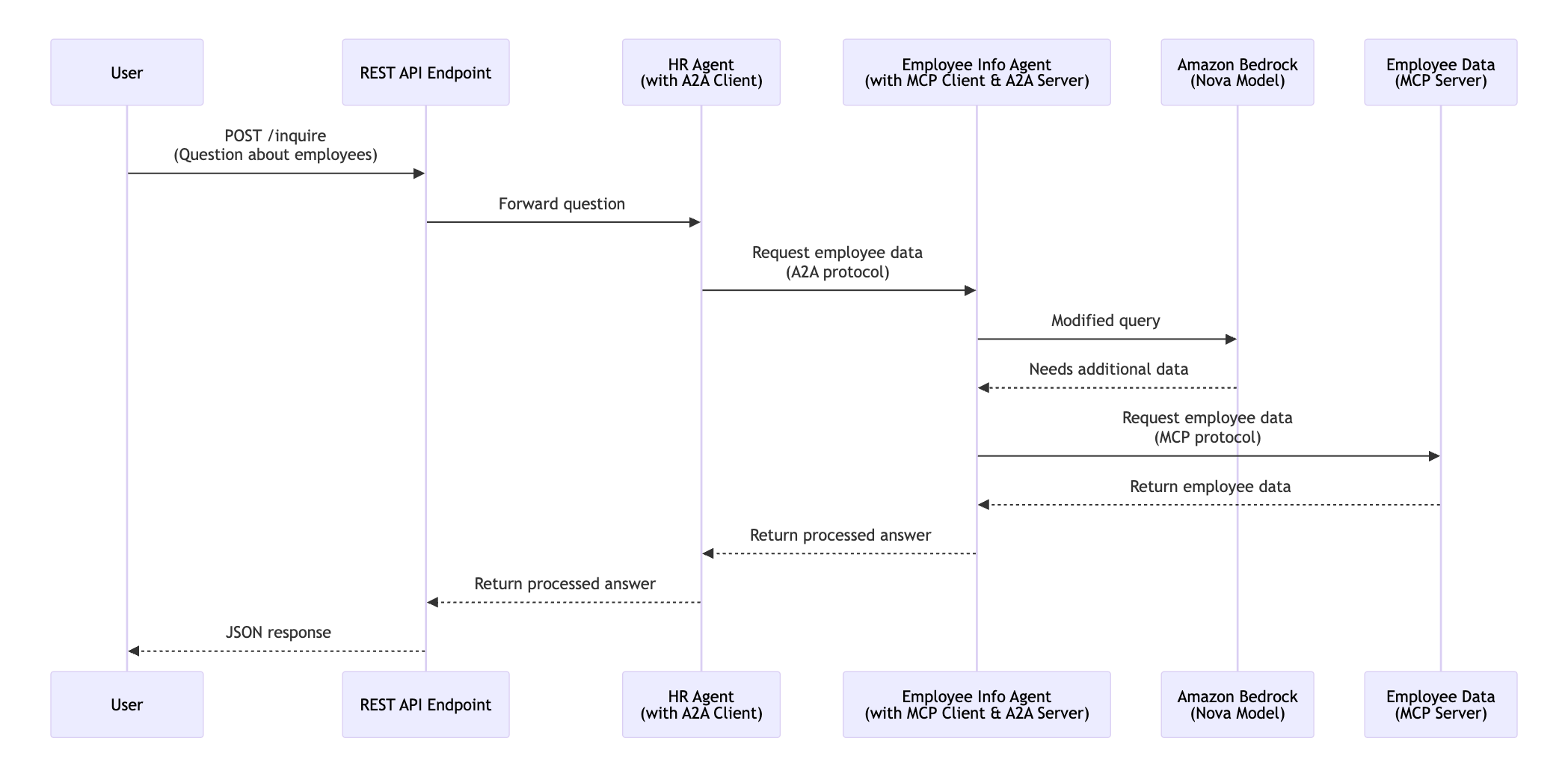
Architecture of the inter-agent system containing two agents (HR & Employee Info), connected using A2A.
Note: The complete, working version of the following example is available in our Agentic AI samples repo.
Our Employee Info agent uses Amazon Bedrock and an MCP tool to get the employee data (see the full code for those aspects):
To expose this agent via A2A, we only need to create the A2A server and start it when the program runs:Note that we pass the EMPLOYEE_AGENT_URL in through an environment variable. This is so our infrastructure definition that knows the endpoint URL can set the host and port that is used in the A2A agent card (used by A2A clients for agent discovery).
Our Employee Info agent is now accessible via A2A and we can create the HR agent:
This agent can now be called in a variety of ways. For this example, we call it from a REST request. See the full code for the REST aspects. Here is what happens when the REST request is made:
- A user (potentially via a web or mobile app) sends a query like “list employees who have AI related skills”
- The HR agent uses the Amazon Nova model, to understand the user’s query and decides that the query needs to be sent to the employee info agent.
- Using A2A, the query is sent to the Employee Info agent.
- The Employee Info agent uses the Amazon Nova model to understand the query and decides it needs to call the Employee Data MCP server.
- The Employee Info agent calls the Employee Data MCP server which queries an employee database and returns the data back to the Nova model.
- Given the system prompt to abbreviate the employees’ first names, the model takes the list of employees, formats it nicely, abbreviating the first names and returns the text to the Employee Info agent.
- The Employee Info agent returns the text to the HR agent which returns it in the REST response.
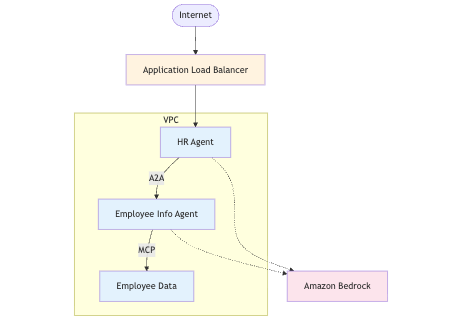
Of course, this can all run on AWS using a variety of runtimes (Amazon Elastic Kubernetes Service (Amazon EKS), Amazon Elastic Container Service (Amazon ECS), Amazon Bedrock AgentCore, AWS Lambda, etc). The example contains an AWS CloudFormation deployment template which deploys the agents and MCP server on Amazon ECS (all in a VPC) and an Application Load Balancer to expose the REST service publicly. The resulting network architecture is:
We can test with curl:
And we get back:
Get the complete source for this example.
Using Strands Agents it only took a few lines of code to expose agents as A2A servers and communicate from agents to other agents using A2A. In future blogs we will cover more advanced agent topographies like Swarms, Graphs, and Workflows.
Customer Perspectives
We’ve already heard from a number of our customers and partners who are excited about our A2A support. Here is what some of them have to say:
“At Autodesk, we’re committed to advancing open standards for agentic AI and interoperability as we shape the future of design and engineering. Through our collaboration with AWS and the A2A community, we’re excited to help build an ecosystem where intelligent agents can communicate seamlessly across Autodesk platforms. As we continue to enhance our Autodesk Platform Services with generative AI capabilities, we see tremendous potential in how interoperable AI agents can transform workflows in architecture, engineering, construction, and manufacturing. Working alongside AWS, we’re dedicated to creating solutions that enable secure and efficient agent collaboration while maintaining enterprise-grade standards.” – Ritesh Bansal,VP of Analytics Data, Insights and AI/ML Platform, Autodesk
“Our commitment to advancing Agentic AI, open protocols, and interoperability is at the core of our vision for secure and intelligent networks. By partnering with AWS and collaborating with the A2A community, we are driving innovation to set new benchmarks in AI-powered security, enabling organizations to operate with greater resilience and confidence in a rapidly evolving AI era.” – Raj Chopra, SVP & Chief Product Officer, Security, Cisco
“As organizations design increasingly sophisticated agentic AI systems, coordination across agents and tools is becoming essential. We’re excited to see AWS advance efforts like A2A that support more interoperable architectures, helping organizations and Datadog’s customers build more observable, reliable, and secure agent-based applications.” — Yrieix Garnier, VP of Product, Datadog
“MongoDB and AWS share a commitment to building an open, composable ecosystem that enables builders to innovate with greater freedom. Embracing open standards like A2A is a key step toward this vision, simplifying how agents can interact with MongoDB’s rich document model, integrated vector search capabilities, and Voyage AI models.” – Abhinav Mehla, VP of Global Partner Programs & Ecosystem, MongoDB
“Interoperability is critical for AI agents to work seamlessly and efficiently across enterprise systems and tools, which is why we collaborated across the industry to develop the A2A standard, and why we will support open standards like A2A and MCP within Agentforce. AWS’s support for A2A will continue to help break down vendor silos, accelerate innovation, and deliver significant value to our shared customers by allowing agents to work across companies’ entire infrastructure and ecosystem of tools and agents.” — Gary Lerhaupt, VP of Product Architecture, Salesforce
“It’s exciting to see industry leaders like AWS rallying behind the Agent2Agent protocol. What began as a bold idea is quickly becoming a shared industry standard—one that’s grounded in openness, security, and cross-platform collaboration. With support from AWS and others, the A2A ecosystem is gaining real traction, and ServiceNow is proud to help lead the charge by making interoperable, enterprise-grade AI agents a reality.” – Joe Davis, EVP of Platform Engineering & AI Technology Group at ServiceNow.
“Snowflake is a firm believer that some of the industry’s greatest innovations have come from open protocols and the communities that foster them. Maximizing the potential of agentic AI depends on open protocols like A2A and the shared knowledge and best practices they provide. We’re glad to see AWS demonstrate their commitment to open protocols for agent interoperability by adding A2A support in Strands Agents. Together, along with the support of the broader technology community, the industry will be able to automate knowledge work with secure agentic systems like Strands Agents and Snowflake Cortex Agents.” – Dwarak Rajagopal, VP of AI Engineering & Research, Snowflake
“In the future enterprise, a fragmented workforce of humans and AI agents will inevitably hinder progress. We believe open protocols, especially Agent-to-Agent Protocol (A2A), are critical to the evolution of this blended workforce. They enable secure, collaborative communication, ensuring interoperability across diverse agent ecosystems. Workday’s Agent System of Record (ASOR) uniquely extends our trusted platform to manage people, money, and agents together. Collaborating with AWS and the A2A community we are committed to advancing secure, interoperable agent communications. This isn’t just about new technology; it’s about securely unlocking new levels of productivity and innovation across the enterprise, all while maintaining comprehensive control.” —Dean Arnold, VP of System of Record, Workday
Get Started and Provide Feedback
To get started building AI agents that interoperate using A2A, check out the Strands Agents A2A docs. We’d love to hear your feedback on using A2A with Strands Agents! Join the discussions on the open source Strands Agents Python SDK repo to let us know what else you need when building inter-agent systems.