AWS Compute Blog
Category: AWS Lambda
Serverless ICYMI Q1 2023
February 12, 2024: Amazon Kinesis Data Firehose has been renamed to Amazon Data Firehose. Read the AWS What’s New post to learn more. Welcome to the 21st edition of the AWS Serverless ICYMI (in case you missed it) quarterly recap. Every quarter, we share all the most recent product launches, feature enhancements, blog posts, webinars, […]

Using AWS Lambda SnapStart with infrastructure as code and CI/CD pipelines
This blog post shows the steps needed to leverage Lambda SnapStart, with examples for AWS CloudFormation, AWS SAM, and Terraform.
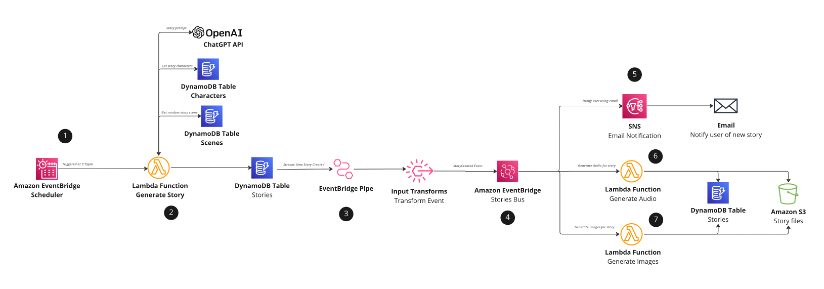
Implementing an event-driven serverless story generation application with ChatGPT and DALL-E
This post demonstrates how to integrate AWS serverless services with artificial intelligence (AI) technologies, ChatGPT, and DALL-E. This full stack event-driven application showcases a method of generating unique bedtime stories for children by using predetermined characters and scenes as a prompt for ChatGPT. Every night at bedtime, the serverless scheduler triggers the application, initiating an […]

Managing sessions of anonymous users in WebSocket API-based applications
In this post, you learn how to keep track of user sessions when using WebSockets API and not lose the session context when the user reconnects again. Apply learnings from this example to improve your user experience when using WebSocket APIs for web-frontend and mobile applications, where internet connections may be unstable.

Server-side rendering micro-frontends – UI composer and service discovery
This post looks at how to use the UI Composer and micro-frontends discoverability. Once this part is developed, it won’t need to change regularly. This represents the foundation for building server-side rendering micro-frontends using HTML-over-the-wire. There might be other approaches to follow for other frameworks such as Next.js due to the architectural implementation of the framework itself.

Introducing AWS Lambda Powertools for .NET
CloudWatch and AWS X-Ray offer functionality that provides comprehensive observability for your applications. Lambda Powertools .NET is now generally available. The library helps implement observability when running Lambda functions based on .NET 6 while reducing the amount of custom code.

Developing portable AWS Lambda functions
This blog post is written by Uri Segev, Principal Serverless Specialist Solutions Architect When developing new applications or modernizing existing ones, you might face a dilemma: which compute technology to use? A serverless compute service such as AWS Lambda or maybe containers? Often, serverless can be the better approach thanks to automatic scaling, built-in high […]

Implementing reactive progress tracking for AWS Step Functions
This blog post is written by Alexey Paramonov, Solutions Architect, ISV and Maximilian Schellhorn, Solutions Architect ISV This blog post demonstrates a solution based on AWS Step Functions and Amazon API Gateway WebSockets to track execution progress of a long running workflow. The solution updates the frontend regularly and users are able to track the […]

Introducing new asynchronous invocation metrics for AWS Lambda
Using these new CloudWatch metrics, you can gain visibility into the processing of Lambda asynchronous invocations. This blog explained the new metrics AsyncEventsReceived, AsyncEventAge, and AsyncEventsDropped and how to use them to troubleshoot issues.
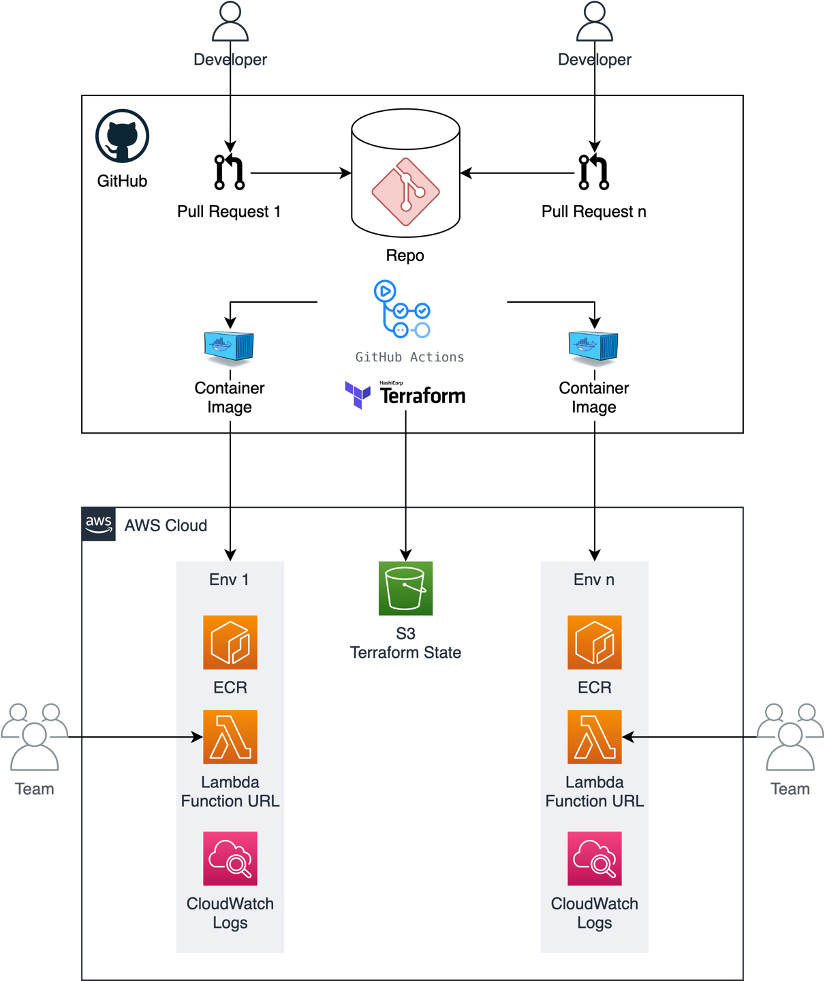
Previewing environments using containerized AWS Lambda functions
This post is written by John Ritsema (Principal Solutions Architect) Continuous integration and continuous delivery (CI/CD) pipelines are effective mechanisms that allow teams to turn source code into running applications. When a developer makes a code change and pushes it to a remote repository, a pipeline with a series of steps can process the change. […]