AWS Compute Blog
Category: AWS Lambda

Selecting cost effective capacity reservations for your business-critical workloads on Amazon EC2
This blog post is written by Sarath Krishnan, Senior Solutions Architect and Navdeep Singh, Senior Customer Solutions Manager. Amazon CTO Werner Vogels famously said, “everything fails all the time.” Designing your systems for failure is important for ensuring availability, scalability, fault tolerance and business continuity. Resilient systems scale with your business demand changes, prevent data […]

Ruby 3.2 runtime now available in AWS Lambda
Get started building with Ruby 3.2 today by making necessary changes for compatibility with Ruby 3.2, and specifying a runtime parameter value of ruby3.2 when creating or updating your Lambda functions.

Developing a serverless Slack app using AWS Step Functions and AWS Lambda
This blog was written by Sam Wilson, Cloud Application Architect and John Lopez, Cloud Application Architect. Slack, as an enterprise collaboration and communication service, presents opportunities for builders to improve efficiency through implementing custom-written Slack Applications (apps). One such opportunity is to expose existing AWS resources to your organization without your employees needing AWS Management […]

Debugging SnapStart-enabled Lambda functions made easy with AWS X-Ray
This post is written by Rahul Popat (Senior Solutions Architect) and Aneel Murari (Senior Solutions Architect) Today, AWS X-Ray is announcing support for SnapStart-enabled AWS Lambda functions. Lambda SnapStart is a performance optimization that significantly improves the cold startup times for your functions. Announced at AWS re:Invent 2022, this feature delivers up to 10 times faster function startup times for […]

Extending a serverless, event-driven architecture to existing container workloads
The blog explains a way to integrate existing container workload running on AWS Fargate with a new event-driven architecture. You use EventBridge to decouple different services from each other that are built using different compute technologies, languages, and frameworks. Using AWS CDK, you gain the modularity of building services decoupled from each other.
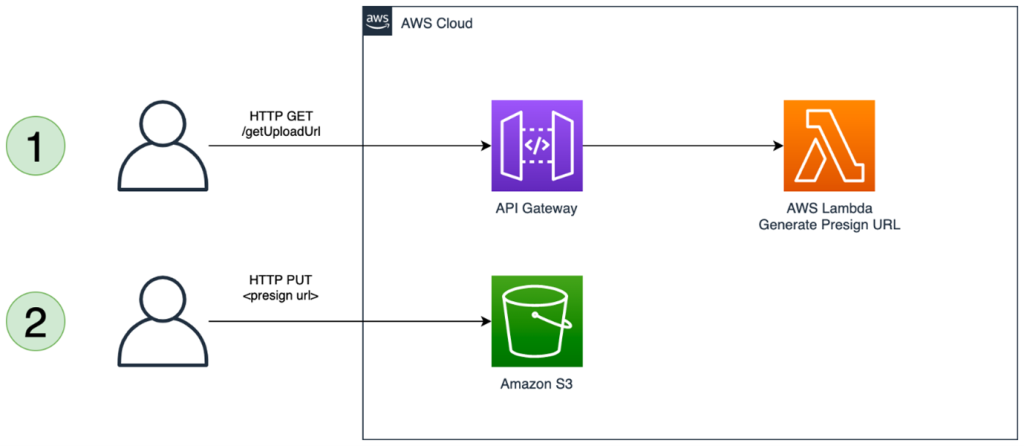
Patterns for building an API to upload files to Amazon S3
This post explores three different approaches to securely upload content to an Amazon S3 bucket via HTTPS without the need to build a dedicated API or client application.

AWS Lambda now supports Java 17
This post was written by Mark Sailes, Senior Specialist Solutions Architect, Serverless. You can now develop AWS Lambda functions with the Amazon Corretto distribution of Java 17. This version of Corretto comes with long-term support (LTS), which means it will receive updates and bug fixes for an extended period, providing stability and reliability to developers […]

Optimizing Amazon EC2 Spot Instances with Spot Placement Scores
This blog post is written by Steve Cole, Principal Specialist SA, and Robert McCone, Sr. Specialist SA. Getting the compute resources you need, even vCPUS numbering in the millions, and completing a workload using Amazon EC2 Spot Instances is just a configuration away. In this post you will learn how to use Spot placement scores […]

Building private serverless APIs with AWS Lambda and Amazon VPC Lattice
Builders can focus on creating customer value and differentiated features instead of complex networking in much the same way that Lambda allows you to focus on writing code. If you are interested in learning more about VPC Lattice, we recommend the VPC Lattice User Guide.

Implementing error handling for AWS Lambda asynchronous invocations
This blog is written by Poornima Chand, Senior Solutions Architect, Strategic Accounts and Giedrius Praspaliauskas, Senior Solutions Architect, Serverless. AWS Lambda functions allow both synchronous and asynchronous invocations, which both have different function behaviors and error handling: When you invoke a function synchronously, Lambda returns any unhandled errors in the function code back to the […]