AWS Web3 Blog
Chainlink Data Standard now available on AWS Marketplace
Developers building digital asset solutions face a fundamental challenge: connecting traditional cloud infrastructure with blockchain networks while maintaining the security, compliance, and reliability standards that financial institutions require. Today, we’re making it easier to address this challenge with the launch of the Chainlink data standard on AWS Marketplace, with Chainlink Data Feeds, Data Streams, and Proof of Reserve now available.
In this post, you will learn how Chainlink’s oracle services integrate with AWS infrastructure and how to get started building blockchain applications that use both AWS and Chainlink capabilities.
Addressing the Oracle Challenge for Tokenization
Blockchain networks operate as self-contained systems that don’t natively connect to external data sources, APIs, or other blockchains, a limitation known as the oracle problem. For various use cases, this creates practical challenges: How do you provide real-time asset prices to smart contracts? How do you verify identity or the reserves backing tokenized assets? How do you connect existing AWS infrastructure to blockchain applications or move assets/data across blockchains?
For tokenization specifically, this is a foundational challenge: the real-world data that gives tokenized assets their value and utility (prices, ownership records, compliance status, reserve verification) simply doesn’t exist natively onchain.
Chainlink solves this problem by securely connecting onchain smart contracts to offchain systems, including AWS services, traditional APIs, identity systems, existing enterprise infrastructure, and other blockchains. This connectivity allows enterprises to build tokenization solutions using both AWS cloud capabilities and blockchain functionality.
Chainlink’s Decentralized Oracle Network (DON) also solves many other critical onchain requirements for financial institutions and decentralized finance (DeFi) protocols, including bringing trusted financial data onchain, moving tokens or messages across blockchains, automating compliance policy enforcement, implementing transaction privacy, and orchestrating workflows across onchain and offchain systems.
Connecting AWS Infrastructure to Digital Assets
AWS provides the foundational building blocks that financial institutions rely on, including compute, storage, and a comprehensive suite of cloud services. Chainlink’s oracle infrastructure extends these capabilities by providing secure, bidirectional connectivity between AWS resources and smart contracts deployed on blockchain networks. The availability of the Chainlink data standard on the AWS Marketplace allows developers to use familiar AWS services when building applications that interact with tokenized assets and smart contracts.
For developers, this means you can:
- Connect AWS data sources and APIs to blockchain applications through secure oracle networks
- Use AWS compute resources alongside blockchain-based systems
- Build solutions that span traditional databases, AWS services, and decentralized protocols
Available Chainlink Data Services on AWS
Three Chainlink data services are now available on AWS Marketplace to support common use cases:
Chainlink Data Feeds provide decentralized price and market data for asset valuation, settlement, and risk management. These feeds aggregate data from multiple sources via a network of independent node operators, designed for applications that require highly secure and reliable financial data.
Chainlink Data Streams deliver fast, secure data that enables onchain systems to respond to market movements in real time, settle with precision, and manage risk dynamically. Data Streams enables advanced use cases, such as perpetual futures, options, and other high-performance markets that were previously impractical to build onchain.
Chainlink Proof of Reserve provides secure, verifiable onchain reserve attestations for stablecoins and other tokenized assets. DeFi protocols and asset issuers can use this data to increase transparency, automate key protocol functions (such as secure token minting), or mitigate against critical attack vectors associated with under collateralization. Proof of Reserve data also enables disclosure and auditability for onchain assets without publicly exposing sensitive information.
Integration Patterns with Chainlink and AWS Services
The following reference architectures demonstrate integration patterns.
Proof-of-Reserve Monitoring
This architecture verifies that a digital asset (such as a stablecoin) is fully backed by underlying reserves.
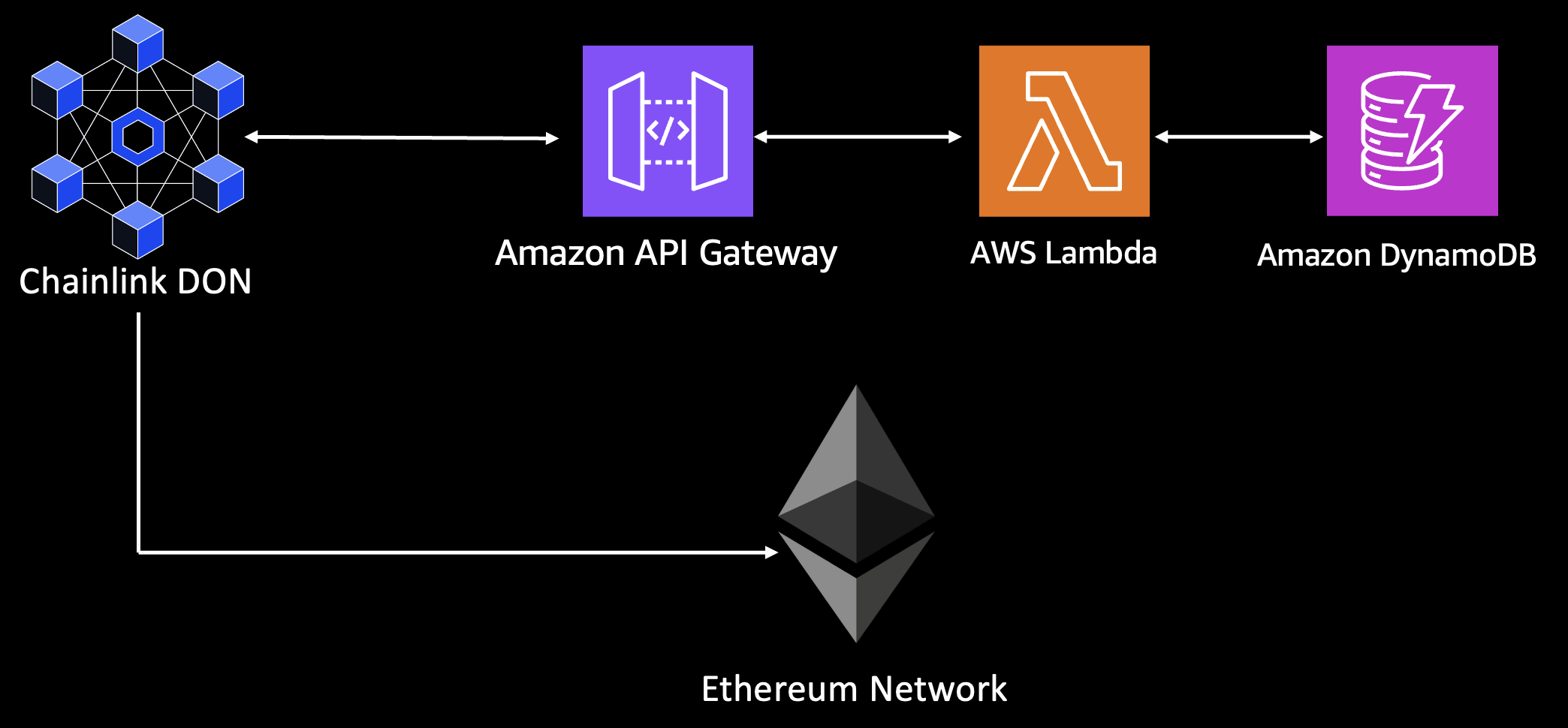
Amazon API Gateway routes requests to AWS Lambda functions that process reserve data stored in Amazon DynamoDB. A Chainlink Runtime Environment (CRE) workflow, deployed on the DON, runs on a scheduled interval to:
- Fetch reserve data from the API Gateway endpoint, with the DON producing a consensus-derived reserve value
- Validate the reserve value against a configured minimum threshold
- Generate a signed report and submit the attested reserve value to a smart contract on Ethereum
The onchain contract serves as the tamper-evident source of truth for downstream consumers, while DynamoDB retains the raw source data for offchain record keeping and audit purposes. A reference implementation is available in the AWS samples repository on GitHub.
Real-Time Trading on Prediction Markets
This architecture combines AWS services with Chainlink Data Streams to build an automated trading system for prediction markets.
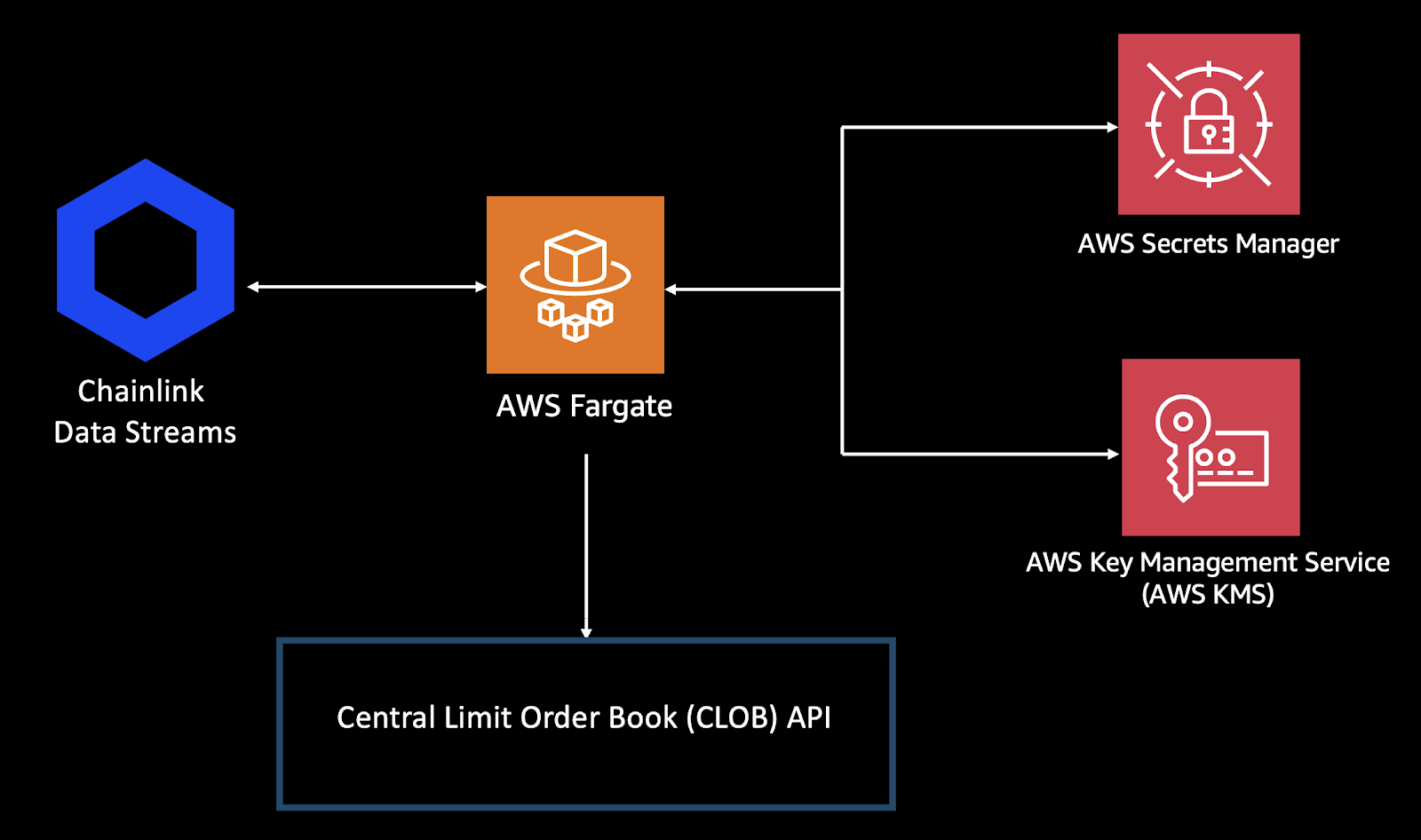
A Data Streams Consumer and Trading Service runs on AWS Fargate and maintains a persistent connection to Chainlink Data Streams. As signed price updates arrive, the system:
- Verifies cryptographic signatures and data freshness
- Normalizes data into a consistent format
- Evaluates trading rules and risk thresholds
- Submits signed transactions to a Central Limit Order Book (CLOB) API when conditions are met
AWS Secrets Manager and AWS Key Management Service (KMS) securely store API credentials and private keys required for transaction signing.
Getting Started
Financial institutions are increasingly exploring tokenization to unlock liquidity, reduce settlement times, and create new asset classes. By combining AWS’s trusted cloud infrastructure with Chainlink’s oracle network, you can build tokenization solutions that meet regulatory requirements while maintaining the security standards your institution demands.
If you’re building digital asset solutions on AWS, you can access Chainlink services through the AWS Marketplace. To explore integration patterns or discuss your specific use case, contact the Chainlink Labs team.