How Bridgestone Modernized Its Mainframe in Seven Months — Unlocking a New Era of Innovation
Overview
For nearly a century, Bridgestone has built its reputation on being a global leader in tires and rubber... But in recent years, the company's leadership recognized that its successes were being undermined by something lurking deep in its technology stack: A mainframe estate built on architectural concepts from years ago. "Our legacy technology was like a boat anchor weighing us down and preventing us from hitting our business goals,” said Brent Gade, Director of Cloud and Infrastructure at Bridgestone Americas. What followed was one of the company's most ambitious IT initiatives — a mainframe-to-cloud migration completed in roughly seven months, yielding 90 percent efficiency gains and potentially millions in savings. It's a story about technology, but more fundamentally about people, culture, and the courage to set aggressive goals.
About Bridgestone
Bridgestone Americas, Inc. is the U.S.-based subsidiary of Bridgestone Corporation, a global leader in tires and rubber, building on its expertise to provide solutions for safe and sustainable mobility. Headquartered in Nashville, Tenn., Bridgestone Americas employs more than 45,000 people across its worldwide operations. Bridgestone offers a diverse product portfolio of premium tires and advanced solutions backed by innovative technologies, improving the way people around the world move, live, work and play.
Challenge | The Weight of Legacy
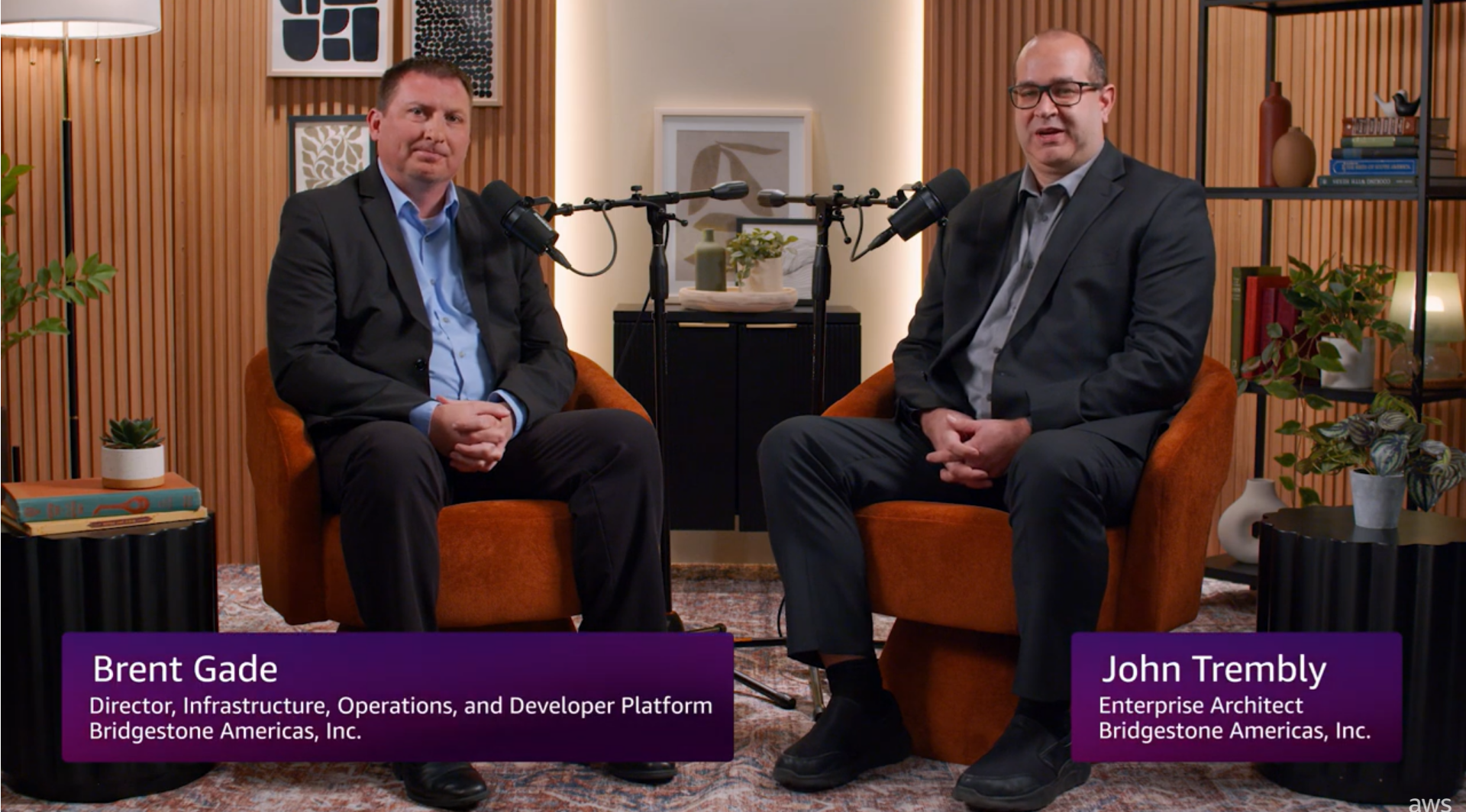
John Trembly, Senior Enterprise Architect who has spent 23 years at Bridgestone, has witnessed the full arc of the company's technology evolution — from basic client-server applications to a large mainframe environment. While the mainframes were solid and reliable, they had become a bottleneck. "They limit our ability to deliver to the business in a timely and flexible way that the business is requiring," Trembly explained.
The consequences were tangible. Bridgestone couldn't respond nimbly to economic uncertainty or market fluctuations, and developers who could work on the legacy code base were increasingly scarce. Applications that had been running for years sat stagnant, riddled with known defects that no one had the time or resources to fix. Critical business data was trapped in rigid, siloed environments, separated from the company's modern analytics platforms. Marrying mainframe data with cloud-based analytics could take days or even weeks.
"These integrations tightly marry the applications together," Trembly explained. "It was limiting our ability to modernize and transform other applications in the environment."
Opportunity | Charting the Path Forward
The first step toward modernization was taking a hard look at what was actually running on mainframes and the business value it was delivering. The team discovered a number of applications that were no longer being used and worked to decommission them. What remained were four applications that were truly critical to the business. With the scope defined, Bridgestone set what Gade described as a "strong, top-down, aggressive goal": migrate those applications from mainframes to AWS in seven to eight months. It was an audacious timeline, but Gade believes that kind of ambition is exactly what was needed. "If you have that strong top-down goal, it enables you to move faster than you ever thought possible," he said. "You’ll notice that your team will rally around that goal and achieve it. If you put it out there aggressively, you just might hit it."
The Solution | AI as an Accelerator — With Guardrails
Moving to the cloud unlocked the ability to use AWS core services, and Bridgestone leveraged several that were fundamental to its new solution, including Amazon EC2 for compute, Amazon S3 for storage, and Amazon RDS for database management. It automated database migration from IBM Db2 z/OS and VSAM to Amazon RDS PostgreSQL. The company chose Amazon RDS in part for its availability and recovery capabilities. RDS delivered much shorter Recovery Point Objectives (RPO) intervals (the time gap between the last successful backup and the moment of a system failure), enhancing its data protection capabilities. “For us, automated failover, snapshotting, and backups made recovery scenarios more predictable and less reliant on manual steps,” said Trembly.
Agentic AI played a foundational role in achieving the aggressive timeline. Using AWS Transform for mainframe, Bridgestone was able to automate many of the most time-consuming aspects of the migration. This included evaluating over 1.2 million lines of legacy code in z/OS COBOL and JCL, replatforming it to modern languages like Java, and performing extensive testing to make sure all of the integrations remained intact.
But Bridgestone was deliberate about not handing the keys entirely to AI. Gade was candid about the risks of unchecked automation: "AI is very powerful and allows you to move much more quickly than you ever would expect. But if used irresponsibly or unchecked, AI can help you drive off a cliff faster." The team adopted a balanced approach: AI handled the mundane, repetitive tasks like code analysis, while human oversight ensured that business-critical logic, compliance requirements, and 95 years of institutional knowledge weren't lost in translation.
"If you use AI by itself with no human oversight, you lose the context around the business logic," Gade explained. "But if you use humans only, you can't accelerate as fast and it takes many, many years to move off of mainframe."
Balancing Speed and Stability
Ask Gade what the most challenging aspect of mainframe modernization is, and his answer might surprise the technically minded: it's not the architecture, the data flows, or getting bits from point A to point B. “As technologists, that's what we like to talk about the most," he admitted. "But really, what drives success of these large-scale modernization efforts is the people and the culture shifts that are required."
Bridgestone invested heavily in upskilling its teams, building communities of practice around cloud-enabled technologies. The goal wasn't just individual learning but creating an environment of collaboration where teammates could explore the art of the possible.
"It's very easy to fall into those old familiar patterns and what's comfortable," Gade said. "But as you move into the cloud, you have to lose some of that thinking. We have to show our teammates that modernization is about creating a culture of innovation. It's not about disruption." The mainframe project itself became a proving ground for this philosophy. The team brought together cloud experts alongside colleagues who had never touched cloud technologies before. "They came together as one cohesive unit," Trembly said. "They upskilled each other."
Gade evangelizes a theme that runs counter to the "move fast and break things" ethos that dominates much of the technology world: balance. "We definitely want to modernize and move fast, but I think there's a risk of moving too quickly and disrupting business operations," he said. "You want to move quickly because you want to get those benefits of cost efficiency and reducing the operational risks that we have with some of that legacy technology. But moving too quickly could disrupt business continuity."
Outcome | Migration Unlocks Significant Business Benefits
Security was woven into the modernization from the start — not bolted on afterward. "Security is everyone's job," Gade said. " Everybody has to build security into those applications. As we modernize them, it gives us a great opportunity to look at the security posture, make them more secure and more resilient."
The modernized applications offer far greater resiliency and uptime. Code modifications that were previously impossible can now be implemented in short order. Data that was once locked away in mainframes is now closer to Bridgestone's analytics platform, dramatically reducing the time it takes to make data-driven decisions.
"Our business began to realize it could do more. They started asking us for enhancements on an application that's been relatively stale."
John Trembly, Senior Enterprise Architect at Bridgestone
The modernization also opened the floodgates for future transformation. With the tightly coupled mainframe integrations removed, Bridgestone can now pursue modernization of other applications across its environment. "Now that we’ve accomplished this, it proves that we can modernize everything," Gade said. With mainframes behind them and a newly empowered workforce ahead, Gade and Trembly see the migration as far more than a technology project. It was a proof point — evidence that Bridgestone can tackle its most complex, deeply entrenched legacy challenges and come out the other side faster, more resilient, and ready to innovate.
"I'm excited to see what our developers can do with the outcome of our migration project," Trembly said. What's next on the horizon? For a company approaching its centennial, the answer seems clear: quite a lot.
AWS Services Used
About the authors
 Brent Gade is Director of Infrastructure, Operations, and Developer Platforms at Bridgestone, where he leads enterprise-scale cloud enablement and platform evolution across core application portfolios. With more than two decades of leadership and experience spanning cloud strategy, platform engineering, and operating-model transformation, Brent focuses on helping application teams reduce operating risk and modernize safely while improving cost transparency, reliability, and speed to value. In his role, he drives alignment between cloud platforms, application portfolios, and configuration management to create a consistent, predictable foundation for decision-making across IT and the business. Brent is a strong advocate for pragmatic approaches that balance governance with team autonomy, ensuring cloud capabilities scale across Bridgestone. He works closely with architecture, security, and delivery teams, and brings a product-oriented mindset to large, complex technology transformations.
 John Trembly is a Senior Enterprise Architect at Bridgestone Americas with broad knowledge spanning cloud platforms, on premises infrastructure, and personal computing environments. His 20+ yrs of experience brings a pragmatic, outcomes focused approach rooted in the philosophy that consistent, stable, and well governed solutions are the foundation for long term business value and operational excellence. John partners closely with cross functional stakeholders across IT and the business to translate strategy into scalable, resilient architectures that deliver measurable results aligned to both current needs and future growth.
 At AWS, Chris Saleski leads Global Customer References for Migration & Modernization, driving customer-led transformation stories. He leverages leadership experience from Intel where he directed marketing for gaming and quantum computing solutions. Chris was a key driver behind the SSD revolution, and led industry initiatives to optimize software for next-generation SSD technology. At Microsoft, he created and led thought leadership campaigns and partnerships focused on DevOps and big data solutions to drive adoption among developers and enterprise customers. Early in his career, Chris was an automotive body designer for Honda.
Did you find what you were looking for today?
Let us know so we can improve the quality of the content on our pages