Key Outcomes
Overview
Building a more equitable world begins with access to quality education. However, according to a 2022 report, an estimated 70 percent of 10-year-olds in low- and middle-income countries don’t have basic literacy skills.
Education technology company TagHive aims to democratize education for all students, regardless of income level or connectivity. TagHive’s product, Class Saathi, is a Bluetooth-based smart classroom solution with offline-capable hardware and personalized, AI-based learning tools. It’s one of the world’s first classroom learning solutions that captures student responses and learning data without internet access—helping make sure that no student is left behind. Class Saathi is widely used across India, South Korea, Vietnam, Malaysia, and South Africa.
Using custom-built generative AI solutions that run on Amazon Web Services (AWS), Class Saathi delivers near real-time assessments, personalized homework, and classroom analytics to educators and students to improve learning outcomes at scale. With support from the AWS Education Equity Initiative, TagHive brings Class Saathi to under-resourced schools, advancing equitable, data-driven learning worldwide.
About TagHive
Based in South Korea and operating worldwide, TagHive is on a mission to make education more accessible for students. The company was founded in 2017 and aims to reach 2.3 million classrooms worldwide with its product, Class Saathi, by 2035.
Opportunity | Using AWS to power AI-driven insights for TagHive
Students and educators face many learning challenges, especially in rural and low-income areas. “There’s an invisible learning crisis,” says Pankaj Agarwal, founder and CEO of TagHive. “Students may go to school, but not all of them are learning. I wanted to build technology that helps teachers and students succeed, even in environments with no internet access.”
While it’s not uncommon to find education technology in under-resourced areas, many products go unused when they require extensive training, frequent updates, or internet access for full usability. When designing its classroom solution, TagHive identified what real classrooms needed: a product that works offline, is intuitive to use, and requires virtually no maintenance.
To realize this vision, TagHive needed a cloud provider that could support the demands of its workloads. The company selected AWS for its seamless user experience and strong support, laying the foundation to deliver Class Saathi at scale.
Solution | Closing the gap in education using generative AI
Class Saathi is a holistic, offline-first, classroom-ready engagement and assessment tool that includes hardware, software, content, and AI features. At its core is a virtually real-time assessment loop: Teachers ask questions, students respond using Bluetooth clickers, and teachers can see almost instantly how well students understand the concepts. This insight helps teachers decide whether to revisit a topic or move forward and highlights which students need additional support. “We believe that every child should receive personalized education,” says Agarwal. “Teachers can use data to focus more on each child.”
To power this personalized experience, TagHive trained an open-source large language model, which it calls SaathiGPT, that drives the AI capabilities of its suite: Saathi Genie, Saathi Tutor, and Saathi Assist. Saathi Genie uses voice or document input to create questions for teachers in just seconds, generate reports, and give personalized homework to students. Saathi Tutor assists students directly, offering unlimited practice and easy doubt resolution. Saathi Assist provides administrators with insight into school-wide performance through query-based reports.
Class Saathi’s AI capabilities use proven, trusted data solutions on AWS. Using Amazon Comprehend, a service for deriving and understanding valuable insights from text within documents, Class Saathi can apply sentiment analysis and key-phrase extraction to educational content, enhancing learning materials and student feedback analysis. The solution uses Amazon Elastic Compute Cloud (Amazon EC2) for secure and resizable compute capacity for running application and assessment workloads in private subnets, which facilitates the secure processing of student assessments, AI-powered grading, intelligent question generation, and near real-time feedback. Class Saathi also uses Amazon Elastic Block Store (Amazon EBS) for easy-to-use, high-performance block storage for student responses, assessment results, and learning analytics. And using Amazon EC2 Auto Scaling helps Class Saathi maintain application availability, along with Application Load Balancer—a service to load balance HTTP and HTTPS traffic with advanced request routing. These two services help Class Saathi seamlessly handle unpredictable usage spikes, such as during exams, while maintaining performance and cost-efficiency.
Together, these AWS services help TagHive deliver an AI-powered classroom experience that empowers both students and educators.
Outcome | Improving student outcomes at scale
Through personalized, gamified learning, Class Saathi boosts information retention and, in one study, increased classroom engagement by 30 percent. In this study—which included more than 12,000 students in India—Class Saathi improved overall final exam scores by 9.6 percent in just 1 academic year. Even the lowest performers showed dramatic growth, with minimum exam scores increasing from 22 points to 40 points—an 82 percent improvement. “One thing that we’ve seen in the education technology space is that many technologies are only helpful to the students who are already succeeding,” says Agarwal. “But such technologies don’t necessarily help struggling students, who may not care because they’re less motivated. Using AWS to power our technology, we can motivate every child. And not only do the struggling students improve, but the top students also become better.”
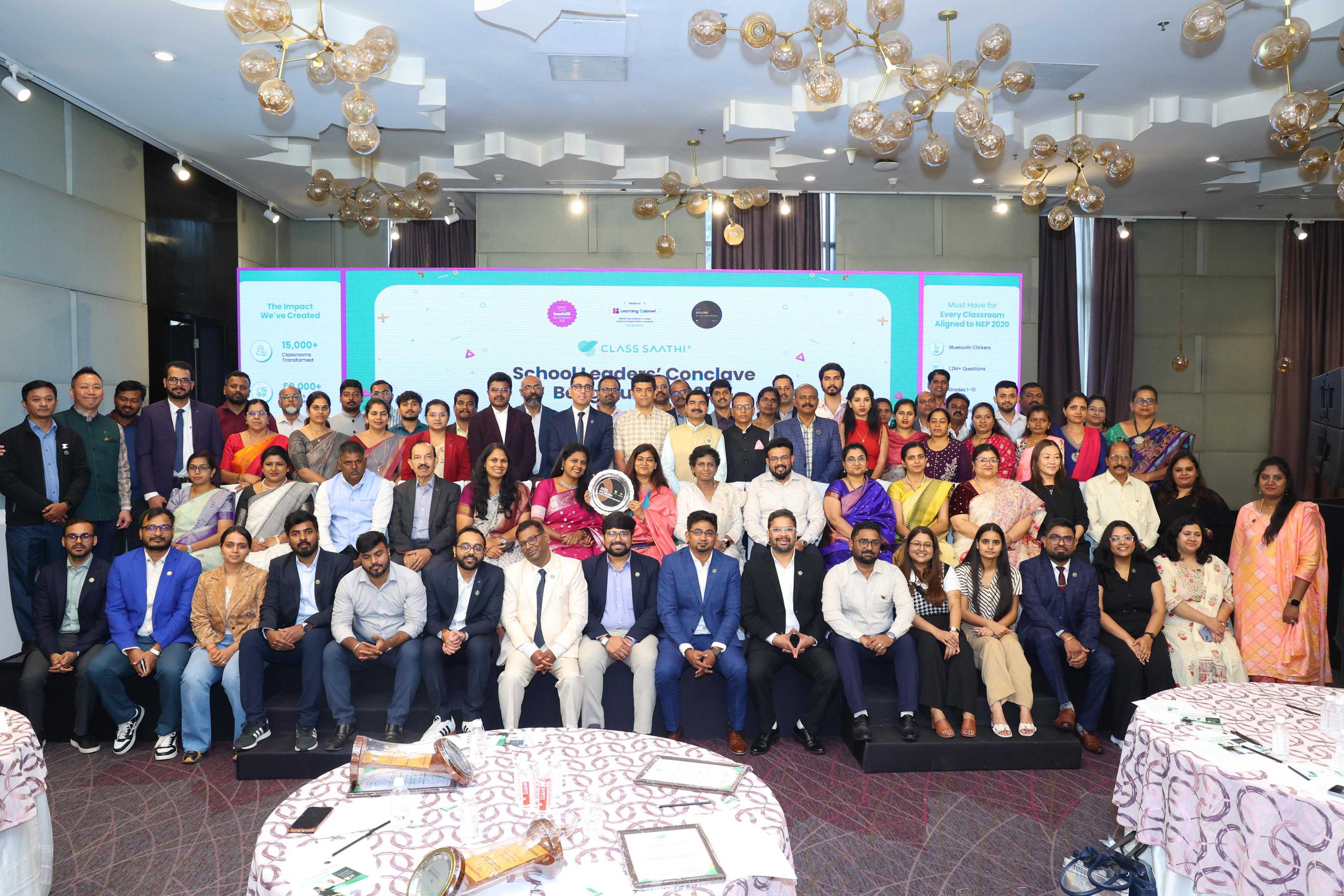
Class Saathi, which is now used in more than 13,000 classrooms across India, is featured in the UNICEF Learning Cabinet, an online discovery platform that helps governments and educators find equitable learning solutions. The product has received multiple awards, including MIT Solver 2025 and a 2025 Edison Awards bronze medal in the EdTech and Learning Evolution category, and is listed on HundrED Global Collections 2026. Harvard Business School also wrote a case study on TagHive.
TagHive aims to reach 2.3 million classrooms by 2035, advancing its mission of democratizing education for all. This growing reach underscores a larger social impact: creating learning environments where every student has an equal chance to succeed. “If a classroom has 40 students and only 39 are heard from, the teacher will know who’s not responding and is empowered to find out what’s going on,” says Agarwal. “The student’s voice is being heard in the classroom. When students participate in class, they learn more, which in turn improves their motivation and leads to better outcomes.”
.668ea29f1db301723fb3f96136897bd797ffe7c3.png)
Using AWS to power our technology, we can motivate every child. And not only do the struggling students improve, but the top students also become better.
Pankaj Agarwal
Founder and CEO, TagHiveAWS Services Used
Did you find what you were looking for today?
Let us know so we can improve the quality of the content on our pages