What Is an Autonomous System?
What is an autonomous system?
An autonomous system is a smaller network under the control of a single administrative entity. You can uniquely identify such networks by their autonomous system number assigned by the Internet Assigned Numbers Authority (IANA). Data travels between autonomous systems as it moves from the source IP address to the destination IP address. Examples of autonomous systems can include internet service providers, large businesses, and universities.
How do autonomous systems work?
Autonomous systems (ASs) are smaller networks that make up the internet. An autonomous system may be an internet service provider (ISP) with home and business customers, a cloud provider's services within a particular region, a government agency with multiple wide area networks, a large university with various local area networks, or a multinational business.
For systems to know how to send data internationally from one IP address to another, they need to know where to route the data packets across the network. An autonomous system has a networked connection to one or more other ASs. An AS is assigned blocks of IP addresses (an IP address space) for devices on their internal network, and routes traffic across their internal network according to internal policies.
By joining ASs together, traffic can be routed across the internet, including across multiple autonomous systems. This means that a device on one IP address in one autonomous system can send data to another IP address on another autonomous system on the other side of the world. ASs are the backbone of the internet and how data flows across it.
How is routing handled between autonomous systems?
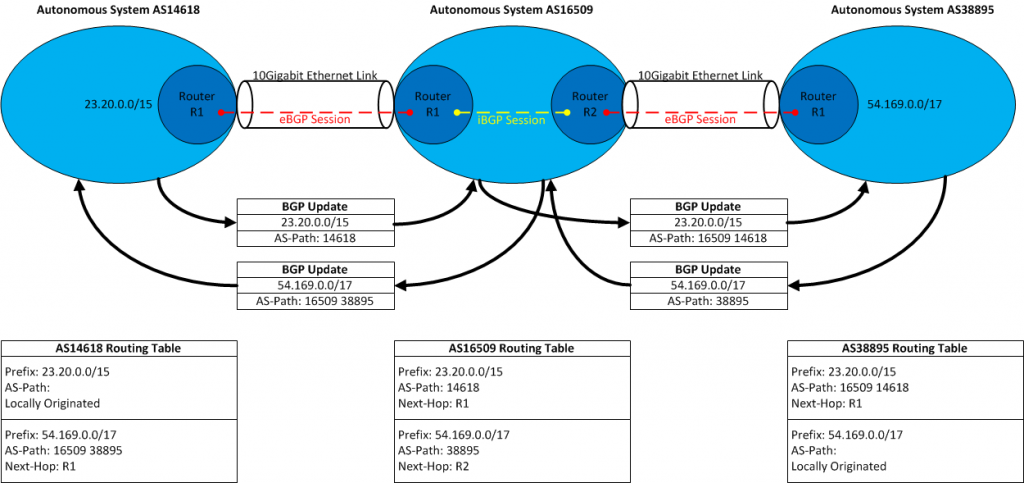
To route traffic between ASs, there must be an agreed-upon protocol to make it possible. In the case of routing between ASs, this protocol is the Border Gateway Protocol (BGP); autonomous systems use the common Border Gateway Protocol to exchange and route internet traffic with one another.
Border Gateway Protocol
Each autonomous system shares the IP addresses they can reach via a BGP router connected to the BGP routers of another autonomous system. Both ASs exchange routing information to learn how they can reach other IP addresses and thus route traffic across the internet. The Border Gateway Protocol takes care of determining the best data path through the various networks using a variety of different policies that may include cost, performance, and preference towards peering rather than transit links. Each autonomous system sets its own clearly defined routing policy with BGP.
Routing policies
Autonomous systems adjust their BGP policies based on factors such as the amount of traffic to given sets of IP addresses, the reliability or latency of network links, and more. The practice of adjusting these policies is known as traffic engineering. Outbound traffic engineering strategies are easier to implement than inbound traffic engineering strategies. Traffic engineers use tools such as traceroute to examine the hops that a data packet has taken across the full network. This helps them to determine where inefficiencies might lie.
How do autonomous system numbers work?
Each autonomous system (AS) must register a globally unique autonomous system number (ASN) to connect with other networks. Autonomous system numbers are usually public to connect to the wider internet, although they may also be private if they connect with only one other networked entity. Autonomous systems are assigned an ASN by registering with the relevant Regional Internet Registry (RIR). The RIR is also responsible for allocating IP addresses to networks, including ASs.
The registry process is critical if an entity wishes to self-manage its network and participate in the wider internet. There are five regional internet registries worldwide:
- African Network Information Center (AFRINIC)
- American Registry for Internet Numbers (ARIN)
- Asia-Pacific Network Information Centre (APNIC)
- Latin American and Caribbean Network Information Centre (LACNIC)
- Réseaux IP Européens Network Coordination Centre (RIPE NCC)
What are the different relationships between autonomous systems?
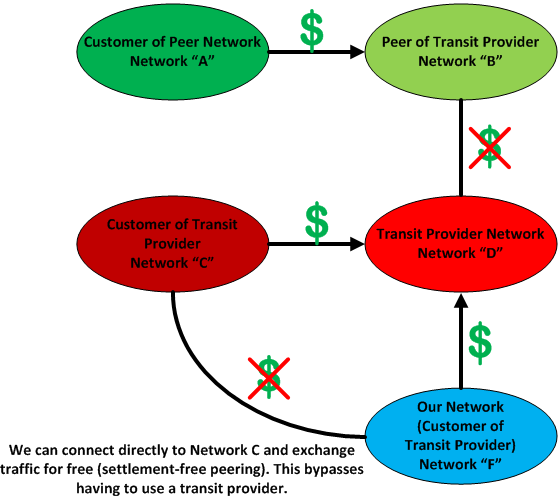
There are two distinct types of relationships between networked ASs for the exchange of data; transit and peering.
Transit
Transit is when two ASs take on a customer-provider relationship. In this instance, a downstream customer AS pays a provider AS to route traffic for them and advertise their IPs to the wider internet. This may be necessary for smaller ASs without direct connectivity to other autonomous systems to gain faster access with better routing to the wider internet.
Peering
Peering is when ASs share their routes and those of their downstream customer ASs with one another, as well as provide traffic exchange between each other at no cost. This is also known as settlement-free peering. A direct connection between two different autonomous systems is known as private peering. When more than two ASs are connected via an Internet Exchange Switch for multi-peering relationships, this is known as Public Peering.
How can AWS help support your autonomous system requirements?
AWS Transit Gateway connects your Amazon Virtual Private Clouds (VPCs) and on-premises networks through a central hub. This connection simplifies your network and puts an end to complex peering relationships.
Transit Gateway is a highly scalable cloud router—each new connection is made only once. It supports BGP to simplify branch connectivity through native integration of network virtual appliances. Any third-party appliances that support BGP work with Transit Gateway.
Similarly, AWS Direct Connect is the shortest path to your AWS resources. While in transit, your network traffic remains on the AWS global network and never touches the public internet.
You can use an AWS Direct Connect gateway attached with one or more transit virtual interfaces. This allows you to interface with up to three transit gateways in any supported AWS Regions. You can establish one IPv4 BGP session and one IPv6 BGP session over a single transit virtual interface.
Get started with BGP routing between your AWS resources and your autonomous systems by creating a free account today.
Browse all cloud computing concepts
Browse all cloud computing concepts content here:
Did you find what you were looking for today?
Let us know so we can improve the quality of the content on our pages