AWS in Switzerland and Austria (Alps)
How Simpego uses Amazon Bedrock to Resolve Swiss Insurance Claims
When a policyholder submits an insurance claim, they want one thing: a fast resolution. Every extra day between filing and payout erodes trust. For Simpego, a digital-first Swiss insurer, that urgency shaped a clear engineering goal: to remove every unnecessary delay from the claims pipeline. Simpego identified the primary bottleneck that was causing these delays: manual data entry. Claims specialists had to manually sift through line items and complex Swiss VAT details from thousands of documents per month. The process was slow, did not scale, and took away precious time from claims specialists who needed to focus on efficiently and correctly resolving claims. Simpego needed a solution that would process claim documents accurately and immediately, empowering the claims specialist to focus on decisions by removing cumbersome process steps and ultimately satisfy customer expectations.
To solve this, Simpego and AWS Advanced Partner copebit built a fully serverless, generative AI-first extraction pipeline using Amazon Bedrock. By using Anthropic’s Claude Opus model, they transitioned from traditional optical character recognition (OCR) with rigid templates to a flexible, intelligent extraction strategy. A large language model (LLM) can reason about the content of a document it has never seen before, essential for Simpego, as complex Swiss invoices vary wildly in format, language, and structure.
Simpego is a young Swiss insurer that utilized the cloud from day one. With lean structures and an all-in AWS strategy, the company operates without the overhead of maintaining legacy. This digital-native DNA made Simpego the ideal candidate to push the boundaries of what’s possible with generative AI in insurance.In this post, we will present the solution overview, the technical deep dive on the extraction workflow, why Anthropic’s Claude Opus on Amazon Bedrock was the definitive choice for complex, multilingual Swiss documents, and the significant business impact of the implementation.
Solution Overview
Claims specialists were spending hours on repetitive data entry each day. At the same time, foundation models capable of contextual document understanding had arrived. Together, these made intelligent document processing the highest-impact automation opportunity in Simpego’s claims workflow. To bring the vision to production, Simpego partnered with copebit AG, an AWS consulting and engineering partner specialized in business process optimization using modern technology like serverless architectures and AI-powered cloud solutions. Together, the teams designed, built, and shipped the pipeline in a matter of weeks.
Architecture and Technical Deep Dive
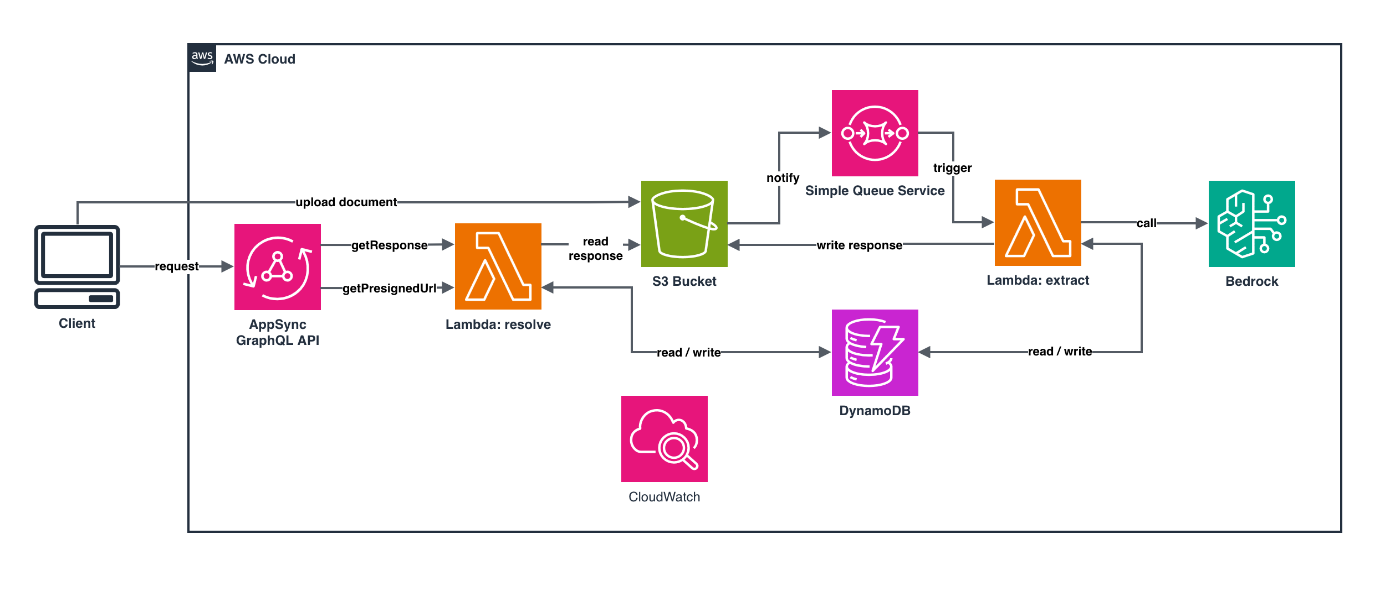
Rather than adopting traditional OCR with rigid templates, Simpego and copebit built a fully serverless, event-driven pipeline on AWS. The pipeline follows an asynchronous, event-driven design that separates document ingestion from intelligence processing. This decoupled architecture ensures that the user-facing claims platform remains responsive at all times; no request blocks while waiting for model inference.
The Extraction Workflow
1. Secure Document Upload
Simpego’s core insurance platform (SIP) sends a GraphQL request to AWS AppSync to fetch the credentials/metadata and the presigned Amazon S3 URL needed to upload a customer document directly to S3. GraphQL consolidates credential retrieval and metadata into a single, strongly-typed call, avoiding the multiple roundtrips a REST API would require. A resolver AWS Lambda function returns a presigned URL for Amazon S3, allowing the client to upload the document directly without routing binary data through the API layer.
2. Asynchronous Extraction
An S3 Event Notification triggers a second Lambda function in the background, the upload response returns immediately to the specialist. This extraction function:
- Retrieves the document and converts it into a model-ready format
- Assembles a prompt containing the document, a strict JSON output schema, field definitions, and multilingual extraction hints for Swiss invoice conventions
- Invokes Amazon Bedrock with Anthropic’s Claude model
- Parses and validates the structured response before passing it downstream
3. Real-Time Response Delivery
The validated data is pushed back to SIP via an AppSync mutation. The platform subscribes to real-time updates through AppSync’s WebSocket-based subscriptions, so the claims specialist sees pre-filled data appear instantly, no polling required.
Hybrid Validation Process
Validating the output of the large language model remains an important step in the overall process. Even the most advanced models can produce errors, especially with highly variable or complex document layouts. This is true even for extraction performed solely by humans, as they are also prone to errors. To mitigate this, Simpego implements a three-step validation strategy:
- Schema Validation: The pipeline uses automated schema validation to ensure the extracted data adheres strictly to the required structure, preventing downstream system failures.
- Arithmetic Checks: The system performs basic arithmetic checks, verifying that extracted line items and VAT amounts correctly sum up to the total amount on the invoice.
- Human-in-the-Loop: The claims specialist performs a final verification of the pre-filled data, correcting any minor extraction errors and serving as a continuous quality and feedback mechanism.
“Automation is only valuable if the output is trustworthy. By pre-filling fields for our specialists, we create a continuous feedback loop that improves our prompts while ensuring our team remains the final decision-makers.”
Michael Ammann, CTO, Simpego
Why Claude by Anthropic in Amazon Bedrock?
Swiss invoices are uniquely challenging. They often mix German, French, and Italian and contain multiple VAT rates (8.1%, 2.6%, and 0%) on a single page. Only the most advanced models like Anthropic Cloud Opus handle this variance through contextual reasoning, understanding that ‘MwSt’ and ‘TVA’ both refer to VAT, regardless of the invoice layout. This gets even more complex because of the varying input quality of the received claim documents. Simpego’s system must handle everything from pristine, machine-generated PDF invoices to blurry, poorly lit smartphone photos of crumpled paper and even handwritten notes. Traditional fixed-template OCR solutions simply fail when faced with such inconsistency, but the advanced contextual reasoning capabilities of Anthropic’s Claude Opus model allow it to consistently extract the necessary structured data regardless of the document’s format, orientation, or visual quality. Amazon Bedrock provides the necessary security for the Swiss financial sector: it is fully managed, does not use customer data to train models, and processing remains within the secure AWS environment. For Swiss financial institutions, data residency is a critical consideration. Switzerland’s Zurich region (eu-central-2) has the most advanced models available. By providing geographically fixed endpoints, Amazon Bedrock enables its users to meet Simpego’s strict governance requirements. This keeps the components within AWS’s secure cloud infrastructure. The commitment to security and compliance, combined with Claude’s Opus superior reasoning for complex, multilingual documents, made it the definitive choice over self-managed models. For unpredictable workloads like insurance claims, Amazon Bedrock’s serverless nature provides key benefits. It allows Simpego to only pay for the actual inference calls made, meaning there are no costs incurred when the system is idle overnight or during low-volume periods. This pay-per-use model is aligned with Simpego’s cloud-native, cost-efficient operational philosophy.
Business Impact
The move to an LLM-based pipeline has transformed Simpego’s operational efficiency. The project moved from kickoff to production in just two months.
| Metric | Before GenAI | After GenAI |
| Processing Speed | Hours of manual entry | Seconds |
| Efficiency | Fully manual transcription | 95% of cases without manual intervention |
| Accuracy | Prone to human errors | High consistency |
| Scalability | Required more staff | Serverless scaling |
Today, the pipeline processes thousands of extractions per month, with an average turnaround of roughly 30 seconds per document. From upload to fully structured, pre-filled data ready for specialist review. What previously required minutes of focused manual work per document now happens automatically in the background, freeing the claims team to focus on decisions rather than data entry. The result is simple: Simpego’s customers have their claims resolved faster. By replacing manual data entry with a flexible LLM-based extraction pipeline on AWS, Simpego delivers on its core promise: a frictionless, digital insurance experience for its policyholders.
Simpego’s Core Infrastructure
The solution integrates directly with Simpego’s modern, cloud-native stack. Simpego’s core infrastructure is deployed using a secure multi-account architecture, spanning dozens of AWS accounts managed by AWS Control Tower, which provides the foundation for security, governance, and compliance. This robust landing zone approach provides scalability and clear separation of environments. Specifically, Amazon EKS manages the container orchestration for the event-driven workflow components, while the core claims data resides in MySQL, hosted on the autoscalable Amazon Aurora Serverless database service. Operational visibility is provided through Amazon CloudWatch for monitoring and alerting. This is supplemented by AWS Glue and Amazon Athena for detailed data analysis and Amazon ElastiCache for Valkey for high-speed data caching.
Next Steps for Your GenAI Transformation
Simpego’s success demonstrates the power of a generative AI-first approach to complex, multilingual document processing. If you are looking to implement similar solutions for claims automation, invoices, or other document-heavy workflows, consider these actionable steps for your organization:
- Unlock AI Flexibility in Switzerland: Learn how to access the broadest selection of foundation models while maintaining EU data processing compliance with cross-region inference for EU data processing and model access.
- Design a Serverless API: Learn how to implement a secure, scalable API for document ingestion using serverless technologies. Start with the AWS AppSync guides to build your event-driven data layer.
- Partner for Expertise: Accelerate your deployment by engaging with an AWS consulting and engineering partner specialized in serverless and generative AI solutions, such as copebit AG. Find more information about copebit AG in the AWS Partner Network.