AWS in Switzerland and Austria (Alps)
What ALPS banks can learn from their EMEA peers: Highlights from the AWS EMEA Summits 2026
How are leading banks in Europe, the Middle East and Africa (EMEA) responding to the steadily rising expectations of their customers? What does it take to move generative AI from first experiments into everyday work in a regulated environment? At the AWS Summits 2026 in Amsterdam, Hamburg, Stockholm, Johannesburg and Zurich, banks such as KBC from Belgium, DKB from Germany, Danske Bank from Denmark, FNB from South Africa and Pictet from Switzerland answered these questions through their own stories.
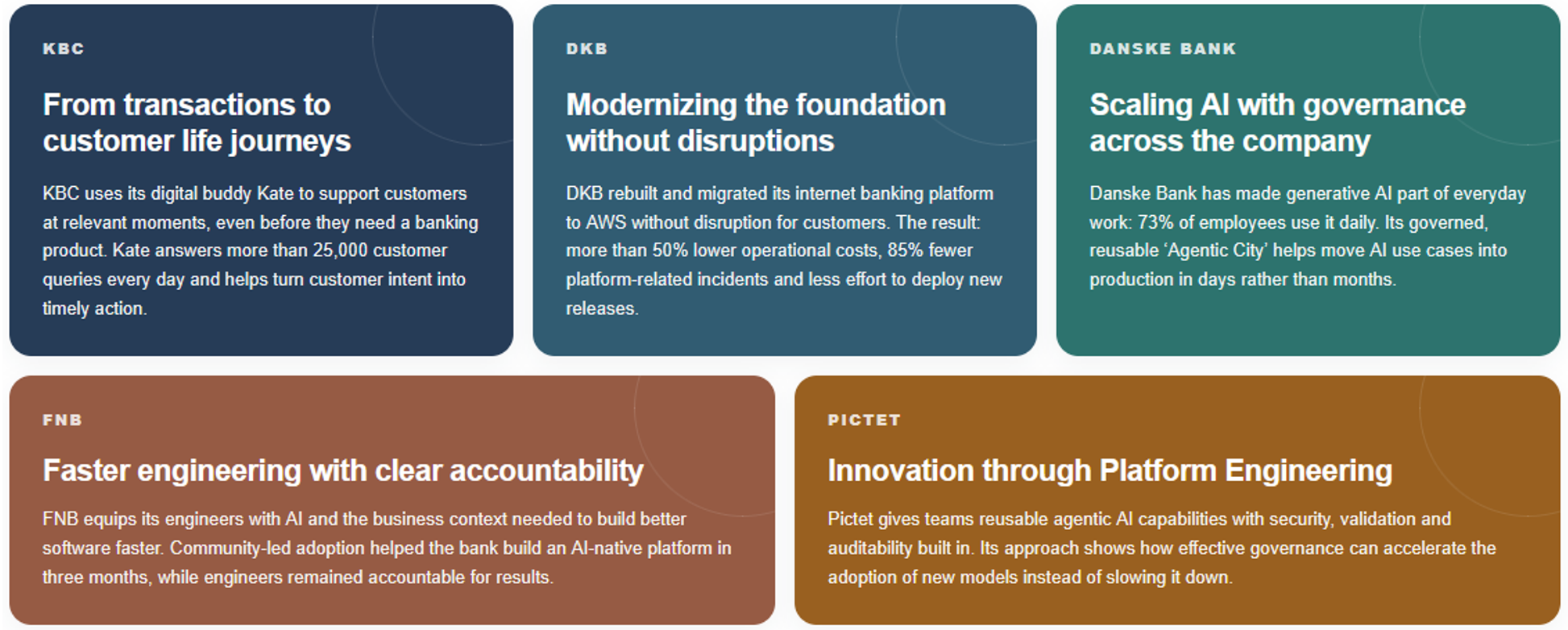
This recap contains the most relevant lessons for banks and financial services providers in ALPS, with links to the recorded keynotes and sessions for deeper exploration.
From transactions to customer life journeys (KBC)
Customer journeys begin long before a mortgage application. This was a central message of Karen Van De Woestyne in the keynote of the AWS Summit Amsterdam. She illustrated this with the example of her daughter Amber, who wants to buy an apartment. Long before Amber applies for a mortgage, she browses property platforms in the evening, visits potential apartments and explores her options. For KBC, which serves 6.1 million customers, this means that a bank should not only support banking transactions but the life journeys of its customers. The shift from reactive to predictive, proactive and journey-based banking is supported and accelerated by technology with AWS, or as Karen Van De Woestyne put it: “If we miss Amber’s intent, someone else will own the moment, shape the relationship, and capture the value.”
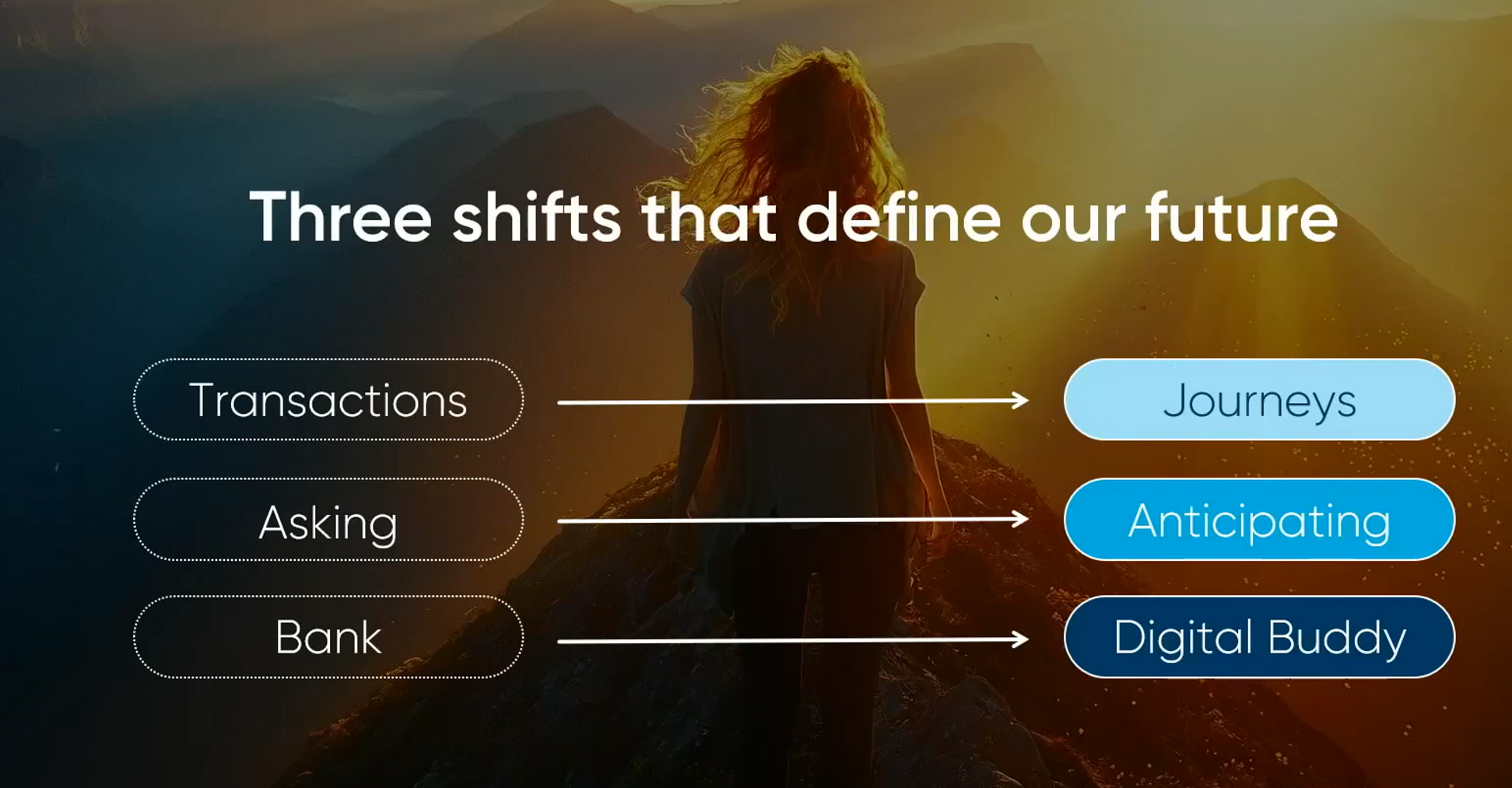
The face of this transformation is Kate, KBC’s trusted digital buddy. Kate is not just a chatbot waiting for a question; Kate reaches out to customers proactively through push and in-app notifications whenever there is something relevant to help them with, for example with the determination of Amber’s home budget. How far KBC has already come is shown by the numbers: Customers have started 80 million conversations with Kate, more than 25,000 customer queries are answered every day and Kate delivers an operational output equivalent to more than 350 full-time employees. With more than 50 integrated third-party services and more than 400,000 products and services sold per year, Kate is becoming the default customer interaction layer of KBC. Technically, Kate is built on Amazon Bedrock AgentCore, Amazon Elastic Kubernetes Service (EKS) and Amazon Simple Storage Service (S3). AgentCore provides a secure, serverless runtime for the AI agents, with built-in memory, identity and observability. EKS runs containerized application services at scale and S3 stores documents and data durably and cost-effectively.
A precondition for anticipating customer needs is to understand what customers really intend to do and here KBC had to crack a difficult problem first. If you just ask customers what they want, you often get the socially acceptable answer, but not necessarily their real intent. David Ogilvy already observed decades ago that customers don’t think how they feel, don’t say what they think and don’t do what they say. Instead of just asking, KBC therefore observes the behavior, context and timing of its customers, and this is exactly where agentic workflows become critical. KBC calls this their intent engine, which turns millions of customer signals into the relevant next step. Karen Van De Woestyne closed with a sentence that summarizes the vision of KBC very well: “The future of banking is not just where money moves, but it’s where life moves.”
Modernizing the foundation without disruptions (DKB)
Arnulf Keese (Chief Digital Officer, DKB) showed in the keynote of the AWS Summit Hamburg how Deutsche Kreditbank (DKB) is transforming itself into a tech bank. As the second largest direct bank in Germany without any branch offices, DKB serves almost 6 million customers and has about 3.8 million logins per day. Keese explained that DKB had a very crowded architecture and had to rethink everything to fulfill the steadily rising expectations of its customers. From DKB’s perspective, there isn’t really an alternative these days to running a modern system in the cloud. In the breakout session Digital Banking on AWS: DKB’s Migration Journey & Lessons, Falk Otto (Lead Project Manager and Technology Lead, DKB) shared more insights about their migration. Internet Banking is the heart of DKB, it is the platform which handles every login, every money transfer and every balance check, and exactly this workload was moved to AWS. The migration scope comprised 14 frontend applications, 53 API services and 42 PostgreSQL databases. DKB didn’t just migrate, but rebuilt the platform using services like Amazon EKS, Amazon Relational Database Service (Amazon RDS) for PostgreSQL, AWS Key Management Service (AWS KMS) and AWS Backup. The final migration was a non-event. Neither the customers nor the colleagues in the bank noticed it. Central outcomes of the migration were a reduction of operational costs by more than 50% compared to the former on-premises infrastructure, 85% fewer platform-related incidents, a 25% faster resolution of incidents and 40% less effort to roll out new deployments. Instead of spending too much time maintaining legacy systems, DKB now benefits from shorter release cycles and more flexibility for innovation, an important step toward its vision of becoming Germany’s most accessible digital-first bank.
Scaling AI with governance across the company (Danske Bank)
How a bank can scale generative AI across the whole organization was shown by Danske Bank at the AWS Summit Stockholm. In the session From AI Agents to Agentic City: Danske Bank’s Journey, John Bustamante Madsen and Anantharaman Seshadri shared how the leading Nordic bank, founded in 1871, with more than 20,000 employees and more than 2.9 million customers climbed to rank 33 globally in the Evident AI Banking Index 2025. For Danske Bank, generative AI is no longer an experiment but part of everyday work. 73% of the employees use it daily and 94% weekly. Importantly, Danske Bank involved its risk and compliance functions (lines of defense) already early in the journey to build confidence, instead of involving them only shortly before go-live.
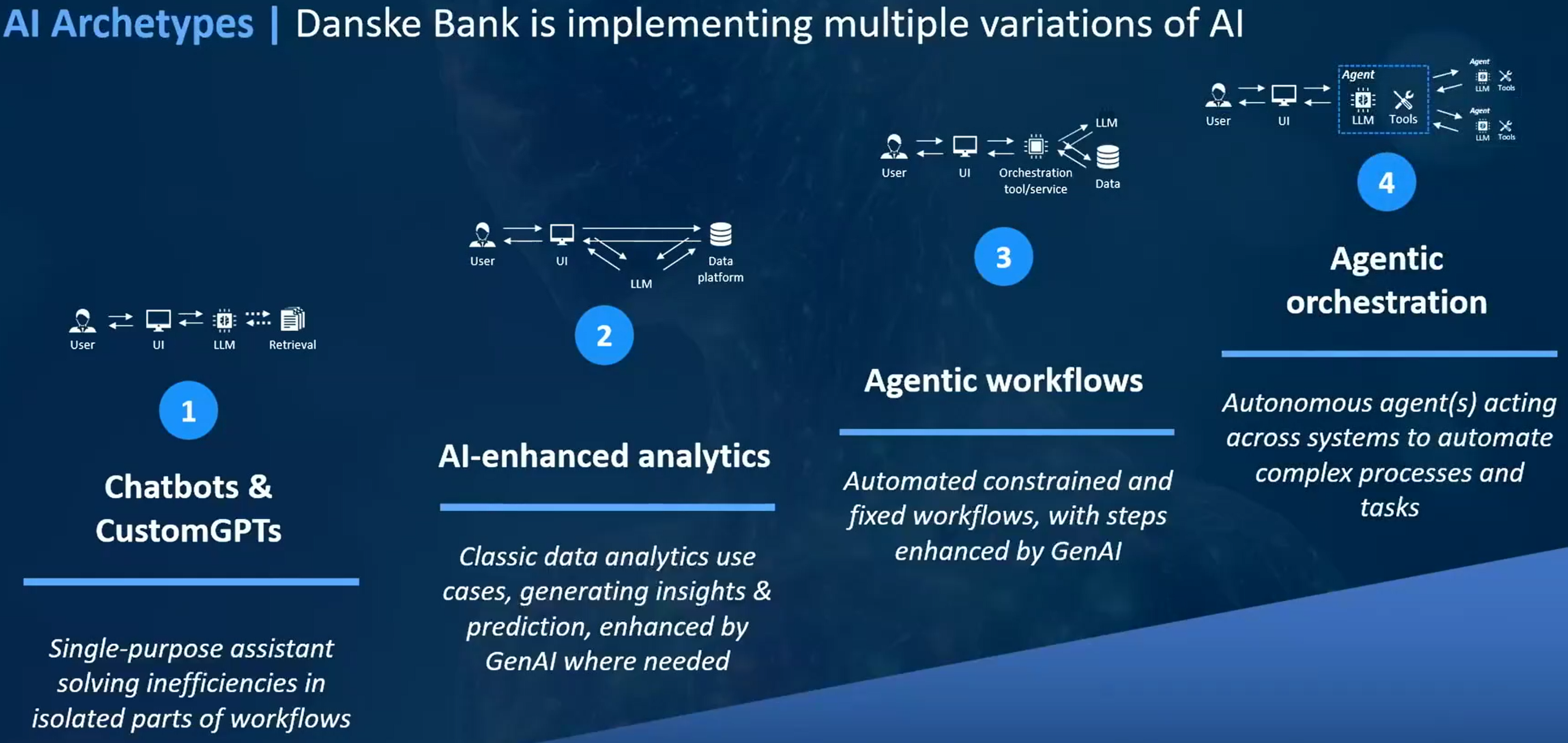
Danske Bank does not see AI as one single technology but implements multiple archetypes, from chatbots and custom GPTs to AI-enhanced analytics and agentic workflows, up to autonomous agents that act across systems to automate complete processes and tasks. As of April 2026, Danske Bank has more than 20 use cases in production on AWS. One example is the AI-enabled customer service in the mobile bank, which achieves a first-time resolution rate of 75%. To be able to scale, Danske Bank is building an “Agentic City”, a governed, reusable platform on AWS with more than 50 reusable capabilities that together form a reference architecture. This reduces the time-to-production from months to days while maintaining enterprise-grade security and compliance.
Faster engineering with clear accountability (FNB)
First National Bank (FNB) showed in the keynote of the AWS Summit Johannesburg how AI changes the way software is built. Kevin Mitchell explained that customers expect banks to innovate across their broad offering, from lending and payments to rewards, insurance and budgeting tools, without any disruption or degradation of service. With around 3,000 engineers, the central question for FNB was how every engineer could get materially more leverage. Coding assistants were useful but only incremental. One key learning was that the LLMs delivered significantly better results once FNB supplied the right context, such as their business requirements, security controls, functional specifications, test plans and architecture standards. It was the context, not the model alone, that made the difference. At the same time, FNB defined a clear principle: “AI accelerates the work but does not inherit accountability for the outcome. The human engineer remains accountable.”
To scale this AI-driven software development lifecycle (AI-SDLC) to 3,000 engineers, FNB chose Kiro, as its spec-driven approach is aligned with the way FNB works. According to Kevin Mitchell, what really made a difference was the support of AWS, for example through hands-on sessions with the engineers. FNB then set itself an ambitious challenge: Can 100 engineers build out a core banking system with Kiro in one week, something that typically takes years and armies of engineers? Already on the first day, the first part of the challenge was solved, which sparked so much excitement that more people wanted to join than FNB could initially accommodate. Three weeks later, the initial cohort started running master classes, which became the real engine of adoption. A weekly 45-minute Kiro sharing session grew into a forum with 1,000 developers and created a flywheel where knowledge persists in the community and adoption deepens across the organization. In the end, FNB built an AI-native platform in three months instead of a multi-year program.
Innovation through Platform Engineering (Pictet)
Finally, Martin Kunz (Group CTO, Pictet) presented at the keynote of the AWS Summit Zurich Pictet’s cloud journey and how AI has accelerated their teams. Founded in 1805 in Geneva, Pictet serves clients globally across asset management, wealth management, alternative investments and asset servicing. The cloud journey started in 2015 with the first software as a service (SaaS) application and continued with a hybrid cloud environment for data scientists and a Data Science Suite based on Amazon SageMaker. In 2025, Pictet built a core business application with generative AI that blends internal company research with broker research and public data like earnings call transcripts. The workload evolved with technology and Pictet moved toward an agentic architecture deployed on Amazon Bedrock AgentCore. In addition, Pictet’s investment teams can use these agents directly with their own research applications that they build with Claude Code and Claude Cowork. Pictet is using Amazon Bedrock to get access to state-of-the-art LLMs and open-weight models. Whenever a new promising open-weight model is released on Amazon Bedrock, Pictet can validate it through its evaluation harness within a week.
In the breakout session Agentic AI with AWS – The Pictet Asset Management Platform Approach, Edilton Dos Santos and Jean Maurice Luisier used an analogy that fits Switzerland perfectly. When a team opens a new route in the mountains, it needs to take the hardest decisions like where to put the fixed lines, where to place the anchors and how to evaluate the risks. But once the route is established, others can follow faster and safer, and enterprise agentic AI is at a similar inflection point. Pictet’s Platform Engineering team therefore builds and operates the technology foundations that let product teams and business users deliver solutions faster, while it owns security, compliance and operational excellence.
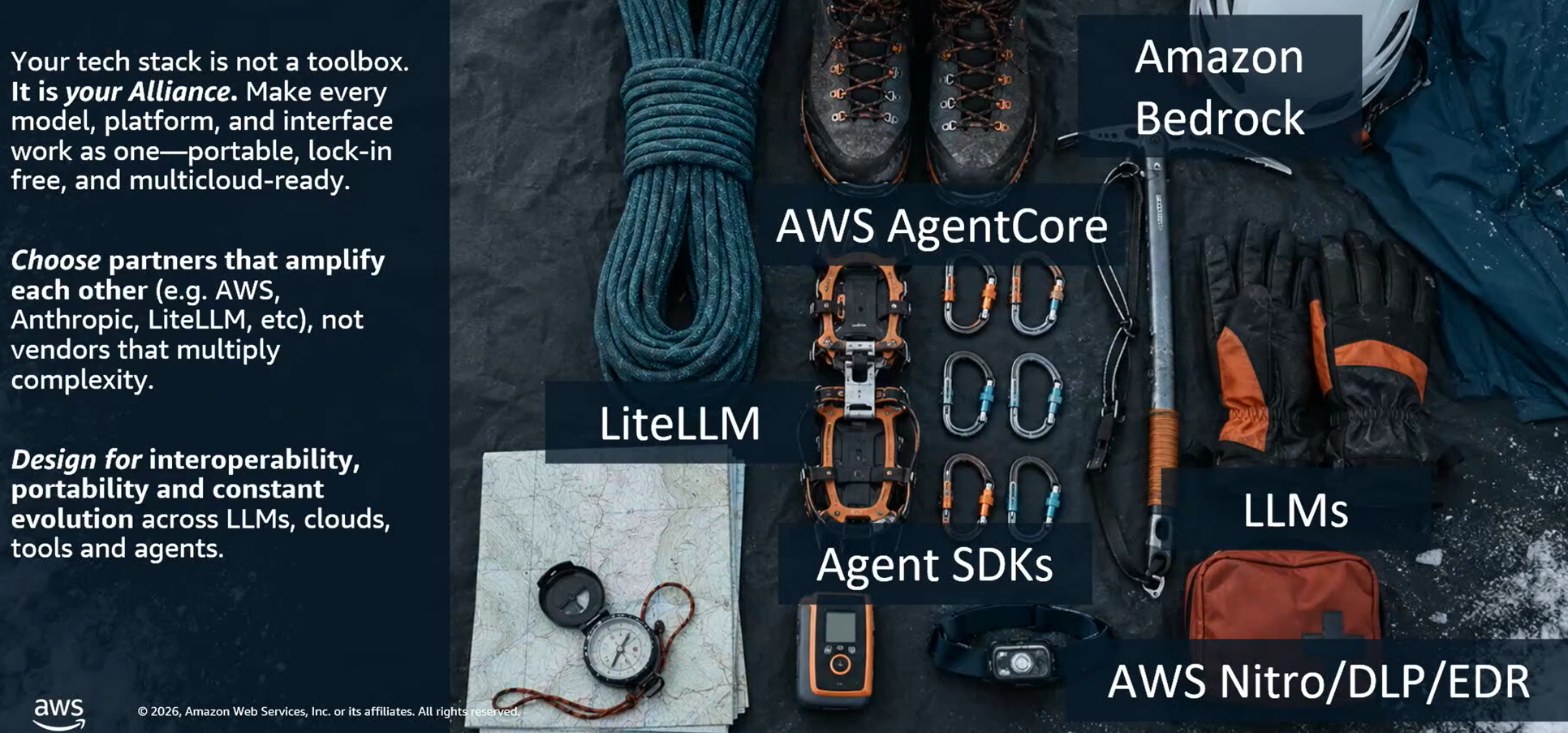
That governance does not have to slow down innovation is shown by two further facts. All developers at Pictet were given access to Claude Code using Amazon Bedrock inference in Europe instead of a standard subscription based in the US, and business users also got access for exploration. Further, when Claude Sonnet 5 was released, Pictet approved it for EU cross-Region inference on the very same day. This illustrates how established governance, platform capabilities and approval processes can support rapid adoption while maintaining appropriate controls.
Conclusion
The AWS EMEA Summits 2026 demonstrated how banks across EMEA are successfully combining innovation with regulatory requirements. KBC showed that the starting point is the customer and that banks need to move from transactions to customer life journeys. DKB made clear that a modern foundation is the precondition to meet these expectations. Danske Bank and Pictet demonstrated that scaling AI requires a governed and reusable platform and that governance can be an enabler instead of a blocker. And FNB highlighted that technology alone is not enough, it is the people, a strong community and clear accountability that turn AI into real impact. It is no longer a question of whether AI agents will find their way into banking, but rather how fast and how well banks are implementing them. For banks and financial services providers in Switzerland, this is a good moment to learn from their peers and to open their own new route. If you would like to discuss how these learnings could be applied to your organization, reach out to us. More insights from other customers can be found on AWS for Financial Services or visit us at the next AWS Event.