AWS Partner Network (APN) Blog
Bringing AI code governance into Kiro with Qodo
By: Len Gomes, Partner Solutions Architect – AWS
By: Tomer Damti, Forward Deployed Engineer – Qodo
Qodo and Kiro help engineering teams keep code quality high as AI agents write more of the code. Kiro is an AI-powered development environment from Amazon Web Services (AWS) that helps developers build and ship production-ready applications through spec-driven development. The Qodo Kiro power brings independent, context-aware code review directly into the Kiro workflow. It reviews agent-generated code against an organization’s standards and its wider codebase while the developer is still coding, before a pull request opens.
In this post, we explain what Kiro powers are, how the Qodo power works inside Kiro, and how teams review AI-generated code against their own standards.
The opportunity: review that keeps pace with AI development
AI coding agents now generate and refactor code faster than review practices designed for human-paced development can keep up with. Teams report that AI writes a large share of initial code, which creates an opportunity to rethink where review and governance belong in the development lifecycle.
Rather than treating review as a final gate at the pull request, organizations can move it earlier, to the moment code is written. Review that runs in the IDE, with full codebase context and the organization’s own rules, gives developers immediate, actionable feedback while they still hold the context in their heads.
This shift from end-of-pipeline review to in-workflow review helps teams shorten review cycles, catch issues before they reach the main branch, and keep a consistent quality bar across every change, regardless of which agent or model produced it. Teams with data residency requirements can choose to run that review, including model inference, in their own AWS account and Region.
What are Kiro powers?
Kiro powers add expert-level context and tools to Kiro AI agents on demand. Rather than loading every tool at once, which overloads the agent’s context window, powers activate dynamically based on the task at hand. For example, the Qodo power activates when a developer asks Kiro to review code, apply coding standards, or explain how part of the codebase works.
This modular design means Kiro can reach a wide range of technologies without overwhelming the agent context. Only the relevant power loads for the task at hand. AWS and partner teams have published powers across a growing range of domains, each bringing production-grade practices directly into the development workflow. Browse the full catalog at Kiro powers.
Introducing the Qodo Kiro power
Qodo has built a Kiro power that brings independent code review and governance into the development workflow. The power runs on the Qodo command-line client, which sits on the developer’s machine and connects it to the organization’s Qodo tenant. A single sign-in makes Qodo’s capabilities available as commands the Kiro agent can call, and one consolidated power routes each request to the right capability. The developer asks in plain language, and Kiro loads only the capability that matches.
The Qodo Kiro power provides four capabilities:
- Code review – Surfaces the issues Qodo would raise in a pull request review, including bugs, correctness problems, standards violations, and cross-repository breaking changes, inside the Kiro IDE before the pull request exists.
- Rule enforcement – Loads the organization’s coding standards so the agent codes against them from the start, with conventions applied during generation rather than corrected afterward.
- Resolve issues – Applies fixes to review findings without leaving Kiro. The review distinguishes what is new, pre-existing, or already resolved, and changes apply to local code only after the developer confirms.
- Codebase context – Answers questions grounded in the full codebase and cross-repository context, so changes are made with the wider architecture in mind.
The power is designed to limit what it can change. It doesn’t run a Model Context Protocol (MCP) server or post to the git forge, and it edits local code only after the developer confirms.
How the review loop works
The value of the Qodo power comes from where the review runs and the context it carries. Kiro’s agents see the current workspace. Qodo adds the rest: full codebase context, the organization’s coding standards, and self-learning rules mined from the codebase and prior review history. Review reflects how the company writes code, not generic style advice.
The loop works as follows:
- The developer plans and builds with Kiro through spec-driven development.
- Before generating, the agent pulls the organization’s relevant rules from Qodo, so conventions apply during generation.
- The developer asks Qodo to review local changes, and findings surface in the Kiro IDE before the developer opens a pull request.
- The developer asks Qodo to resolve findings, and fixes apply to local code after confirmation.
- Corrections can become new rule suggestions in Qodo, so each session sharpens the ruleset for the next one.
Because review runs against the same rules the agent used to generate the code, standards stay consistent from generation through to merge, and they improve with every session. Qodo also includes a requirement-gap check that reads acceptance criteria from ticket management systems such as Jira and Linear and evaluates whether a change implements them, flagging both what is missing and anything added that was not asked for.
How Qodo runs on AWS
Qodo routes its model inference through Amazon Bedrock, and offers both Qodo-managed and customer-hosted deployment options.
- Qodo-managed (default): Qodo runs inference on Amazon Bedrock in its own AWS environment.
- Customer-hosted: teams with data residency or isolation requirements can deploy Qodo single-tenant on Amazon Elastic Kubernetes Service (Amazon EKS) in their own AWS account, with inference on their own Amazon Bedrock deployment in the AWS Region they choose.
Qodo is available in AWS Marketplace, with charges billed through the customer’s AWS account.
Business scenarios
The Qodo Kiro power addresses code quality challenges across different organizational contexts:
- High-growth startup shipping quickly – A startup using Kiro to accelerate its first product generates a large share of code through AI agents. The Qodo power gives the team review against its own standards from the first change, so quality holds even as the pace increases.
- ISV managing developer scale – An independent software vendor (ISV) with a distributed engineering team needs consistent review standards across AI-assisted development without adding review headcount. The Qodo power applies the same rules and context on every agent-generated change across repositories, with the option to run inference in the ISV’s own AWS account through the customer-hosted deployment.
- Enterprise maintaining governance – An enterprise adopting multiple coding agents needs one consistent review and governance standard across all of them. Qodo centralizes rules and gives engineering leaders visibility into findings across teams, repositories, and pull requests.
What the evidence shows
- Consider a team of 100 developers where AI agents write most first drafts. In a typical pull request workflow, a reviewer might spot a standards violation two days after the code was written, by which time the author has moved on. With the Qodo Kiro power, the same finding appears in the IDE minutes after generation, and the developer fixes it before anyone else opens the change. This scenario is illustrative and doesn’t represent measured customer results.
Early review helps only if developers act on it. In an industry study of a review tool built on Qodo’s PR Agent, developers resolved 73.8% of automated comments across 1,568 pull requests, though average pull request closure time also increased.
Getting started with the Qodo Kiro power
Installing the Qodo Kiro power takes a few steps:
- Install the Qodo command-line client, which runs on the developer’s machine.
- Sign in to connect the client to your organization’s Qodo tenant.
- Open the powers panel in the Kiro IDE or visit Kiro powers, add the Qodo power, and reload.
- Ask in plain language, for example “qodo review my local changes.”
The following screenshot shows the powers panel in the Kiro IDE. Full prerequisites and setup detail are in the GitHub repository.
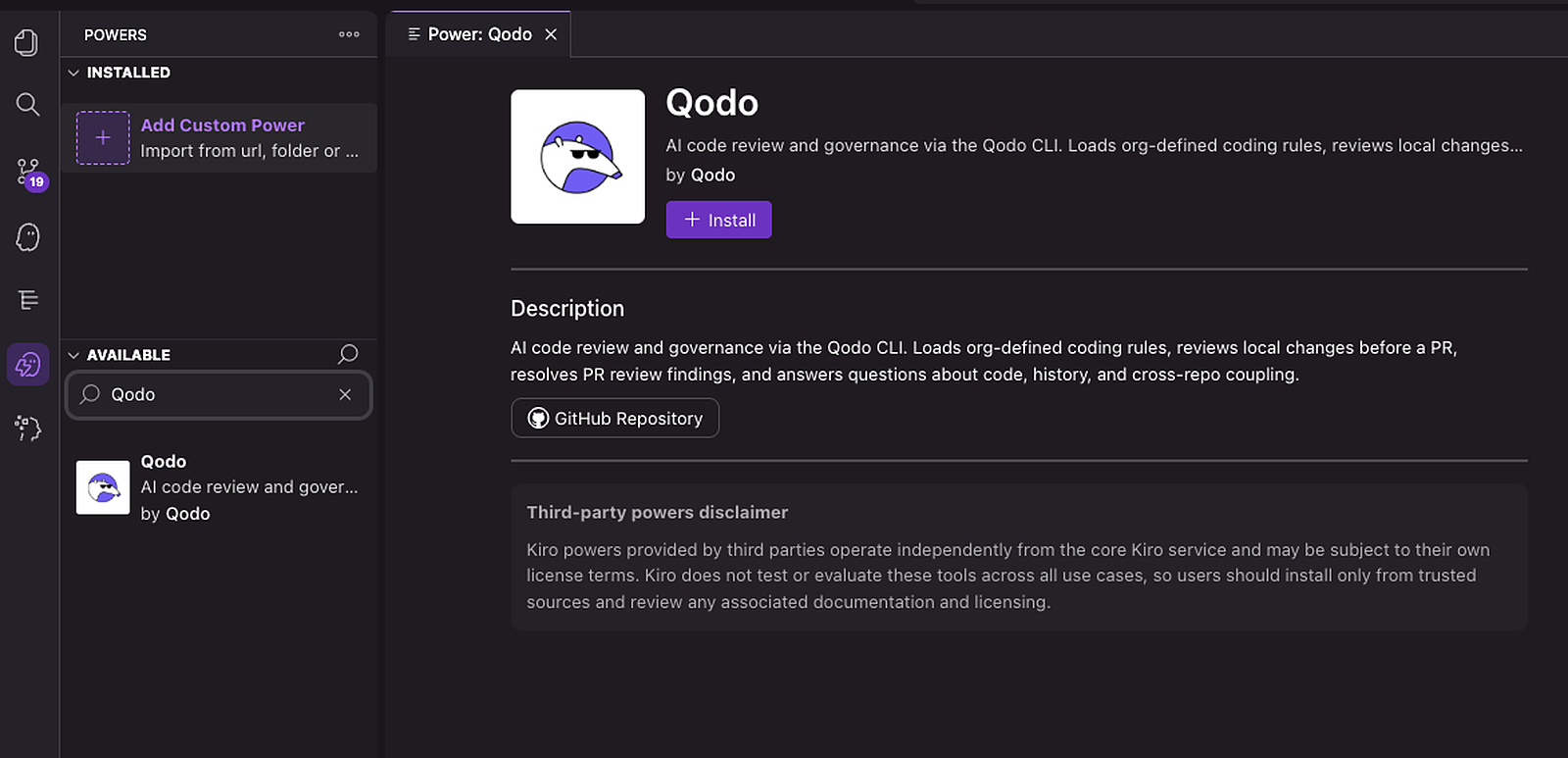 Figure 1: Installing the Qodo power from the Kiro IDE powers panel
Source code and documentation: Qodo Kiro power on GitHub.
Conclusion
AI-driven development is the new baseline for how fast-moving teams build software. The Qodo Kiro power brings independent, context-aware review into the agentic development workflow, so teams keep a consistent quality bar at the pace AI development allows. Review runs early, findings surface in context, fixes apply after developer confirmation, and inference runs on Amazon Bedrock, with a customer-hosted option for teams that need code and inference to stay in their own AWS account.
Explore Qodo in AWS Marketplace, add the Qodo power in Kiro at Kiro powers, and learn more about Qodo on AWS at qodo.ai/partners/aws.

Qodo – AWS Partner Spotlight
Qodo is an AWS Specialization Partner and AWS AI Software Competency Partner that builds the AI code review and governance platform for teams shipping at the pace AI writes code. Qodo reviews every change against the full codebase, requirements, and organizational standards, from the IDE to the pull request.