
Sold by: Qodo
Deployed on AWS
Qodo is the AI code review platform that helps teams catch critical issues early, reduce review noise, and maintain consistent code quality across fast-moving, AI-driven development.
4.5
Overview
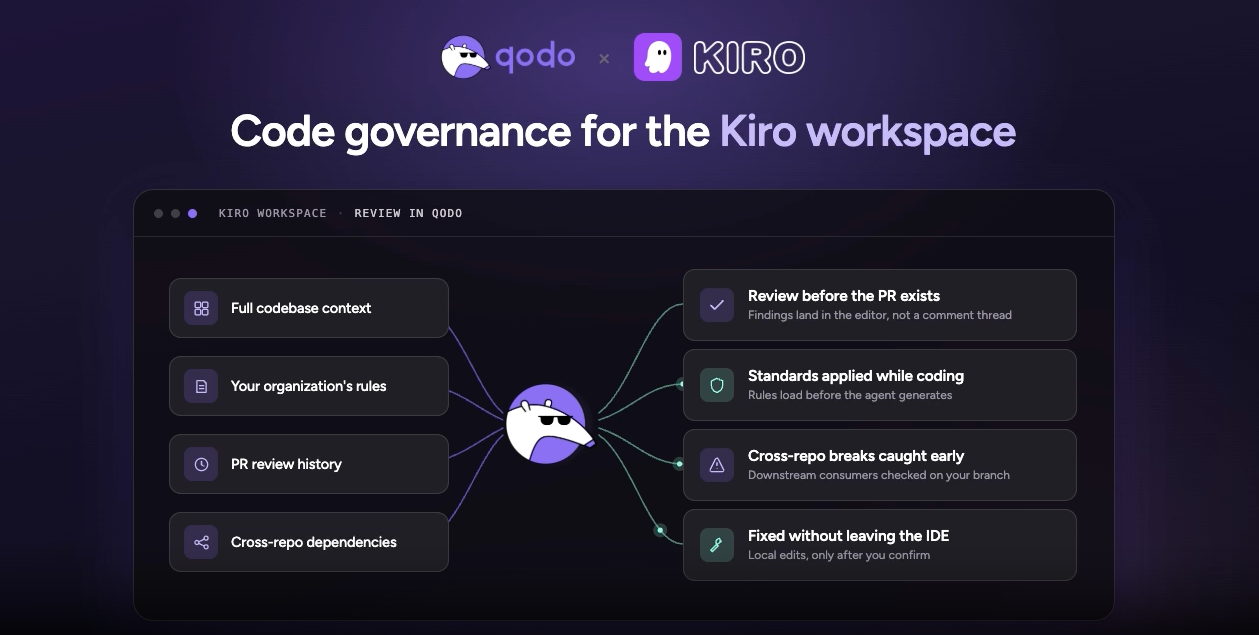
Video
Qodo x Kiro Integration

Video
Product video
Qodo is the enterprise AI code review platform that ensures quality scales with AI-driven development. Our agents run across the IDE and Git with shared cross-repo context and organization-specific rules to deliver precise, high-signal reviews. The result is cleaner code, faster review cycles, and higher-quality software across teams, repositories, and AI-generated development.
Highlights
- Multi-agent code review in your Git: Qodo runs specialized agents across every PR to write descriptions, flag real issues with remediations, and enforce your team's governance and security standards at scale, all with full codebase context. (GitHub, GitLab, Bitbucket, Azure DevOps)
- Cross-repo codebase context: Review code against your full, cross-repo codebase to catch breaking changes, dependency conflicts, architecture-level issues, and other hidden risks.Agentic review automation: Build configurable, specialized review agents with shared context to enforce code quality rules, use tools to execute specific review tasks
- A centralized rules system to define and enforce organizational standards across the repository - security policies, coding and style standards, architectural conventions, and compliance requirements, applied consistently to all pull requests so quality holds at scale.
Details
Sold by
Delivery method
Deployed on AWS
Features and programs
Financing for AWS Marketplace purchases
AWS Marketplace now accepts line of credit payments through the PNC Vendor Finance program. This program is available to select AWS customers in the US, excluding NV, NC, ND, TN, & VT.

Pricing
Pricing is based on the duration and terms of your contract with the vendor. This entitles you to a specified quantity of use for the contract duration. If you choose not to renew or replace your contract before it ends, access to these entitlements will expire.
Additional AWS infrastructure costs may apply. Use the AWS Pricing Calculator to estimate your infrastructure costs.
Dimension | Description | Cost/month |
|---|---|---|
Trial Teams | qodo Gen and qodo Merge for 5 developers | $240.00 |
Teams | qodo Gen and qodo Merge for 50 developers | $1,900.00 |
Qodo Pro Teams | Qodo Pro Teams 20,000 credits | $240.00 |
Dimensions summary
You pick from three contract options based on team size and usage. Trial Teams covers qodo Gen and qodo Merge for 5 developers. Teams covers the same tools for 50 developers. Both scale by developer count. Qodo Pro Teams works differently: it bills on a pool of 20,000 credits rather than seat count. Credits meter review activity, with larger reviews drawing more. So you choose between developer-based access for the first two and credit-based usage for the Pro Teams option, matching the structure to how your team consumes reviews.
Top-of-mind questions for buyers
A credit is the unit Qodo uses to meter review activity. Every code review draws credits from your pool. Smaller pull requests draw fewer credits; larger or more complex reviews draw more. The 20,000-credit Qodo Pro Teams pool supports roughly 144 reviews per month. Your dashboard shows real-time balance and burn rate.
Reviews keep running. Once base credits are depleted, you enter overage at the same per-credit rate, with no premium or penalty. Overage accrues against a monthly spending cap you set and can change anytime. You get notifications before any pause. Credits expire each monthly cycle and do not roll over.
The Trial Teams and Teams options bill by developer count, covering qodo Gen and qodo Merge for 5 and 50 developers. Qodo Pro Teams bills on a pooled credit balance instead of seats. Developer-based options suit fixed team sizes; the credit model suits teams whose cost should track review volume.
www.qodo.ai
Helpful?
Vendor refund policy
According to our terms of use: https://www.qodo.ai/terms/
Custom pricing options
Request a private offer to receive a custom quote.

Legal
Vendor terms and conditions
Upon subscribing to this product, you must acknowledge and agree to the terms and conditions outlined in the vendor's End User License Agreement (EULA) .
Content disclaimer
Vendors are responsible for their product descriptions and other product content. AWS does not warrant that vendors' product descriptions or other product content are accurate, complete, reliable, current, or error-free.
Delivery details
Software as a Service (SaaS)
SaaS delivers cloud-based software applications directly to customers over the internet. You can access these applications through a subscription model. You will pay recurring monthly usage fees through your AWS bill, while AWS handles deployment and infrastructure management, ensuring scalability, reliability, and seamless integration with other AWS services.
Resources
Vendor resources
Support
Vendor support
AWS Marketplace subscribers are entitled to our Standard Support: support@qodo.ai Enterprise customers receive priority support and a dedicated CSM.
AWS infrastructure support
AWS Support is a one-on-one, fast-response support channel that is staffed 24x7x365 with experienced and technical support engineers. The service helps customers of all sizes and technical abilities to successfully utilize the products and features provided by Amazon Web Services.
Updated weekly
By GitLab

By Sourcegraph
Top
25
In Testing
Top
100
In Generative AI, Collaboration & Productivity
Top
10
In Source Control
Sentiment is AI generated from actual customer reviews on AWS and G2
Functionality
Ease of use
Customer service
Cost effectiveness
Positive reviews
Mixed reviews
Negative reviews
AI generated from product descriptions
Multi-Agent Code Review Automation
Specialized agents run across pull requests to write descriptions, flag issues with remediations, and enforce governance and security standards across GitHub, GitLab, Bitbucket, and Azure DevOps.
Cross-Repository Codebase Context
Code review analysis leverages full cross-repository codebase context to identify breaking changes, dependency conflicts, architecture-level issues, and hidden risks.
Centralized Rules Engine
Centralized system to define and enforce organizational standards including security policies, coding standards, architectural conventions, and compliance requirements consistently across all pull requests.
IDE and Git Integration
Agents operate across integrated development environments and Git platforms with shared cross-repository context to deliver precise code reviews.
Configurable Review Agents
Specialized review agents can be configured with shared context to enforce code quality rules and execute specific review tasks using integrated tools.
AI-Powered Code Generation and Review
Automated merge request generation based on user stories and AI-driven merge request reviews integrated into development workflows
Unified DevSecOps Platform
Comprehensive platform covering the entire software development lifecycle with integrated security and compliance controls from commit to production
Multi-Step Workflow Automation
AI agents capable of performing complex, multi-step tasks including test generation, code upgrades, and deployment workflow automation
Security and Compliance Integration
Enterprise-grade security controls with automated secure code practices and unified compliance management across the development pipeline
Cross-Platform Integration
Seamless integration between GitLab workflows and Amazon Web Services infrastructure with unified data store for accelerated development
Multi-Language Code Support
Supports analysis and navigation across multiple programming languages within enterprise codebases.
Multi-Repository Management
Handles code understanding and indexing across multiple repositories, code hosts, and branching structures simultaneously.
Enterprise-Scale Performance
Maintains performance and functionality across large, complex, fragmented codebases including monoliths, microservices, and various frameworks.
Code Context and Search
Provides instant access to code context, dependencies, and search capabilities across the entire codebase for developers and AI agents.
Compliance and Change Validation
Ensures accuracy, compliance, and consistency of code changes across the organization for both human and AI-driven modifications.
Validated by AWS Marketplace
FedRAMP
GDPR
HIPAA
ISO/IEC 27001
PCI DSS
SOC 2 Type 2
No security profile
No security profile
-
-
-
-
Standard contract
No
No
Customer reviews
Rahul S.
Great Cross-Repo PR Insights, Though Severity Flags Can Miss the Mark
Reviewed on Sep 24, 2026
Review provided by G2
What do you like best about the product?
It's feature for cross repo awareness in my code and analysing things in PR and raising flags according to the priority
What do you dislike about the product?
sometimes it's not that aware and raises very lame issues with high severity
What problems is the product solving and how is that benefiting you?
We use it in our AI DLC as a code reviewer tool for reviewing like a third eye on all PRs
Charles F.
Faster Code Reviews and Better Code Quality
Reviewed on Sep 15, 2026
Review provided by G2
What do you like best about the product?
Qodo improves code quality while making code reviews faster and more efficient. I regularly rely on its automated code suggestions and issue detection to spot potential bugs, gaps, and areas for improvement early in the development process. As a result, I spend less time on manual review, and developers can write cleaner, more reliable code.
Another benefit is how smoothly Qodo fits into our existing development workflow. Its recommendations are easy to review and act on without disrupting the coding process. It has also helped keep reviews more consistent across the team by adding an extra layer of automated analysis before code is merged.
Another benefit is how smoothly Qodo fits into our existing development workflow. Its recommendations are easy to review and act on without disrupting the coding process. It has also helped keep reviews more consistent across the team by adding an extra layer of automated analysis before code is merged.
What do you dislike about the product?
One area that could be improved is the relevance and specificity of some code suggestions. At times, the recommendations feel too generic and still require extra manual review to confirm whether they truly fit the specific codebase or use case. If Qodo were more context-aware—taking into account the surrounding code, project structure, and existing coding patterns—the suggestions would likely be more accurate and actionable.
It would also help to have smoother integrations with a broader range of development tools and workflows. Stronger integrations, combined with more context-aware recommendations, would reduce manual effort and make Qodo even more effective as part of my everyday development and code review process.
It would also help to have smoother integrations with a broader range of development tools and workflows. Stronger integrations, combined with more context-aware recommendations, would reduce manual effort and make Qodo even more effective as part of my everyday development and code review process.
What problems is the product solving and how is that benefiting you?
We used to spend a significant amount of time on manual code reviews and trying to spot potential issues. With Qodo, we’re able to catch problems earlier, receive actionable suggestions, and make the review process smoother. This reduces manual effort while improving overall code quality and development efficiency.
Midha T.
A useful extra review layer when coding with AI tools
Reviewed on Sep 11, 2026
Review provided by G2
What do you like best about the product?
The confidence it adds to code review process while using AI tools like Claude or Cursor especially when working on a security-sensitive, HIPAA-compliant application.
One feature I found particularly useful was its ability to highlight function complexity, including cyclomatic and cognitive complexity. This made it easier to identify functions that were becoming difficult to maintain or potentially needed refactoring.
One feature I found particularly useful was its ability to highlight function complexity, including cyclomatic and cognitive complexity. This made it easier to identify functions that were becoming difficult to maintain or potentially needed refactoring.
What do you dislike about the product?
One small downside for me is having the `.qodo` folder visible in the GitHub repository. I understand that it is used to store repository-level Qodo workflows so they can be shared and version-controlled across the team, but I generally prefer keeping tool-specific configuration out of the main project structure where possible. It would be nice to have a cleaner way to manage this configuration without adding additional folders to the repository.
What problems is the product solving and how is that benefiting you?
These days a lot of developers are coding with tools like Claude and Cursor, which definitely makes development faster, but it also means code can be generated very quickly without every detail being reviewed properly.
For us, Qodo helps add another layer of checking before code gets merged. It can point out bugs, edge cases, complex functions and code that probably needs refactoring.
For us, Qodo helps add another layer of checking before code gets merged. It can point out bugs, edge cases, complex functions and code that probably needs refactoring.
Marketing and Advertising
Efficient AI Code Reviews That Catch Bugs and Missing Tests Early
Reviewed on Sep 09, 2026
Review provided by G2
What do you like best about the product?
At Ebiquity, Qodo can help our engineering teams make code reviews and testing more efficient, especially when multiple developers are working on the same projects. It provides an additional AI-based review layer that can identify potential bugs, quality issues and missing test cases before changes are merged. This reduces some of the repetitive manual checking developers have to do and helps catch issues earlier in the development process.
What do you dislike about the product?
The main downside is that its suggestions are not always 100% relevant, so developers still need to use their own judgement rather than accepting everything automatically. If a team receives too many low-value suggestions, it could also create some review fatigue. For Ebiquity, I would also want to consider data privacy, security and how our code is handled before using it extensively across the company.
What problems is the product solving and how is that benefiting you?
The biggest benefit is having an additional "pair of eyes" during code reviews without requiring another developer to spend time on every detail. I also find the support for generating and improving tests useful, as it can help developers think about edge cases they may otherwise overlook. Overall, it can save development time while improving consistency and confidence in the code being delivered.
敏熙 .
Great PR summaries and actionable patches, but recall and large-diff coverage limit trust
Reviewed on Sep 06, 2026
Review provided by G2
What do you like best about the product?
The review layout. Not the comment count.
Qodo gives me a short summary, a walkthrough grouped by what the change does (not a file list), then comments that name a file and offer a patch. I can tell in a minute whether the PR is even the change I thought I shipped. A wall of nits is worse than silence. This I can actually work through.
How I use it: Copilot or Cursor writes the code. Before I merge, Qodo is the first look at the GitHub diff. It is useful on the mechanical stuff I skip because I already think I know the intent: null paths, sloppy error handling, a test I should have written. I still open the file and check the line. Some comments are noise. I would not merge because Qodo was happy.
What do you dislike about the product?
It is a first pass. It is not a merge gate. That gap is the main problem.
Recall is not high enough to trust a quiet review. If Qodo says nothing, I still read the diff. Independent numbers put catch rate in the mid-50s at best, and on live PRs it is often lower. The cost is false confidence: I almost shipped a change because the bot was quiet, then found the bug myself on a second read.
Large diffs get truncated. Somewhere around a few hundred lines of change the review stops being complete. I have to split the PR or accept that the bottom of the diff was never looked at. For kernel-style or multi-file refactors that is a real limit, not a nit.
What problems is the product solving and how is that benefiting you?
Before Qodo, the bottleneck was not writing the change. Copilot or Cursor already does that. The bottleneck was reviewing my own AI-generated GitHub PR. I skip obvious bugs because I already think I know the intent. Style nits and null paths ate the human pass; design got whatever time was left.
Qodo sits on the PR as the first look. It gives a short summary, a walkthrough grouped by behavior, then comments with a file and a suggested patch. The mechanical stuff gets named before I start: a missing test, sloppy error handling, a null path I would have waved through.
What changed: I still merge myself, and I still read the diff. Quiet Qodo is not a pass. The benefit is where the remaining time goes. The human pass is spent on architecture and product intent instead of hunting the easy misses. I cannot honestly put a hours-per-week number on that. The difference is that I no longer treat "I wrote it, it compiles" as a review.