AWS Partner Network (APN) Blog
Running SnapLogic Jean-Paul in Production on Amazon Bedrock
By: Jocelyn Arcega, Head of Solutions Engineering, EMEA – SnapLogic
By: Tamara Astakhova, Sr. Partner Solutions Architect – AWS


Enterprises can now build an AI agent that reasons impressively in a pilot. Turning that pilot into an agent that safely touches production systems and acts on behalf of real users is where projects stall. The blocker is rarely the model. It is the infrastructure, security, and governance required to run an agent in production.
This post shows how SnapLogic solved that problem with Jean-Paul, its enterprise AI agent, by running it inside the customer’s own AWS account on Amazon Bedrock. What’s new here is the production-readiness pattern itself: running an autonomous agent in your own AWS account, with the governance and controls your security team already trusts. If you are trying to move an enterprise AI agent from pilot to production on AWS, this is the pattern to follow.
What is Jean-Paul?
Jean-Paul is SnapLogic’s enterprise AI agent, built to live inside Slack, Microsoft Teams, and email. Employees across finance, sales, operations, and HR describe what they need in plain language, and Jean-Paul does the work: querying systems, assembling output, and delivering it back in the channel they already use. What makes Jean-Paul different is that the work doesn’t disappear when the conversation ends. As people use it, Jean-Paul captures successful workflows as reusable skills that teams can share or promote into self-running standard procedures. Those skills add up to department-level digital workers: a sales agent watching pipeline, an operations agent processing invoices, a customer success agent prepping renewal reviews. Jean-Paul ships with 25 production-grade skills on day one across analytics, document generation, CRM operations, and reporting, so teams see value immediately instead of spending months on a proof of concept. Every request and every action is logged in a governance dashboard, giving teams a useful and auditable agent.
The wall every enterprise AI pilot hits
Most enterprise AI pilots stall on the same problem: infrastructure. Today’s large language models (LLMs) are genuinely capable at reasoning. The harder question is how you let an agent touch production systems and act on behalf of real users while keeping your security posture intact. Jean-Paul runs server-side, inside your own AWS account, governed by the same controls your security team already trusts. AWS serves as the security and integration foundation the agent operates within.
How AWS makes it production-ready
Three AWS services carry the weight of turning Jean-Paul into an agent an enterprise can actually run.
- Amazon Bedrock handles reasoning. Inference runs inside your own account and Region, so regulated data stays within the perimeter your security team governs.
- Amazon Elastic Compute Cloud (Amazon EC2) provides the always-on runtime the agent needs to hold a session open across a long, multi-step task.
- Amazon Simple Storage Service (Amazon S3) and Amazon CloudFront handle the deliverables the agent returns, moving files through a private, access-controlled path with signed, time-limited links.
Your AWS identity controls govern access throughout, extending the primitives your security team already trusts to this new workload. For Pushpay, the challenge looked familiar: an AI agent that could reason well but could not act, unable to reach the systems where the actual work happens. Getting from a capable model to a production deployment meant solving the infrastructure problem every enterprise runs into, giving the agent a governed way to reach real data and real workflows without asking the security team to make exceptions.
Pushpay case study
Pushpay builds giving and engagement software for churches and nonprofits. Its go-to-market teams work across multiple systems: sales calls in Outreach, accounts in Salesforce, customer health in Gainsight, training in Skilljar, and product knowledge in Confluence and on their website.
Jean-Paul operates as a dedicated AWS deployment. Team members sign in with Pushpay Okta credentials and interact via Slack, like messaging a colleague. Amazon Bedrock handles reasoning, while an Amazon Bedrock Knowledge Base on Amazon S3 Vectors indexes more than 2,700 pages of Pushpay’s Confluence and web content to answer product questions accurately.
The agent also works autonomously on an always-on Amazon EC2 instance: processing sales call transcripts from Outreach, categorizing insights, and routing analysis to relevant stakeholders. Before updating any system of record, it requests user confirmation via a Slack approval card. Every request and action is logged in a governance dashboard. Pushpay’s sales leaders estimate Jean-Paul saves them two to three hours per week they used to spend sorting through dashboards and reports, because they can ask questions in Slack and get answers. With the rollout to reps still ahead, managers are already reporting much greater clarity into their teams today.
“Jean-Paul is remarkably simple, and adoption has been easier than expected. People already work in Slack, so there’s nothing new to learn. The connection to our systems is what makes it valuable, and as we activate more of them, we’re seeing its true potential. We’re just scratching the surface, and we’re already doing more in sales ops, sales enablement, and rep coaching than our existing tech stack allowed.”
– Cary Yocum, Senior Vice President of Growth, Pushpay
Architecture, at a glance
The diagram below shows a production deployment. Business users reach Jean-Paul through Slack, Teams, or email. The agent runs inside your AWS account, where it calls Amazon Bedrock for reasoning and SnapLogic for access to enterprise data. Finished work is handed back through a private, access-controlled delivery layer, all within your own account boundary.
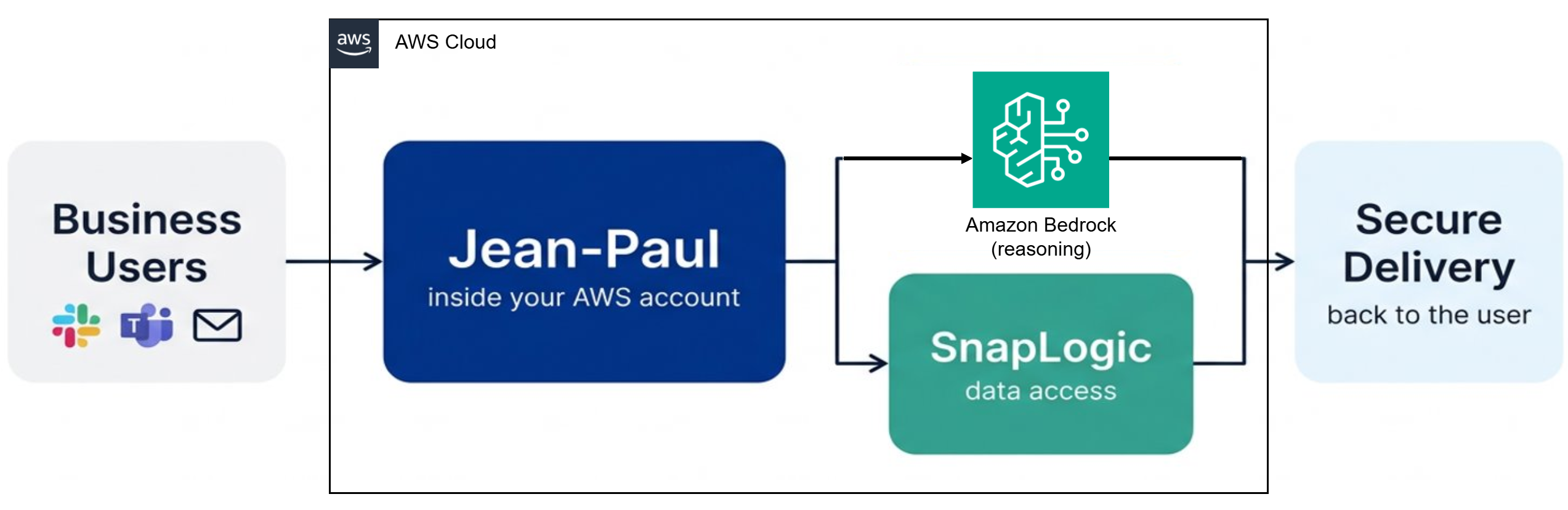
Figure 1: Jean-Paul runs inside your own AWS account, using Amazon Bedrock for reasoning and SnapLogic for data access, with secure delivery back to the user.
Why SnapLogic and AWS, together
Turning a convincing AI demo into something an enterprise can rely on comes down to the layer underneath: where the agent runs, what it can reach, and how the data it touches is governed. SnapLogic has spent two decades building the integration layer enterprises use to move work between systems. Jean-Paul brings agent capability to that layer. AWS provides the account, the identity controls, and the audit trail that give a security team confidence to sign off. As an AWS Partner, SnapLogic delivers Jean-Paul built on AWS services, deployed natively into your own AWS account, so it inherits the identity, network, and audit controls you already govern. Because SnapLogic builds on Amazon Bedrock, you get a solution that keeps pace with AWS.
What’s next on AWS
Long-term session archival will make Amazon S3 the default home for completed agent conversations, giving regulated teams an audit-ready record without new infrastructure. Private connectivity through AWS PrivateLink will keep the path to the model entirely inside your own network, a priority for financial services, healthcare, and the public sector. Amazon Bedrock Guardrails will add a model-layer defense, with personally identifiable information (PII) redaction and prompt-injection detection, alongside the access controls Jean-Paul already enforces.
How does Jean-Paul remember context across complex tasks? Its knowledge layer relies on an Amazon Bedrock Knowledge Base backed by Amazon S3 Vectors. Search index data resides in your own account. Results are then reranked inside Amazon Bedrock before reaching the model, empowering the agent with enterprise knowledge.
Get started
Getting an enterprise AI agent past the pilot stage comes down to where it runs and how it is governed. By deploying Jean-Paul inside your own AWS account on Amazon Bedrock, you get an agent that reaches real systems and does real work under the controls your security team already trusts, as Pushpay’s production deployment shows. Jean-Paul is delivered natively into your own AWS environment, governed by your existing identity and audit controls from day one. As an AWS Partner, SnapLogic makes that the default for new deployments.
Jean-Paul is available in AWS Marketplace, so you can procure it through your existing AWS agreement, with consolidated billing and a faster path from evaluation to production.

SnapLogic – AWS Partner Spotlight
SnapLogic is an AWS Advanced Tier Partner with the AWS Data and Analytics ISV Competency and the AWS Migration and Modernization ISV Competency. Through its visual, automated approach to integration, SnapLogic empowers business and IT users to accelerate integration needs for applications, data warehouse, big data, and analytics initiatives.