AWS Big Data Blog
Introducing the Workday Data Cloud integration with AWS
Connecting enterprise systems to modern analytics and AI platforms often requires building brittle pipelines, duplicating data, or sacrificing the governance and business context that makes the data trustworthy. Today we’re introducing the integration of Workday Data Cloud with AWS. With this integration you get bi-directional, zero-copy access to Workday’s governed people and money data from the AWS analytics and AI services that you already use.
Workday Data Cloud overview
Workday Data Cloud is an open, secure, and headless data platform that makes Workday’s people and money data available in the tools where developers build, with its semantic definitions, permission models, metric logic, and audit controls intact. It provides a curated, unified view of people and money data through the Workday Data Lake, bi-directional zero-copy access to that data through Workday Data Connect using Apache Iceberg, and near real-time SQL access for applications and AI agents through Workday Live Data Query.
AWS analytics overview
AWS provides a comprehensive set of analytics and AI services that work together for data engineering, analytics, and machine learning. Here’s how the key services come together in the context of the Workday Data Cloud integration:
Amazon SageMaker Unified Studio
Amazon SageMaker Unified Studio (SMUS) is a unified development environment for data analytics and AI. It brings together data access, querying, visualization, and notebook-based development in one place. With SMUS, developers can connect to Workday Data Cloud, explore datasets interactively, run SQL queries, and build machine learning models, all without switching between multiple tools or interfaces.
Amazon Athena
Amazon Athena is a serverless, interactive query service to analyze data directly in Amazon Simple Storage Service (Amazon S3) using standard SQL. With the Workday Data Cloud integration, analysts and developers can run ad hoc queries against Workday data stored as Iceberg tables without needing to set up or manage infrastructure.
Amazon Redshift
Amazon Redshift is a cloud data warehouse that delivers fast query performance on structured and semi-structured data using SQL. Organizations already using Amazon Redshift for their analytics workloads can now incorporate Workday people and money data through the Glue Data Catalog federation for cross-domain analytics without data movement.
AWS Glue Data Catalog
AWS Glue Data Catalog serves as the central metadata repository that makes Workday data discoverable across the supported AWS analytics services. Through the integration, Workday’s Iceberg REST Catalog is registered as a federated catalog in AWS Glue, which means any AWS service that reads from the AWS Glue Data Catalog such as Amazon Athena, Amazon Redshift, Amazon EMR, and Amazon SageMaker AI can automatically discover and query Workday datasets without additional configuration.
Glue Data Catalog also works in the other direction, letting Workday query data that lives in AWS. Customers can register the Iceberg REST Catalog endpoint of the AWS Glue Data Catalog as an external catalog in Workday Data Cloud. Workday users can then browse and query Apache Iceberg tables stored in Amazon S3 in near real-time, without copying the data into Workday.
AWS Lake Formation
With AWS Lake Formation, you can set up and manage a secure data lake. In this integration, AWS Lake Formation provides the fine-grained permission layer that governs who can access Workday data within the AWS environment, complementing the governance that Workday already applies at its data layer. Administrators can scope each analyst or application to specific databases, tables, rows, or columns.
Amazon S3
Amazon S3 is the foundational storage layer for data lakes on AWS. In the context of this integration, Amazon S3 stores Apache Iceberg tables that can be queried from Workday, so organizations can query and analyze data in AWS alongside their Workday data.
Workday Data Cloud and AWS integration overview
The integration between Workday Data Cloud and AWS enables bi-directional, zero-copy data access. This means data doesn’t need to be copied or replicated between Workday and AWS. Instead, each platform can query the other’s data in place, respecting existing governance and security controls on both sides.
Accessing data in AWS from Workday
Workday applications and AI agents can access data stored in AWS, enriching HR and finance workflows with external business data. Developers building agents or analytics within the Workday platform can query Apache Iceberg tables stored on Amazon S3 by registering the Iceberg REST Catalog endpoint of the AWS Glue Data Catalog as an external catalog in Workday Data Cloud.
Zero-copy federation
Workday Data Cloud federates to the AWS Glue Data Catalog using OAuth 2.0 authentication. After registration, Workday users can discover and query Iceberg tables backed by AWS directly from within Workday Data Cloud without copying data. AWS Lake Formation defines which databases and tables the Workday connection can read, whereas Workday’s Configurable Security controls which individual Workday principals can access the federated tables. This means an AI agent handling workforce planning in Workday can pull in revenue forecasts from an Iceberg table on AWS. Combining those financial projections with headcount data gives HR planners hiring recommendations to review, accounting for both business growth and budget constraints.
Accessing data in Workday from AWS
AWS analytics and AI services can access Workday’s governed people and money data. There are two primary patterns for AWS to query Workday data, each optimized for different use cases:
Live Data Query
Some use cases require near real-time access to Workday data, such as an AI agent checking current headcount or a dashboard showing today’s financial close status. For these, developers can use Workday Live Data Query. From Amazon SageMaker Unified Studio, Amazon Athena, Amazon EMR, or AWS Glue, users connect to Workday through the Live Data Query connector and execute SQL queries directly against live Workday datasets. The query runs within Workday’s governed environment and results flow back in near real-time. This is ideal for operational AI agents, near real-time dashboards, and any application where data freshness is critical.
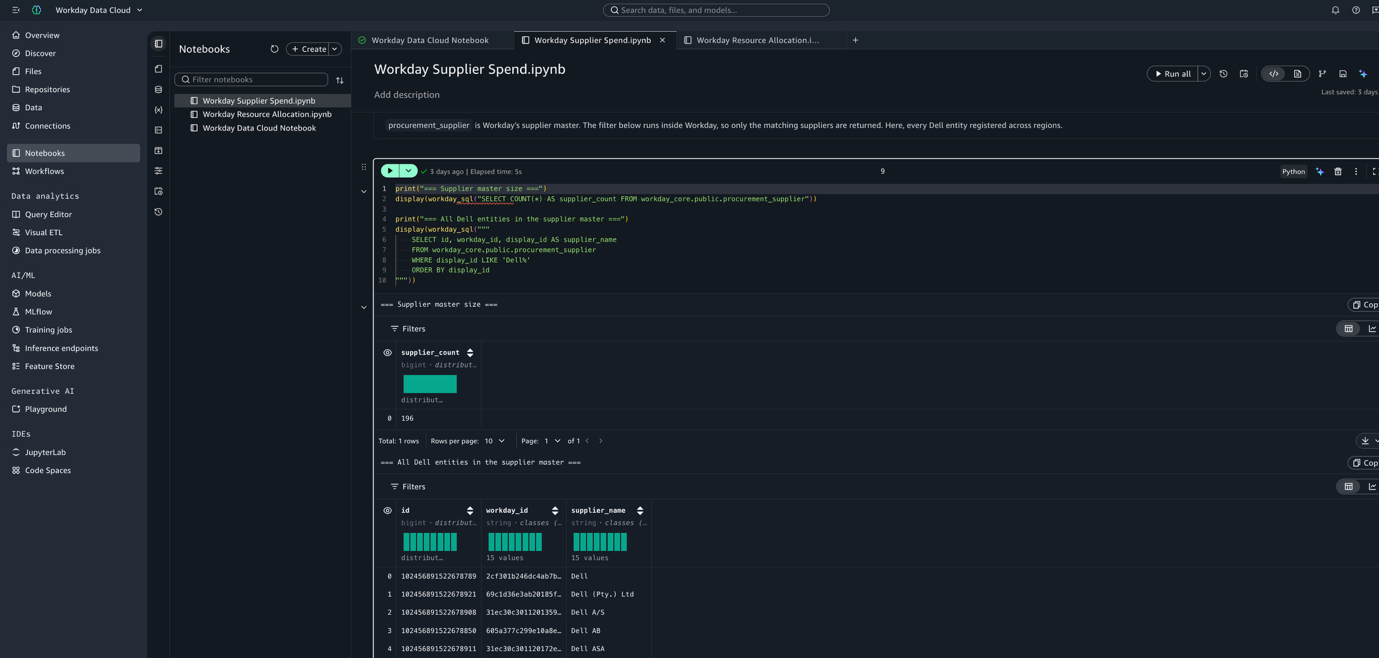
Figure 1: Querying live Workday supplier data from an Amazon SageMaker Unified Studio notebook with Workday Live Data Query
Zero-copy federation with Apache Iceberg
For near real-time analytics, machine learning (ML) training, and large-scale data exploration, developers access Workday data through Workday Data Connect’s Apache Iceberg integration. By registering the Workday Iceberg REST Catalog in AWS Glue Data Catalog or AWS Lake Formation, all Workday datasets appear as standard Iceberg tables discoverable by any AWS analytics service. The compute runs on the customer’s AWS environment (using Athena, Amazon Redshift, Amazon EMR, or SageMaker AI) while the data stays in Workday Data Cloud.
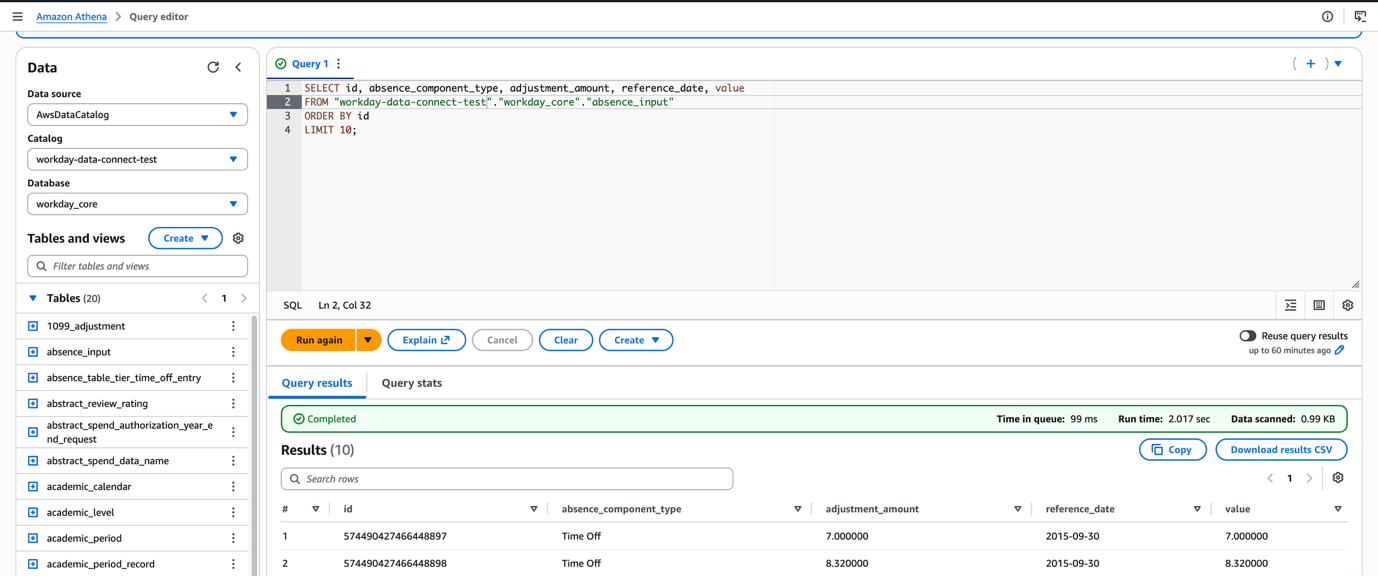
Figure 2: Querying a Workday Data Connect Iceberg table with standard SQL in the Amazon Athena query editor
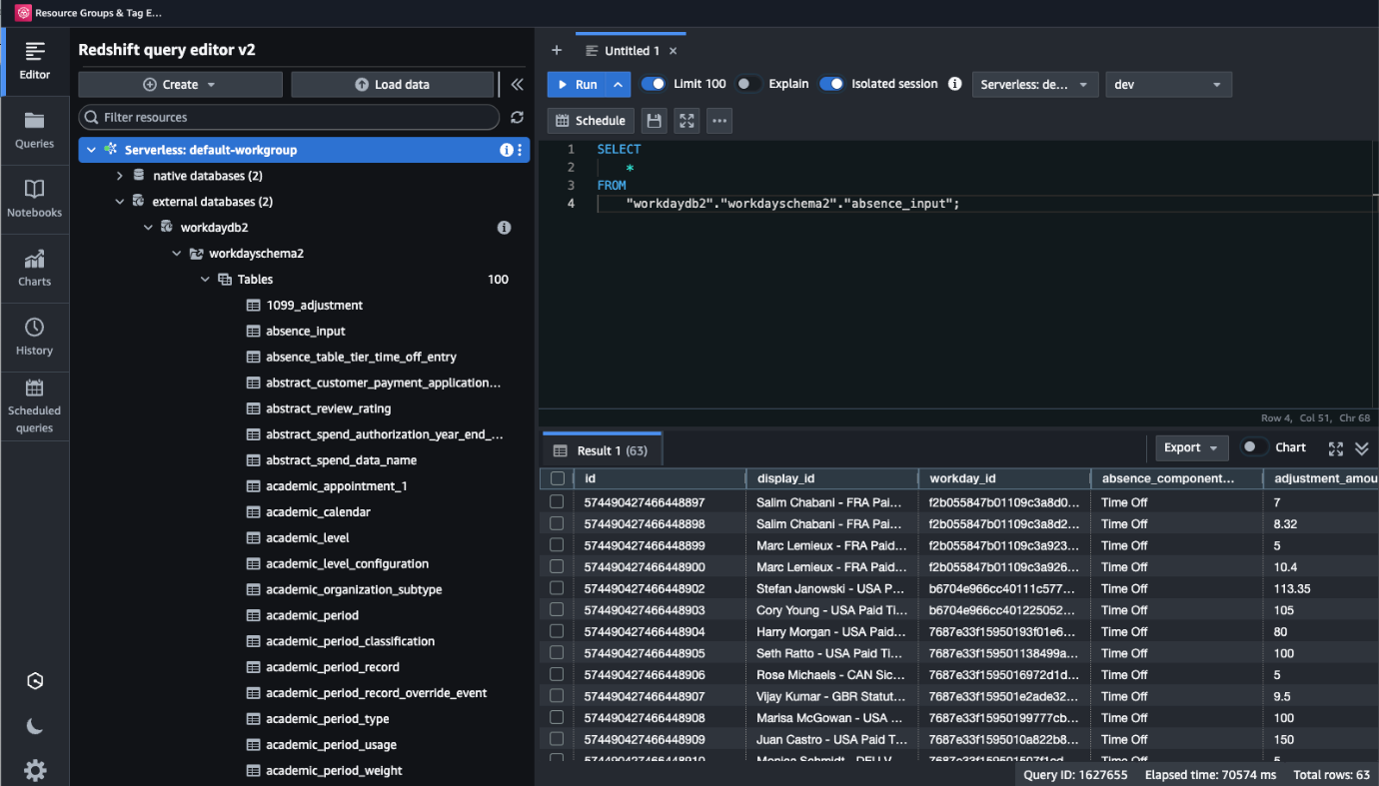
Figure 3: Querying a Workday Data Connect Iceberg table with standard SQL in Amazon Redshift Query Editor v2.
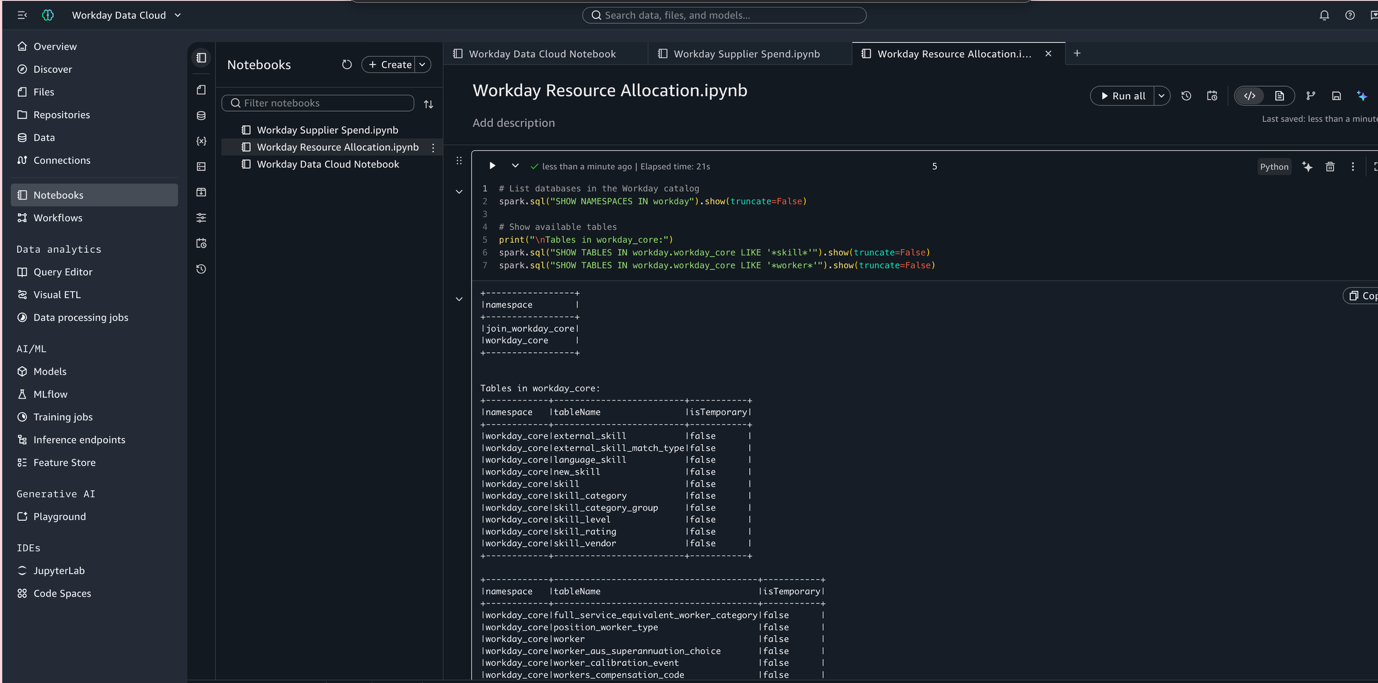
Figure 4: Browsing Workday Iceberg tables with PySpark in a SageMaker Unified Studio notebook using Workday Data Connect
What this means for customers
This integration changes how organizations work with their people and money data for analytics and AI. Here’s what it unlocks:
- Organizations no longer need to build and maintain complex extract, transform, and load (ETL) pipelines to get Workday data into their analytics environment, which removes data silos without duplicating data. The data stays where it lives, governed and accurate, while remaining fully accessible for analysis and AI.
- When AI agents and models can access Workday data with its full business context, developers spend less time reverse-engineering business logic and rebuilding permission models. That context includes who has access to what, what a metric actually means, and how calculations are defined.
- Workday’s permission model, audit controls, and business logic travel with the data, and AWS Lake Formation adds governance on the AWS side. The result is data access that is both open and controlled, which is exactly what regulated industries and enterprise security teams require.
- Instead of building pipelines, monitoring data freshness, and reconciling duplicates, data teams can focus on building analytics and machine learning applications that drive business outcomes.
Use case walkthrough: AI-powered workforce analytics
Consider a Chief People Officer who wants to understand the relationship between employee engagement scores, compensation benchmarks, and attrition patterns across the organization. Today, this requires extracting data from Workday, loading it into a separate analytics platform, joining it with market data, and building custom reports. This process takes weeks and produces stale results.
With the Workday Data Cloud and AWS integration, a data team can perform the following steps:
- Connect to Workday Data Cloud from AWS Glue using the pre-built Workday connector.
- Explore workforce datasets such as compensation, tenure, engagement, and performance directly, with full semantic context (job levels, org hierarchies, and tenure calculations) already defined.
- Join Workday people data with market compensation benchmarks and recruiting pipeline data stored as Iceberg tables on Amazon S3, all through standard SQL in Athena or SageMaker AI notebooks.
- Build a machine learning model in SageMaker AI that predicts attrition risk based on the combined dataset.
- Deploy an AI agent that flags high-risk attrition patterns for HR business partners to review and act on. The agent uses Live Data Query for near real-time signals and batch Iceberg access for historical trend analysis.
The entire workflow runs without any data leaving its governed environment, without any custom pipelines to maintain, and with full auditability at every step.
Getting started
The Workday Data Cloud integration with AWS is generally available.
- Amazon SageMaker Unified Studio users can connect to Workday Data Cloud directly through the Workday Live Data Query connector or the Workday Iceberg REST Catalog connector.
- Workday Live Data Query connections can also be created in the AWS Glue console, and users can query live Workday data from Amazon Athena, Amazon EMR, and AWS Glue ETL jobs.
- AWS Glue and AWS Lake Formation users can register the Workday Iceberg REST Catalog as a federated catalog to make Workday datasets discoverable across AWS analytics services.
- Workday users seeking to query AWS data can register their Glue Data Catalog Iceberg REST endpoint as an external catalog in Workday Data Cloud.
For deeper technical walkthroughs and step-by-step configuration guides, refer to the following resources:
This integration represents a new model for enterprise data access, where governed data flows freely between platforms without compromising security, accuracy, or business context. We are excited to see what customers build with Workday Data Cloud and AWS together.